Every year, thousands of CTET aspirants prepare rigorously for the exam. Yet a silent but costly mistake often undermines even the best preparation: incorrect or careless OMR sheet filling.
You might know the subject content perfectly, but if your OMR sheet is filled incorrectly, your answers might not get evaluated at all, or worse, they could get misread completely.
This blog gives you step-by-step OMR filling instructions, highlights common mistakes students make, and offers precise strategies to avoid them. By the end, you’ll know exactly how to handle your answer sheet with confidence and precision.
What Is the CTET OMR Sheet?
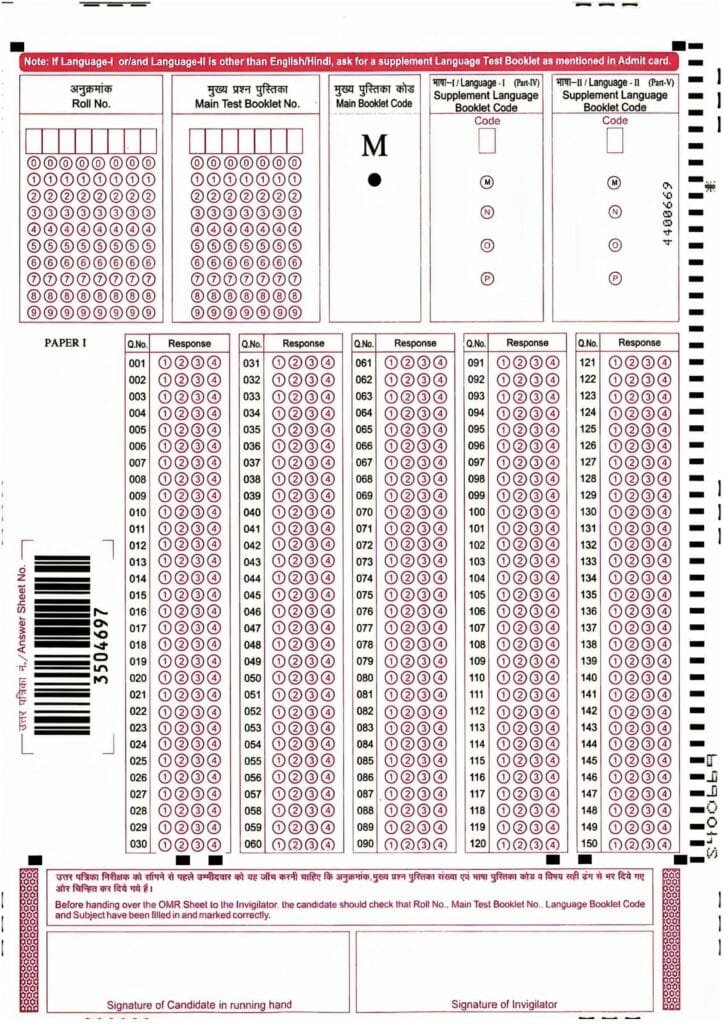
In CTET, the OMR (Optical Mark Reader) sheet is the official answer document where you mark your chosen answers. The scan machine reads only what is correctly darkened in the specified pattern. If the bubbles are filled incorrectly or outside guidelines, the machine may not read them at all.
Unlike computer-based exams, paper-based CTET requires manual filling of the OMR sheet under strict rules. Even a single spilled question or misalignment can shift your entire sheet and lead to scoring errors.
Before the Exam: OMR Sheet Structure You Must Know
The OMR sheet has three major sections:
- Candidate Details Area
- Name
- Roll number
- Date of birth
- Test booklet code
- Signature
- Answer Grid (Bubble Sheet)
- Rows and columns for 150 questions
- Options A, B, C, D for each question
- Space for Invigilator’s Seal & Test Center Use
Understanding the structure helps you avoid mistakes such as misalignment, skipping questions, or darkening the wrong bubbles.
Step-by-Step OMR Sheet Filling Instructions
1. Always Use a Black/Blue Ballpoint Pen
Unlike pencils used in other exams, CTET OMR sheets are designed to be marked with a black or blue ballpoint pen only. Mark your answers intentionally and neatly, stray marks can confuse the scanner.
Common Mistake: Using gel pens, fountain pens, pencils, or ink-based markers.
Impact: Unreadable bubbles and rejected answers.
2. Fill Personal Details Carefully
Before you start answering:
- Write your name exactly as on the admit card
- Fill your roll number and date of birth bubbles accurately and completely
- Mark the Test Booklet Code (A/B/C/D), if applicable
- Sign exactly in the signature box (don’t overshoot)
These fields are used to identify your OMR sheet. Any mismatch with the admit card can result in your sheet being rejected.
Common Mistakes:
- Mismatched name spelling, incomplete roll number, unfilled DOB bubbles
- Wrong booklet code filled
- No signature or signature outside the box
3. Match Your Question Booklet Code
CTET often uses multiple sets (A, B, C, D). After your invigilator announces the booklet code:
- Verify the code printed on your question paper
- Locate the code area on the OMR sheet
- Darken the correct circle completely
- Ensure there are no stray marks
Common Mistake: Filling the wrong booklet code or forgetting to fill it at all.
Impact: Your OMR sheet will be incorrectly evaluated because the answer key for that booklet may not match.
4. Answer Marking Rules: Do It Right!
For every question:
- Darken only one circle per question (A, B, C or D).
- Fill the bubble completely and neatly, don’t tick, cross, half-shade, or doodle.
Example:
- Correct: Fully filled circle for Option B
- Incorrect: Tick mark, half shade, line, dot, or faint shade
Why? Because the scanner detects only uniform darkened bubbles.
Any unclear or light shading might be read as a wrong answer or no answer.
5. Avoid Multiple Bubbles in One Row
There should be only one darkened bubble per question:
- Good: OMR row marked for one choice
- Bad: Multiple bubbles marked
- Bad: Bubble erased/ scratched
Since CTET does not allow negative marking, some aspirants lightly shade multiple answers, hoping to decide later. This is a recipe for disaster. The machine will consider this as 0 marks for that question, as multiple answers can’t be interpreted.
6. How to Correct If You Make a Mistake
Unlike pencil OMR sheets, CTET OMR sheets cannot be completely erased.
If you accidentally fill the wrong bubble:
- Do not try to erase with force
- Do not scribble
- Ask the invigilator for a fresh OMR sheet (if permitted)
- Make sure you transfer all answers carefully from the old one
This is perhaps the most ignored but critical instruction: Once an OMR sheet is mis-filled, even erasing partially can result in unreadable data.
7. Sequence Matters
Candidates often mark answers directly on the OMR sheet without reading the question properly or sequencing answers.
Always maintain:
- Question in exam booklet & Same question number on OMR grid
If you misalign (e.g., answer question 12 but mark in the row meant for 21), your entire answer pattern is offset.
Best practice:
- After attempting in the booklet, verify the question number and then mark in the OMR.
8. Final Review Before Submission
Before handing your sheet to the invigilator:
- Ensure all bubbles are filled fully
- Name, roll number, DOB, booklet code & signature are completed
- No stray marks outside relevant fields
- All answers are placed in the correct sequence
- No extra writing anywhere on the OMR sheet
Top 10 OMR Mistakes CTET Aspirants Make
| Common Mistake | Impact on Evaluation |
| Wrong booklet code | Entire OMR misread |
| Multiple bubbles in one row | Zero score for that question |
| Erased or scratched marks | Scanner fails to read answers |
| Pencil/Gel pen usage | Misinterpretation of answers |
| Name/roll mismatch | Sheet invalidation |
| Light shading | Scanner reads as no answer |
| Signature outside box | Sheet rejected |
| Skipped personal details | Sheet may not be evaluated |
| Misalignment of question number | All subsequent answers shift |
| Stray marks near OMR grid | False readings by scanner |
OMR Filling Checklist (Final Minute Before Submission)
Keep this quick checklist with you:
- Black/blue ballpoint pen only
- Names spelled correctly
- Correct booklet code marked
- One darkened bubble per question
- No erasures, scribbles, stray marks
- Signature within the box
- Answers filled in the correct sequence
OMR Accuracy Is as Important as Your Preparation
Success in CTET is not just about how well you prepared; it’s also about how well you execute on the exam day, especially on the OMR sheet. Many aspirants lose precious marks due to careless mistakes, not because they lack knowledge, but because they misunderstand simple instructions.
OMR sheet errors are avoidable if you follow step-by-step guidelines and stay calm under pressure. On the actual day, take a few extra minutes to review your sheet. That extra precision could be the difference between qualifying and missing the cut-off.
Remember: Your knowledge earns marks, but your accuracy ensures they are counted.
Relevant Posts:
- CTET Feb 2026 Exam Result Out Very Soon: Latest Updates
- Official CTET Answer Key 2026 & OMR Sheet: Direct Download Link & Complete Guide
- CTET Feb 2026 Final Answer Key OUT @ctet.nic.in Soon
- CTET Feb 2026 Display of Answer Key and Scanned OMR Sheet
- CTET Answer Key 8 Feb 2026: Paper 1 & Paper 2 Solutions, Question Paper PDF
- CTET Exam Analysis 7 Feb 2026
- CTET Question Paper 7 Feb 2026 – Paper 2 PDF Download
- CTET Answer Key 7 Feb 2026 – Paper 2 (Official Question Paper Based)
- CTET Feb 2026 Live Updates – Paper 1 & Paper 2 (7 & 8 Feb)
- CTET Feb 2026 City Slip Released: 3 Critical Checks & The “Home Centre” Reality
Related posts:
 CTET February 2026 Exam Announced: Official Notice, Exam Dates, Syllabus & Updates
 CTET Eligibility February 2026: Check Minimum Qualifications for Paper 1 & Paper 2
 CTET February 2026 Exam Pattern and Syllabus PDF Download (Paper 1 & Paper 2)
 CTET Previous Year Papers PDF with Solutions (2024-2018) – Free Download
 Difference Between CTET Paper 1 vs Paper 2 – Which Should You Apply For?
 CTET vs State TET – Which is Better for Teacher Jobs?
 Does CTET Guarantee a Job? Complete Discussion
 CTET Passing Marks 2026 + Category-Wise Criteria