CBSE Class 9 Science Chapter 11 Sound is an important chapter for exams, as many questions are directly asked from the NCERT textbook and NCERT Exemplar. Students often spend a lot of time searching for notes, which creates confusion and wastes valuable study time.
In this post, I have provided CBSE Class 9 Science Chapter 11 Sound Important Questions and Answers, written in easy and exam-oriented language. These questions are carefully selected from NCERT and NCERT Exemplar, making them highly useful for quick revision. By studying these questions thoroughly, students can revise the entire chapter effectively without relying on separate notes.
CBSE Class 9 Science Chapter 11 Sound Important Questions and Answers (NCERT Based)
1. What is sound and how is it produced?
Ans. Sound is a form of energy which produces a sensation of hearing in our ears.
Sound is produced by vibrating objects.
2. How does the sound produced by a vibrating object in a medium reach your ear?
Ans. Sound reaches the ear through vibrations of particles of the medium.
The vibrating object sets nearby particles vibrating, which transfer the disturbance from one particle to another until it reaches the ear.
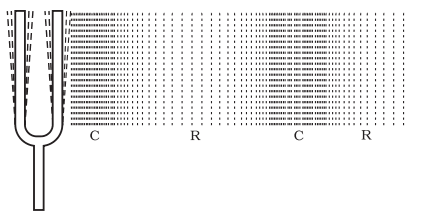
3. Describe with the help of a diagram, how compressions and rarefactions are produced in air near a source of sound.
Ans. When a sound-producing object vibrates in air, it creates compressions and rarefactions.
When the object moves forward, it pushes the air particles closer together, forming a region of high pressure and high density called compression.
When the object moves backward, air particles spread apart, forming a region of low pressure and low density called rarefaction.
The alternate formation of compressions and rarefactions travels through air as a sound wave.
4. Explain how sound is produced by your school bell.
Ans. When the school bell is struck:
- The bell starts vibrating
- These vibrations create compressions and rarefactions in the surrounding air
- The disturbance travels through air to our ears
- Hence, we hear the sound of the bell
5. Why are sound waves called mechanical waves?
Ans. Sound waves are called mechanical waves because:
- They are produced by vibrations
- They need a material medium (air, water, solids)
- Energy is transferred by the motion of particles
6. Suppose you and your friend are on the moon. Will you be able to hear any sound produced by your friend?
Ans. No, sound cannot be heard on the moon because:
- The moon has no atmosphere (no medium)
- Sound cannot travel without a medium
7. Why is sound wave called a longitudinal wave?
Ans.
- Sound travels through a medium as a series of compressions and rarefactions.
- The particles of the medium vibrate back and forth.
- Their motion is parallel to the direction of sound propagation.
- The particles do not move forward, they only oscillate about their mean (rest) position.
- This type of wave is called a longitudinal wave.
- Therefore, sound waves are longitudinal waves.
8. Differentiate between longitudinal waves and transverse waves.
Ans.
| Longitudinal Waves | Transverse Waves |
|---|---|
| Particles vibrate parallel to the direction of wave propagation. | Particles vibrate perpendicular to the direction of wave propagation. |
| Particles move back and forth, while the wave moves forward. | Particles move up and down, while the wave moves forward. |
| Example: Sound waves | Example: Water waves, Light |
9. What are wavelength, frequency, time period and amplitude of a sound wave?
Ans. Wavelength (λ): Distance between two consecutive compressions or rarefactions.
SI unit: meter (m)
Frequency (𝑣): Number of complete oscillations per second.
SI unit: hertz (Hz)
Time Period (T): Time taken for one complete oscillation.
SI unit: second (s)
Amplitude (A): Maximum displacement of particles from their mean position.
It determines the loudness of sound.
10. Which wave property determines (a) loudness, (b) pitch?
Ans. Amplitude determines the loudness of a sound.
Frequency determines the pitch of a sound.
| Characteristic | Depends On | What It Tells Us |
|---|---|---|
| Pitch | Frequency | High or low sound |
| Loudness | Amplitude | Loud or soft sound |
| Quality (Timbre) | Waveform | Difference between sounds |
| Speed | Medium | How fast sound travels |
11. Guess which sound has a higher pitch: guitar or car horn?
Ans. Car horn has a higher pitch.
Reason: A car horn produces sound of higher frequency than a guitar.
12. Which characteristic of the sound helps you to identify your friend by his voice while sitting with others in a dark room?
Ans. The quality (timbre) of sound helps us to identify our friend by his voice while sitting with others in a dark room.
13. How are wavelength and frequency related to the speed of sound?
Ans. They are related by the formula: Speed = Wavelength x Frequency [v=λv].
14. A sound wave has a frequency of 2 kHz and wave length 35 cm. How long will it take to travel 1.5 km?
Ans. Given,
Wavelength = 35 cm = 35/100 = 0.35m
Frequency = 2kHz = 2x1000 Hz = 2000 Hz
Speed = wavelength x frequency = 0.35 x 2000 = 700 m/s
Time required to travel 1.5 km = Distance/Speed = 1.5 x 1000 / 700 = 15/7 = 2.1 s.
15. A person is listening to a tone of 500 Hz sitting at a distance of 450 m from the source of the sound. What is the time interval between successive compressions from the source?
Ans. We know, v=1/T
⇒ T = 1/v = 1/500 = 0.002 s
16. Distinguish between Loudness and Intensity of Sound.
Ans.
| Loudness | Intensity |
|---|---|
| Loudness is a measure of the response of the ear to the sound. | The amount of sound energy passing each second through unit area is called the intensity of sound |
| Subjective quantity | Objective quantity |
| Depends on amplitude and ear sensitivity | Depends only on amplitude |
17. The frequency of a source of sound is 100 Hz. How many times does it vibrate in a minute?
Ans. Frequency = 100 Hz
⇒ No. of vibrations in 1 sec = 100
∴ No. of vibrations in 60 sec = 100 x 60 = 6000.
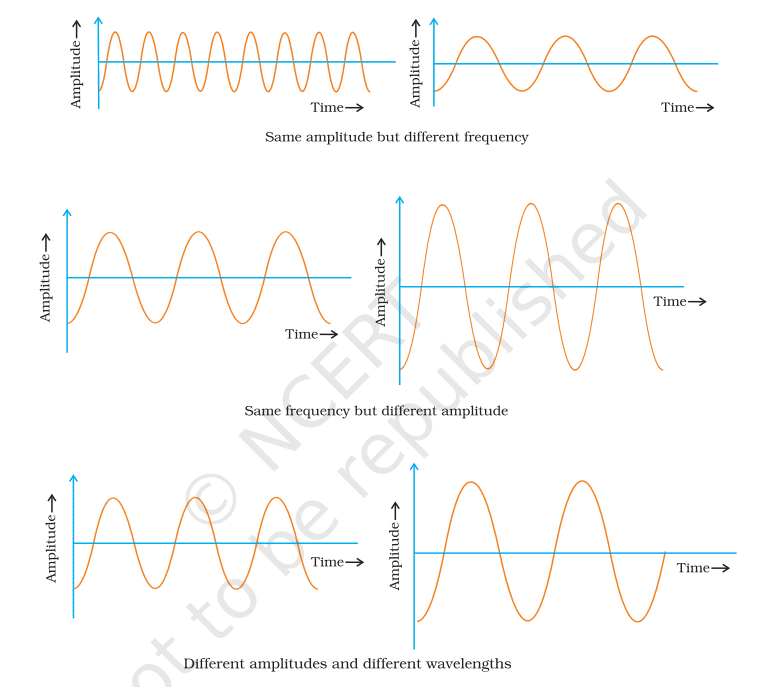
18. Represent graphically by two separate diagrams in each case
(i) Two sound waves having the same amplitude but different frequencies?
(ii) Two sound waves having the same frequency but different amplitudes.
(iii) Two sound waves having different amplitudes and also different wavelengths.
Ans.
19. Difference between music and noise.
Ans.
| Music | Noise |
| Pleasant to hear | Unpleasant to hear |
| Rich Quality | Low Quality |
20. Flash and thunder are produced simultaneously. But thunder is heard a few seconds after the flash is seen. Why?
Ans. Because:
- Light travels much faster than sound
- Light reaches our eyes almost instantly
- Sound takes more time to travel through air.
21. What are the factors affecting speed of sound?
Ans.
- Nature of the Medium: Speed in solids > speed in liquids > speed in gases
- Temperature of the Medium: As the temperature increases, the speed of sound increases.
22. Two children are at opposite ends of an aluminium rod. One strikes the rod. Find the ratio of times taken by sound in air and aluminium to reach the second child.
Ans. Speed in air = 346 m/s
Speed in aluminium = 6420 m/s
Time in Air/Time in Aluminium = Speed in Aluminium/Speed in Air = 6420/346 = 18.6
23. Does sound follow the same laws of reflection as light does? Explain.
Ans. Laws of Reflection of Sound
Just like light, sound also follows the same laws of reflection:
- The angle of incidence is equal to the angle of reflection.
- The incident sound wave, the reflected sound wave, and the normal at the point of incidence all lie in the same plane.
24. Why do we hear an echo?
Ans.
- When we clap or shout, sound travels to the reflecting surface.
- It gets reflected and comes back to our ears.
Important Points about Echo
- Minimum time gap required: 0.1 s
- Minimum distance (at 22°C): 17.2 m
- Distance changes with temperature (because speed of sound changes)
25. What is reverberation? How can it be reduced?
Ans. Reverberation is the persistence of sound in an enclosed space due to repeated reflections from walls, ceiling, and other surfaces.
Auditoriums are designed using sound-absorbing materials, such as:
- Compressed fibreboard
- Rough plaster
- Draperies (curtains)
- Cushioned seats
These materials absorb sound energy and reduce repeated reflections.
26. A person clapped his hands near a cliff and heard the echo after 2 s. What is the distance of the cliff from the person if the speed of the sound, v is taken as 346 m s–1?
Ans. A person hears an echo after 2 s near a cliff.
Speed of sound = 346 m/s
Distance travelled by sound = Speed x time = 346×2=692 m
Distance of cliff = 692/2 = 346 m.
27. When a sound is reflected from a distant object, an echo is produced. Let the distance between the reflecting surface and the source of sound production remains the same. Do you hear echo sound on a hotter day?
Ans. To hear a distinct echo, the reflected sound must return after at least 0.1 second.
- On a hotter day, because sound travels faster, the echo may return in less than 0.1 s.
- In such a case, the reflected sound mixes with the original sound, and a distinct echo may not be heard.
28. Why are the ceilings of concert halls curved?
Ans. The ceilings of concert halls are curved so that sound waves, after reflection, spread evenly throughout the hall and reach all listeners with nearly the same intensity.
29. Give two practical applications of reflection of sound waves.
Ans.
- Used in megaphones, horns, musical instruments
- Used in stethoscopes to hear faint sounds.
30. What is the audible range of the average human ear?
Ans. 20 Hz to 20,000 Hz.
31. What is the range of frequencies associated with
(a) Infrasound?
(b) Ultrasound?
Ans. Infrasound: < 20 Hz
Ultrasound: > 20 kHz
32. A sound wave travels at a speed of 339 m s–1. If its wavelength is 1.5 cm, what is the frequency of the wave? Will it be audible?
Ans. v = 339 m/s, λ = 1.5 cm = 0.015 m
v=λv
⇒ v = v/λ = 339/0.015 = 22,600Hz
Since 22,600 Hz > 20,000 Hz, the sound is not audible to humans.
33. A stone is dropped from the top of a tower 500 m high into a pond of water at the base of the tower. When is the splash heard at the top? Given, g = 10 m s–2 and speed of sound = 340 m s–1.
Ans. Given:
Speed of sound, v=340m s−1
Height of the tower, h=500m
Acceleration due to gravity, g=10m s−2
Step 1: Time taken by the stone to fall into the water
For a body dropped from rest:
h = ut + 1/2 gt2
⇒ 500 = 0 x t + 1/2 x 10 x t2
⇒ 500 = 5t2
⇒ t = 10 s
Step 2: Time taken by sound to travel back to the top
Speed = Distance / time
⇒ Time = Distance/Speed = 500/340 = 1.47 s
∴ Total Time taken = 10 + 1.47 = 11.47 s.
34. How is ultrasound used for cleaning?
Ans. Ultrasound is used to clean objects that are hard to reach or have complex shapes.
- Objects are placed in a cleaning solution.
- Ultrasonic waves are passed through the solution.
- High-frequency vibrations cause dust, grease, and dirt particles to detach from the object.
- The objects get thoroughly cleaned.
35. Explain how defects in a metal block can be detected using ultrasound.
Ans. Ultrasound is used to detect internal cracks or holes in metal blocks.
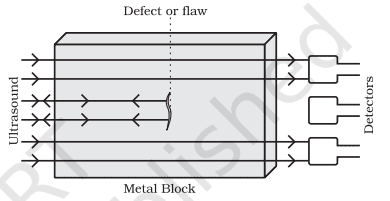
- Ultrasonic waves are sent through the metal.
- If the metal is perfect, waves pass through.
- If there is a crack or flaw, waves get reflected back.
- Reflected waves indicate the presence and location of the defect.
36. Explain Ultrasonography.
Ans. An ultrasound scanner uses ultrasonic waves to obtain images of internal organs such as:
- Liver
- Kidney
- Gall bladder
- Uterus
Working:
- Ultrasonic waves pass through body tissues.
- They get reflected at boundaries where tissue density changes.
- Reflected waves are converted into electrical signals.
- These signals form images on a monitor or film.
Uses:
- Monitoring the foetus during pregnancy to detect growth or congenital defects
- Detecting stones, tumours, and other abnormalities
Also See:
- CBSE Class 9 Sound Chapter Important Questions for Exams (NCERT Focused)
- CBSE Class 9 Science Chapter 10 Work and Energy Important Questions & Answers
- Improvement in Food Resources: CBSE Class 9 Science Important Questions and Answers
- Structure of the Atom – Important Questions and Answers for CBSE Class 9
- Atoms and Molecules Class 9 – Most Important Questions and Answers
- Gravitation Class 9 Important Questions
- Force and Laws of Motion Class 9 Important Questions
To prepare Class 9 Science Chapter 11 – Sound efficiently, focusing on important questions and answers is far more effective than reading lengthy notes. These questions cover all key concepts and numericals of the chapter in a structured manner.
As a teacher at CBSE Guidance, I strongly recommend students to revise this chapter through these questions and answers. If you prepare them well, you will not need separate notes and can feel confident in your exams.
Related posts:
 Atoms and Molecules Class 9 – Most Important Questions and Answers
 Improvement in Food Resources: CBSE Class 9 Science Important Questions and Answers
 Matter in Our Surroundings Class 9 Important Questions
Is Matter Around Us Pure? Class 9 Important Questions
The Fundamental Unit of Life (Class 9) Important Questions
Science Class 9 Important Questions
Motion Class 9 Science Important Questions
Force and Laws of Motion Class 9 Important Questions
Matter in Our Surroundings Class 9 Important Questions
Is Matter Around Us Pure? Class 9 Important Questions
The Fundamental Unit of Life (Class 9) Important Questions
Science Class 9 Important Questions
Motion Class 9 Science Important Questions
Force and Laws of Motion Class 9 Important Questions