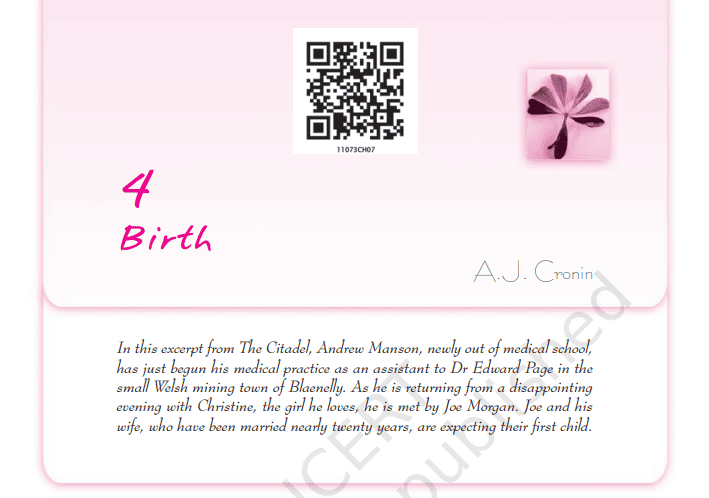
“Birth” by A.J. Cronin is one of the most important chapters in the Class 11 English Snapshots book, and students often find its emotional depth and medical drama both fascinating and challenging. To make your preparation easier, this post brings you clear, concise, and exam-friendly questions and answers covering every major theme, character, and incident from the chapter. Whether you’re revising before an exam or trying to understand the story better, these Q&As will help you score high and grasp the true essence of this powerful narrative.
REVISION SHEET – “BIRTH”
1. Author & Source
- A.J. Cronin, excerpt from the novel The Citadel
- Shows a young doctor’s emotional and professional growth.
2. Main Characters
- Dr. Andrew Manson – young, sincere, determined doctor; faces emotional conflict but performs brilliantly in crisis.
- Joe Morgan – anxious father-to-be after 20 years of marriage.
- Susan Morgan – mother; nearly dies during childbirth.
- Susan’s mother – wise, experienced, hopeful, deeply emotional.
- The Midwife – nervous, traditional, often panics.
3. Key Events (Very Short)
- Andrew returns from a troubling evening with Christine.
- Joe Morgan urgently calls him.
- Long wait at the Morgan home; Andrew reflects on unhappy marriages.
- Difficult delivery → Baby is born still (lifeless).
- Mother is almost pulseless; Andrew saves her first.
- Tries to revive baby with:
- Hot-and-cold water method
- Artificial respiration
- After half an hour → Baby begins to breathe → cries.
- Andrew feels he has done something truly meaningful.
4. Themes
- Dedication to Duty – Andrew stays all night; perseveres against hopelessness.
- Science + Instinct – Uses memory and quick judgment, not just textbooks.
- Miracle of Life – Revival symbolizes hope, renewal.
- Professional Growth – Andrew understands the real value of being a doctor.
5. Important Lines
- “Don’t fret, mother, I’ll not run away.” → Commitment
- “It’s stillborn.” → Turning point
- “I’ve done something; oh God! I’ve done something real at last.” → His transformation
6. Short Summary
“Birth” tells the story of young Dr. Andrew Manson, who is called late at night to attend the delivery of Susan Morgan, expecting her first child after twenty years of marriage. Though emotionally upset after an evening with Christine, Andrew waits patiently at the Morgan home. After a long and difficult struggle, Susan gives birth to a lifeless baby while she herself becomes dangerously weak. Andrew first saves the mother and then desperately tries to revive the newborn. Using a hot-and-cold water method and artificial respiration, he works tirelessly for over half an hour. At last, the baby begins to breathe and cry. Overwhelmed with relief and joy, Andrew feels he has done something truly meaningful, marking a turning point in his medical career.
IMPORTANT QUESTIONS & ANSWERS
SHORT ANSWER QUESTIONS (2–3 Marks)
1. Why had Joe Morgan been walking up and down outside the house?
Answer:
Joe Morgan was extremely anxious because his wife, Susan, was about to give birth to their first child after twenty years of marriage. His nervousness made him pace outside the house, waiting desperately for the doctor.
2. Why did Andrew decide to stay back instead of going home?
Answer:
Although tired and emotionally disturbed, Andrew knew the case needed constant attention. He also felt he wouldn’t be able to sleep because of his troubled state of mind. So he decided to stay until the delivery was over.
3. What were Andrew’s thoughts as he sat by the kitchen fire?
Answer:
Andrew thought about the unhappy marriages he had seen — Bramwell, Denny, and Edward Page. These made him doubt the idea of marriage, but his love for Christine conflicted with these doubts. He felt emotionally drained and confused.
4. Why was the child born lifeless?
Answer:
The child suffered from asphyxia pallida — lack of oxygen during birth, causing it to appear pale, limp, and still, almost like a stillborn baby.
5. What dilemma did Andrew face after the child was born?
Answer:
He had to decide whether to save the newborn baby, which seemed dead, or the mother, who was collapsing and almost pulseless because of the long labour and anesthesia.
6. How did Andrew manage to revive the child?
Answer:
He used the hot-and-cold water technique and artificial respiration. He repeatedly plunged the child into hot and icy water, rubbed it vigorously with a towel, and massaged its chest until it finally began to breathe and cry.
7. What was the reaction of the midwife and the grandmother when the child revived?
Answer:
The midwife burst into hysterical tears of joy, while the grandmother silently prayed, overwhelmed with gratitude and relief.
8. What does Andrew mean when he says, “I’ve done something real at last”?
Answer:
Andrew felt he had finally performed a truly meaningful act as a doctor. Saving a seemingly dead newborn after an exhausting and desperate struggle gave him deep professional satisfaction and pride.
LONG ANSWER QUESTIONS (5–6 Marks)
9. Describe Andrew’s emotional and mental state before he began the delivery. How did it influence his actions?
Answer:
Andrew was emotionally disturbed after his disappointing meeting with Christine. He felt drained, confused, and resentful as he thought of the unhappy marriages of people he knew.
However, these feelings did not weaken his professional duty. In fact, staying awake and tense helped him remain alert. His emotional unrest made him more determined to prove himself. When the crisis came, he fought desperately to save both mother and child. His inner turmoil ultimately strengthened his resolve, leading to the miraculous revival of the baby.
Thus, his personal struggle shaped his commitment and made the night eventful and transformative.
10. The story highlights the difference between textbook knowledge and real medical practice. Discuss.
Answer:
Textbooks offer neat, structured knowledge, but real medical situations are unpredictable and messy. In the story, Andrew faces a real crisis: a dying mother and a stillborn child. No textbook could tell him exactly what to do in that chaotic moment.
He relied on memory (a case from the Samaritan Hospital), instinct, and quick decision-making. The hot-and-cold water technique was not something he learned step-by-step from a book; it was practical knowledge applied in a desperate situation.
Thus, the story shows that medical practice demands presence of mind, courage, improvisation, and emotional strength, qualities beyond textbook learning.
11. How does the story “Birth” reflect Andrew’s professional growth?
Answer:
At the beginning, Andrew is inexperienced and emotionally troubled. He lacks confidence and feels burdened by personal issues. However, the childbirth case becomes a turning point.
He shows:
- Responsibility (stays all night)
- Presence of mind (saves mother first)
- Determination (works 30 minutes on the baby)
- Skill and courage (revival technique)
When the child finally breathes, Andrew experiences a deep sense of fulfilment. He realises the true meaning of being a doctor — saving lives. This marks the beginning of his professional maturity and self-belief.
12. The revival of the baby is the central miracle of the story. Describe how this moment is built up dramatically.
Answer:
The suspense builds as:
- The delivery is difficult and exhausting.
- The baby is born pale, limp, and lifeless.
- The mother also lies almost pulseless.
- The midwife believes the baby is dead.
- Andrew battles hopelessness but refuses to give up.
- After 30 minutes of relentless effort, the baby gives a faint heave, then breathes, turns pink, and finally cries.
This dramatic transformation from death to life creates a powerful emotional climax. It highlights Andrew’s perseverance and makes the moment truly miraculous.
Also See:
- The Tale of Melon City – Complete Question-Answer Guide | Class 11 English
- Birth by A.J. Cronin – Class 11 Q&A | Summary, Key Points & Solutions
- The Laburnum Top – Summary, Q&A, Literary Devices | CBSE Class 11 English
- Discovering Tut: The Saga Continues – Class 11 English | Most Important Questions & Answers
- Class 11 NEET Preparation – Biology-Focused Timetable & NCERT Strategy
Related posts:
 The Portrait of a Lady Class 11: Most Important Questions & Answers for Exams
 A Photograph: Important Questions & Answers (Class 11 English)
 The Summer of the Beautiful White Horse: Important Questions & Answers
 We’re Not Afraid to Die… if We Can All Be Together: Important Q&A
 Discovering Tut: The Saga Continues – Class 11 English | Most Important Questions & Answers
 The Laburnum Top – Summary, Q&A, Literary Devices | CBSE Class 11 English
 Class 11 JEE Preparation – How to Build a Strong Foundation in Physics, Chemistry & Maths
 Class 11 NEET Preparation – Biology-Focused Timetable & NCERT Strategy