The National Testing Agency (NTA) successfully conducted the first shift of JEE Main 2026 today, January 21st (Morning Shift: 9:00 AM to 12:00 PM). For aspirants preparing for upcoming shifts, understanding the trend of this first paper is crucial.
Based on student feedback and memory-based questions, the overall difficulty of the paper was Moderate to Tough, with Chemistry emerging as the surprise "rank decider" due to its length.
Here is a complete breakdown of the JEE Main 2026 (Jan 21 Shift 1) question paper, including topic weightage and memory-based questions.
Disclaimer: This analysis is based on memory-based feedback from students. The actual paper may vary slightly when the official question paper is released by NTA.
JEE Main 2026 Exam Overview
| Particulars | Details |
|---|---|
| Exam Name | Joint Entrance Examination (JEE) Main 2026 |
| Conducting Body | National Testing Agency (NTA) |
| Date | 21 January 2026 |
| Shift | Morning Shift |
| Time | 9:00 AM – 12:00 PM |
| Mode | Online (Computer-Based Test) |
| Duration | 3 Hours (180 minutes) |
| Official Website | jeemain.nta.nic.in |
JEE Main 2026 Marking Scheme
- Correct Answer: +4 marks
- Incorrect Answer (MCQs): −1 mark
- Numerical Value Questions: No negative marking
Subject-wise Question Distribution
| Subject | MCQs | Numerical Questions | Total Marks |
|---|---|---|---|
| Mathematics | 20 | 5 | 100 |
| Physics | 20 | 5 | 100 |
| Chemistry | 20 | 5 | 100 |
| Total | 75 | — | 300 |
Overall Difficulty Verdict
- Overall Level: Moderate to Tough
- Difficulty Order:
Chemistry > Mathematics > Physics - Physics: Easiest section
- Chemistry: Toughest and time-consuming
- Mathematics: Moderate with some lengthy questions
Compared to JEE Main 2025, the paper was slightly more difficult, mainly due to lengthy Chemistry questions.
| Section | Difficulty Level | Key Characteristic |
| Physics | Easy to Moderate | Formula-based & Scoring |
| Chemistry | Tough | Lengthy, Calculation-intensive |
| Mathematics | Moderate | Algebra-heavy, less lengthy than 2025 |
| Overall | Moderate to Tough | Time management was key in Chemistry |
Subject-Wise Paper Analysis
Physics Paper Analysis
The Physics section was easy to moderate and mostly formula-based. Students who had revised standard formulas could attempt a good number of questions.
Physics Difficulty Level
- Easy to Moderate
- Easier than Mathematics and Chemistry
- Easier compared to JEE Main 2025
Important Physics Topics Asked
- Thermal Properties of Fluids (Bernoulli’s Theorem)
- Optics (Microscope, Power of Lens)
- Semiconductor Electronics (Logic Gates)
- Units & Dimensions (Dimensions and Error)
- Current Electricity
- Calorimetry
- Rotational Motion (Moment of Inertia)
- Kinematics (NLM)
- Gravitation
- Electromagnetic Waves
- Electromagnetic Induction
- Electrostatics
Student Feedback: Physics was scoring and manageable with proper revision.
Chemistry Paper Analysis
The Chemistry section was the most difficult part of the paper. Questions were lengthy, statement-based, and required careful reading.
Chemistry Difficulty Level
- Tough
- Lengthy questions
- Required more time (60–70 minutes on average)
Important Chemistry Topics Asked
- Coordination Chemistry (3 questions)
- Chemical Bonding and Molecular Structure
- p-Block Elements
- Mole Concept (3–4 questions)
- General Organic Chemistry (GOC)
- Biomolecules
- Chemical Thermodynamics
- Electrochemistry & Redox Reactions
- Chemical & Ionic Equilibrium (mixed question)
Student Feedback: Chemistry was time-consuming and tricky, especially Inorganic and Physical Chemistry.
Mathematics Paper Analysis
The Mathematics section was moderate. Some questions were lengthy but conceptually straightforward.
Mathematics Difficulty Level
- Moderate
- Easier than Chemistry
- Required speed and accuracy
Important Mathematics Topics Asked
- Calculus (few questions)
- Vector Algebra & 3D Geometry (2–3 questions)
- Quadratic Equations
- Matrices (lengthy)
- Sets and Relations (2 questions)
- Sequence and Series
- Permutation & Combination with Probability
- Straight Lines and Circles
- Conic Sections (Parabola, Ellipse, Hyperbola)
- Application of Derivatives
- Binomial Theorem
- Trigonometry
Student Feedback: Mathematics required good time management but was not overly difficult.
Expected Qualifying Cutoff (Percentile)
This is the minimum percentile required to qualify for JEE Advanced 2026.
| Category | Expected Cutoff (Percentile) |
| Common Rank List (CRL) | 91.5 – 93.5 |
| EWS | 78 – 81 |
| OBC-NCL | 76 – 79 |
| SC | 52 – 55 |
| ST | 39 – 43 |
Marks vs. Percentile Prediction (Jan 21, Shift 1)
This helps students estimate their rank based on their raw score.
| Target Percentile | Approx. Score Required (Out of 300) | College Possibility |
| 99.5+ %ile | 205 - 215+ | Top NITs (CS/EC) |
| 99 %ile | 180 - 190 | Top NITs (Core Branches) |
| 98 %ile | 160 - 170 | Good NITs/IIITs |
| 95 %ile | 130 - 140 | Lower NITs / Top Pvt Colleges |
| 90 %ile | 88 - 95 | Qualifying for JEE Advanced |
Factors Influencing the Cut-off
The "Easy Physics" Factor: Since Physics was formula-based and easy, the average score will go up. Most serious aspirants will score 60+ in Physics alone.
The "Moderate Maths" Factor: Maths was not as brutally lengthy as in 2025. This means students likely solved 2-3 more questions in Maths than last year, pushing the cutoff slightly higher.
The "Tough Chemistry" Balancer: Chemistry is usually a high-scoring section. Since it was tough and lengthy this time, it will prevent the cutoff from going too high (like 200+ for 99%ile).
Top Memory-Based Questions (Jan 21 Shift 1)
Here are a few questions recreated from student memory to help you practice:
CHEMISTRY – MEMORY BASED QUESTIONS
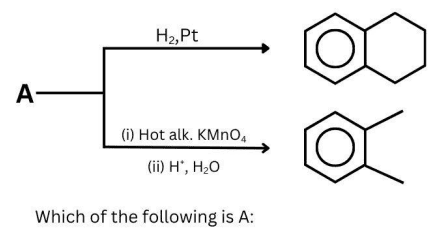
Question 1
A reaction sequence is given:
Question 2
For two chemical reactions A and B, if the difference between their activation energy is 20 kJ at 300 K (R = 8.3 J K⁻¹ mol⁻¹).
Determine ln (k2 / k1).
Question 3
In Carius method, 0.75 g of an organic compound gave 1.2 g of barium sulphate.
Find % of sulphur (molar mass of S = 32 g mol⁻¹, molar mass of BaSO₄ = 233 g mol⁻¹).
Options:
A) 16.48%
B) 4.55%
C) 21.97%
D) 10.30%
Question 4
In S estimation, 0.7 g of an organic compound gives 1 g BaSO₄ in Carius method.
What is the % of S in compound?
Options:
- 19.61
- 23.85
- 27.93
- 14.57
Question 5
14.0 g of calcium metal is allowed to react with excess HCl at 1 atm pressure and 273 K.
Which of the following statement is incorrect?
(Molar Mass of Ca = 40, Cl = 35.5)
a) 0.35 mol of H₂ gas is evolved
b) The limiting reagent is calcium metal
c) 33.3 g of CaCl₂ is produced
d) 7.84 L of H₂ gas is evolved
Question 6
Which of the following is correct order with respect to the property indicated?
- Cl⁻ > O⁻ (Ionisation energy)
- K₂O > Na₂O > Al₂O₃ (Basic nature)
- K > Na > Al > Mg (Metallic character)
- None of these
Question 7
Given below are two statements:
Statement I: Arginine and Tryptophan are essential amino acids.
Statement II: Glycine does not have any chiral carbon.
In the light of above statements, which is correct?
- Both statement I and II are correct
- Both statement I and II are incorrect
- Statement I is correct and statement II is incorrect
- Statement I is incorrect and statement II is correct
Question 8
Reaction sequence involving benzene:
Benzene
→ (conc. HNO₃ / conc. H₂SO₄) → (A)
→ (Sn / HCl) → (B)
→ (CH₃COCl / AlCl₃) → (C)
→ (conc. HNO₃ / conc. H₂SO₄) → (D)
→ (H₂O) → (E)
Find % of N in compound E.
Question 9
In the following reaction:
MnO₄²⁻ → (H⁺)
Manganate ion undergoes disproportionation to form:
- MnO₂ and MnO₄⁻
- MnO₂ and MnO₄²⁻
- MnO₂ and MnO
- MnO₄⁻ and MnO
Question 10
Observe the following reaction sequence:
(P) ──NH₃ / Δ──> (Q) ──Br₂ / KOH──> (R)
Which of the following is the correct structure for P, Q and R?
Question 11
8.0 mL of organic compound is mixed with 264 mL O₂ and ignited.
It gives 224 mL of gaseous mixture at NTP.
After passing KOH, 64 mL of gas remains.
The organic compound is:
- C₂H₄
- C₂H₂
- C₃H₁₀
- C₃H₆
Question 12
Statement A: But-8-ene shows optical isomer
Statement B: Propanal & Propanone are functional group isomers
Statement C: Pentane & 2,2-Dimethyl propane are chain isomers
Identify the correct statement:
A) Only A & B
B) Only A & C
C) Only B & C
D) All
PHYSICS – MEMORY BASED QUESTIONS
Question 1
Which logic gate is given in the figure?
Options:
- XOR
- NOR
- NAND
- OR
Answer: Option 3 – NAND
Question 2
A rod of mass m and length l is attached to two ideal strings.
Find tension in left string just after right string is cut.
Options:
- mg/2
- mg/3
- 2mg/3
- mg
Answer: Option 2
Question 3
Find the heat produced in external circuit (AB) in one second.
(Circuit with 1Ω, 2Ω resistances and 8V battery)
Options:
- 1181.25 J
- 1311.25 J
- 1207.50 J
- 1410.50 J
Question 4
A conducting circular loop of 100 turns, area 1.0 m² is placed perpendicular to a magnetic field which varies as
B = sin(100t) tesla.
If resistance of loop is 100 Ω, find average thermal energy dissipated in one period.
Options:
A) 2π
B) π²
C) π/2
D) π/4
Question 5
An α-particle having kinetic energy 7.7 MeV is approaching a fixed gold nucleus (atomic number 79).
Find distance of closest approach.
Options:
- 1.72 nm
- 6.2 nm
- 16.8 nm
- 0.2 nm
Answer: Option 1
Question 6
A current carrying solenoid is placed vertically. A particle of mass m and charge q is released from rest along the axis.
If g is acceleration due to gravity, acceleration of charged particle will satisfy:
a) a = g
b) a = 0
c) 0 < a < g
d) a > g
Question 7
An air filled capacitor of capacitance C is filled with dielectric (k = 3) of width d/3.
If d is separation between plates, the new capacitance is:
Options:
- 5C/2
- 4C/3
- 3C/2
- 4C/5
Answer: Option 4
Question 8
A light wave described by
E = 60 (sin (3 × 10¹⁵ t) + sin (12 × 10¹⁵ t)) (SI unit)
falls on metal surface of work function 2.8 eV.
Find maximum KE of photoelectron (in eV). (h = 6.6 × 10⁻³⁴ Js)
Options:
a) 7.8
b) 6.8
c) 3.8
d) 5.6
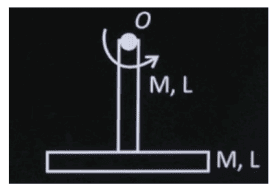
Question 9
Find moment of inertia of system formed using two identical rods about the given axis of rotation.
Options:
- 17/12 ML²
- 11/12 ML²
- 3/4 ML²
- 4/3 ML²
Question 10
Spring constant k₁ = 2 ± 0.1 N/m, k₂ = 4 ± 0.1 N/m are in parallel.
Find % error.
Question 11
In a double slit experiment, distance between slits is 0.1 cm and screen is placed at 50 cm.
When slit is covered with transparent sheet of thickness t and refractive index 1.5, central fringe shifts by 0.2 cm.
Find value of t.
MATHEMATICS – MEMORY BASED QUESTIONS
Question 1
The value of cosec 10° − √3 sec 10° is:
- 1
- 2
- 4
- None of these
Question 2
If the roots of a² − x + 1 = 0 are α and β, find
(α + β)⁴ + (α² + β²)⁴ + … + (α²⁵ + β²⁵)⁴
Question 3
If A = \[2,2, [1, 4]], B = \[1,1, [1, 1]]
and A² − 4A + 2I = 0; B² − 2B + I = 0
Find |adj (A³ − B³)|.
Question 4
∫₀^π [Sin x + Sin 3x + Sin 4x] dx
Question 5
The value of ∫₀^(π/2) |sin x + sin 2x + sin 3x| dx is:
- π/3
- π/2
- π
- 3
Question 6
If y dy/dx + (1 + x²) dy + (1 − tan⁻¹x) dx = 0 and y(0) = 1, find y(1).
Question 7
The sum of roots of equation |x − 1|² − 5|x − 1| + 6 = 0 is:
Question 8
Find all points on curve y = x³ − 3x + 1 where tangent passes through (1, 2).
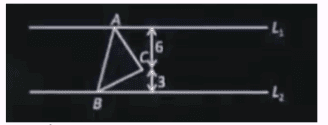
Question 9
If L₁ and L₂ are two parallel lines and ΔABC is equilateral triangle, then area of triangle ABC is:
Options:
- 7√3
- 4√3
- 21√3
- 84
Question 10
If α & β are roots of x² + x + 1 = 0, then value of
(α + β)⁴ + (α² + β²)⁴ + … + (α²⁵ + β²⁵)⁴ is:
Options:
- 145
- 140
- 415
- 541
Question 11
Ellipse: x²/16 + y²/9 = 1
A hyperbola confocal with ellipse and eccentricity = 5/3.
Find length of latus rectum of hyperbola if its principal axis is x-axis.
Question 12
Consider set S = {a, b, c, d}.
Number of reflexive as well as symmetric relations from S → S are:
- 1024
- 256
- 16
- 64
Question 13
If x² + x + 1 = 0, then
(x + 1/x)⁴ + (x² + 1/x²)⁴ + … + (x²⁵ + 1/x²⁵)⁴ is:
Question 14
The locus of point of intersection of tangent drawn to circle
(x − 2)² + y² = 16
which subtends an angle of 120° is:
- 3x² + 3y² − 12x − 18y − 25 = 0
- x² + y² − 12x − 18y − 25 = 0
- 3x² + 3y² + 12x + 18y − 25 = 0
- x² + y² + 12x + 18y − 25 = 0
Question 15
If a₁, a₂, a₃, … are in increasing GP such that
a₁ + a₃ + a₅ = 21
a₁a₃a₅ = 64
Then a₁ + a₂ + a₃ is:
- 5
- 7
- 10
- 15
Question 16
Find sum of rational terms in (2 + √3)⁸.
Question 17
Let center of circle C is (0, 2), radius = 4.
Let A & B be point of contact of tangents.
Find locus of point of intersection of tangents if ∠AOB = 90°.
Question 18
In expansion of (ax² + bx + c)(1 − 2x)²⁶,
if coefficient of x, x² and x³ are −56, 0, 0 respectively,
find value of a + b + c.
Question 19
Find value of integral:
∫₀^(π/4) (2x+4sinx)/(1−sinx)(1+sinx) dx
Question 20
If mean and variance of observations x₁, x₂, 12, 14, 4, 10, 2 is 8 and 6 respectively where x₁ ≥ x₂,
find value of 3x₁ − x₂.
Question 21
If A = {1, 2, 3, 4, 5, 6} and B = {1, 2, 3, …, 8, 9}.
Then number of strictly increasing functions from A → B such that f(0) ≠ i ∀ i = 1, 2, 3, 4, 5, 6 are:
Strategy for Upcoming Shifts
- Don't Ignore POC: Practical Organic Chemistry (Carius/Kjeldahl methods) is being asked. Memorize the formulas.
- Speed in Chemistry: Be prepared for lengthy statements in Inorganic and Organic chemistry.
- Physics is Your Safety Net: Ensure you don't make silly mistakes in Physics; it is the high-scoring section this year.
Related posts:
 JEE Main 2026: Why It’s Conducted Twice & Which Session You Should Choose
 Is It Possible to Crack JEE Main Without Coaching in 2026?
 JEE Main 2026 Notification Out – Download PDF, Registration Dates, Eligibility & Exam Schedule
 The JEE Main 2026 Exam Pattern Might Surprise You — Here’s Why
 JEE Main 2026 Countdown: What You Should Do 100 Days Before the Exam
 JEE Main 2026 Chapterwise Weightage: High-Scoring Topics You Can’t Miss!
 JEE Main PYQs (2020–2025): Download Chapter-wise & Year-wise PDF
 JEE Main 2026 Application Form Rejected? Here’s What NTA’s Bulletin Really Says About Corrections