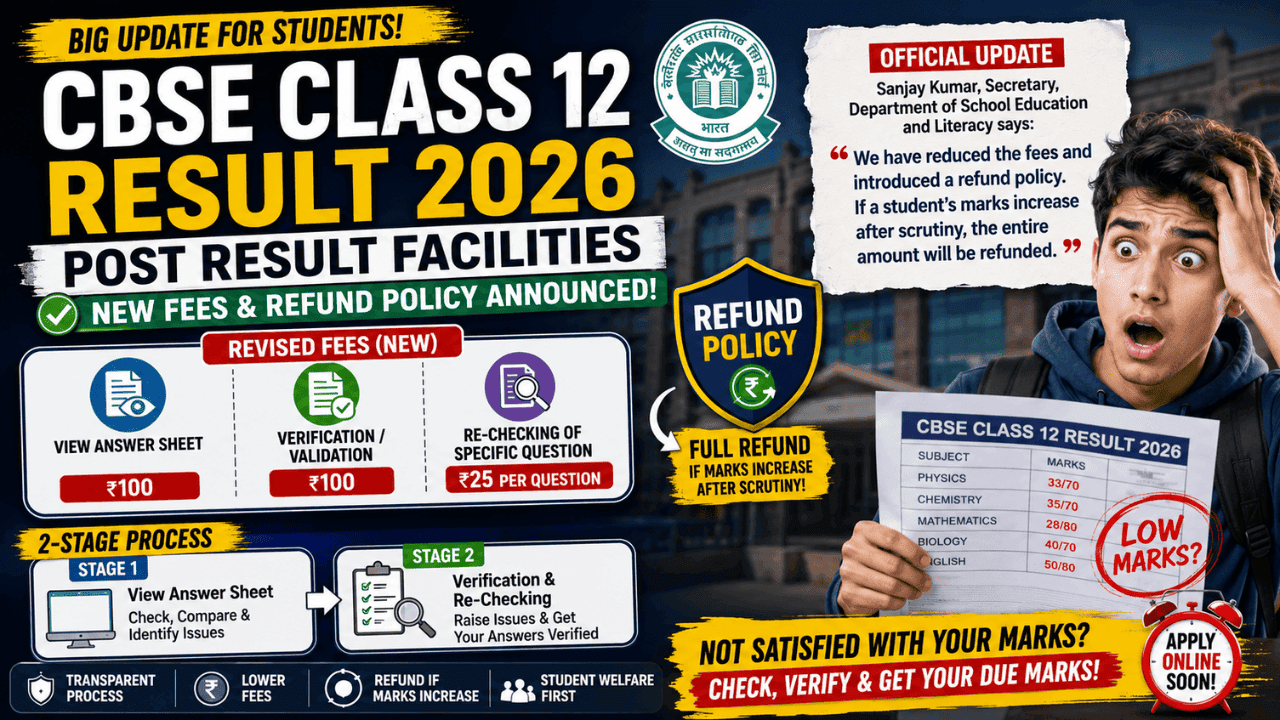
After the declaration of the CBSE Class 12 Result 2026, thousands of students across the country expressed concerns regarding unexpectedly low marks, especially in subjects like Physics, Mathematics, Chemistry, and Biology. Social media platforms were flooded with reactions from students, parents, and teachers questioning the new On-Screen Marking (OSM) system introduced by CBSE this year.
Many students demanded:
- greater transparency,
- cheaper re-evaluation,
- free access to scanned answer sheets,
- and fair verification of marks.
Now, in a major relief for students, the Ministry of Education and CBSE have announced important changes in the post-result process and fees.
Delhi: Sanjay Kumar, Secretary, Department of School Education and Literacy, recently stated that student welfare remains the top priority and no student should feel that they received lower marks than they deserved.
He also announced a significant reduction in fees for viewing answer sheets, verification, and re-checking.
In this article, we will explain:
- the complete revised CBSE post-result process,
- new reduced fees,
- refund policy,
- how to apply,
- Stage 1 and Stage 2 process,
- important guidelines,
- and what students should do if they are not satisfied with their marks.
Why Is There So Much Discussion Around CBSE Results This Year?
This year, CBSE introduced On-Screen Marking (OSM) for Class 12 answer book evaluation.
Under OSM:
- answer sheets were scanned digitally,
- teachers checked copies on computers,
- and evaluation became fully digital.
According to CBSE, the benefits of OSM include:
- better transparency,
- error-free evaluation,
- reduced manual handling,
- faster processing,
- and strict implementation of the marking scheme.
However, after results were declared, many students felt their marks were lower than expected.
Several students and teachers argued that:
- evaluation appeared stricter this year,
- step marking may have been more rigid,
- and teachers possibly had less flexibility compared to physical checking done earlier.
Earlier, during offline evaluation, sometimes examiners informally:
- gave grace marks,
- became lenient in borderline cases,
- or awarded extra marks based on overall presentation.
But in digital checking:
- every mark is expected to follow the marking scheme strictly,
- and no physical modification in answer sheets is possible.
This is believed to be one major reason why many students are discussing the results so intensely this year.
CBSE Responds to Student Concerns
After massive discussions online, CBSE and the Ministry of Education clarified that:
- student welfare is the highest priority,
- students must get full transparency,
- and anyone having doubts regarding marks should use the official re-evaluation process.
Sanjay Kumar, Secretary, Department of School Education and Literacy, said:
“We want to ensure that no child feels that they have received lower marks than they deserve.”
He also confirmed that:
- re-evaluation provisions already existed,
- but CBSE has now reduced the fees significantly,
- and students whose marks increase after scrutiny will get their fees refunded.
This is a major update because earlier students were heavily criticizing the high re-evaluation fees on social media.
CBSE Class 12 Post Result Facilities 2026
CBSE follows a Two-Stage Post Result Process.
| Stage | Facility |
|---|---|
| Stage 1 | Viewing / Obtaining Answer Sheet |
| Stage 2 | Verification & Re-Checking / Re-Evaluation |
Revised CBSE Fees Announced
The biggest change is the reduction in fees.
Earlier, the fees mentioned in the official notice were:
- Rs. 700 for scanned copies,
- Rs. 500 for verification,
- Rs. 100 per question for re-evaluation.
After student concerns, the Ministry has now announced revised charges.
New Revised Fees
| Facility | Revised Fee |
|---|---|
| Viewing Answer Sheet | Rs. 100 |
| Verification / Validation of Paper | Rs. 100 |
| Re-checking of Specific Question | Rs. 25 per question |
Refund Policy Introduced
Another major relief for students is the new refund policy.
CBSE has announced that:
If a student’s marks increase after scrutiny or re-evaluation, the entire amount paid for the process will be refunded.
This step has been welcomed by many students because earlier one of the biggest criticisms was:
“Why should students pay for mistakes in evaluation?”
Now CBSE is trying to make the process more student-friendly and transparent.
Stage 1: Viewing the Answer Sheet
The first step is to apply for access to the answer sheet.
Students who are not satisfied with their marks should:
- Apply online,
- View the scanned answer sheet,
- Download the official question paper and marking scheme,
- Compare answers carefully.
What Should Students Check in Their Answer Sheet?
Students should carefully verify:
- whether all pages are present,
- whether supplementary sheets are attached,
- whether any answer is unchecked,
- whether totaling is correct,
- whether step marking has been awarded properly,
- and whether scanning is clear and complete.
CBSE itself advises students to compare answers with the official marking scheme before applying for re-checking.
Stage 2: Verification & Re-Checking
If students still find issues after checking their answer sheets, they can move to Stage 2.
This includes:
- verification of marks,
- checking totaling errors,
- and re-checking specific questions.
Students must clearly mention:
- the question number,
- the issue identified,
- and proper reasoning.
Important Guidelines Released by CBSE
1. Entire Process is Online
All applications must be submitted online only.
No offline application will be accepted.
2. Apply Within Deadline
Students must apply within the official schedule announced by CBSE.
Late applications will not be accepted.
3. Marks Can Increase or Decrease
CBSE has clearly stated that:
- marks may increase,
- remain unchanged,
- or even decrease after verification/re-checking.
Even a decrease of one mark will be implemented.
4. Revised Marksheet Will Be Issued
If marks change:
- students will have to surrender the old marksheet,
- and CBSE will issue a revised marksheet/certificate.
5. CBSE’s Final Decision Will Be Binding
The board has stated that:
- the final result after re-checking/re-evaluation will be binding,
- and no further appeal will be entertained.
Read the official notification here.
Why Were Students Angry Earlier?
Before the revised fee announcement, many students strongly criticized CBSE online.
Students argued:
- Rs. 700 for scanned copies was too expensive,
- digital answer sheets should be available freely under OSM,
- and students should not pay heavily for verification.
Several students also questioned:
- whether OSM evaluation was too strict,
- whether moderation was properly applied,
- and whether difficult papers in Physics and Mathematics affected scores.
The new reduced-fee structure appears to be CBSE’s response to these concerns.
Important Advice for Students
If your marks are lower than expected, do not panic immediately.
Follow this process calmly:
| Step | What You Should Do |
|---|---|
| Step 1 | View your answer sheet |
| Step 2 | Download official marking scheme |
| Step 3 | Compare answers carefully |
| Step 4 | Identify genuine issues logically |
| Step 5 | Apply for verification/re-checking if necessary |
Remember:
- social media reactions can create panic,
- but every student’s case is different,
- and proper analysis of the answer sheet is important before applying.
Direct Link to Apply for Scanned Copy of Answer Sheet 2026
FAQs on CBSE Class 12 Post Result Process 2026
What is OSM in CBSE?
OSM (On-Screen Marking) is a digital evaluation system where teachers check scanned answer sheets on computers instead of physical copies.
What is the new fee for viewing answer sheets?
Students now need to pay Rs. 100.
What is the fee for verification of marks?
The revised fee is Rs. 100.
What is the fee for re-checking a question?
Students need to pay Rs. 25 per question.
Will CBSE refund the fees?
Yes. If marks increase after scrutiny/re-evaluation, the paid amount will be refunded.
Can marks decrease after re-checking?
Yes. Marks can increase or decrease.
Should students compare answers with the marking scheme?
Yes. CBSE itself advises students to compare answers with the official marking scheme before applying.
Final Words
This year’s CBSE Class 12 result discussion became much larger because of the introduction of the new OSM evaluation system and unexpectedly low marks reported by many students.
However, after listening to student concerns, CBSE and the Ministry of Education have now:
- reduced the fees significantly,
- introduced a refund policy,
- and assured students of full transparency.
Students should now use the process wisely:
- first check the answer sheet carefully,
- compare it with the marking scheme,
- and then take an informed decision regarding verification or re-checking.
The most important thing is not to panic but to approach the process logically and carefully.
Related posts:
 CBSE Academic Calendar 2025–26: Exam Dates, Holidays & Key Updates
 CBSE Holiday List 2026: January School Holidays, Republic Day & Winter Break Update
 CBSE Class 12 Date Sheet 2026 Released: Revised Exam Schedule
 CBSE Introduces On-Screen Marking (OSM) for Class 12 Board Exams 2026: Complete Details
 Items Allowed & Banned in CBSE Board Exam Hall 2026
 CBSE Class 12th Result 2026 Expected Date Updates: Check Here
 CBSE Class 12 Result 2026: Latest Updates
 The Last Lesson Class 12: Top Questions and Answers for Exam Preparation
Revarification of marks