With the CBSE Class 10 Science Board Exam just around the corner on February 25, 2026, it is time to shift your strategy from reading textbooks to smart, targeted revision. Have you ever wondered what exactly the examiners look for when awarding a perfect 80/80?
Scoring full marks in Science isn't just about knowing the concepts; it is about how clearly you present your diagrams, how accurately you balance your chemical equations, and how well you structure your long answers.
To give you the ultimate last-minute preparation toolkit, I have compiled everything you need right here. In this post, you can download the Official CBSE Class 10 Science 2025 Question Paper, the highly guarded CBSE Official Marking Scheme, and the actual Topper’s Handwritten Answer Sheet in PDF format. By analyzing how the topper framed their answers against the official step-marking scheme, you will discover the exact blueprint to maximize your score and avoid silly deductions. Let’s decode the secret to full marks!
SCIENCE
Time allowed: 3 hours | Maximum Marks: 80
General Instructions:
Read the following instructions very carefully and strictly follow them:
(i) This question paper comprises 39 questions. All questions are compulsory.
(ii) This question paper is divided into five sections - A, B, C, D and E.
(iii) Section A - Questions No. 1 to 20 are Multiple Choice Questions. Each question carries 1 mark.
(iv) Section B - Questions No. 21 to 26 are Very Short Answer type questions. Each question carries 2 marks. Answer to these questions should be in the range of 30 to 50 words.
(v) Section C - Questions No. 27 to 33 are Short Answer type questions. Each question carries 3 marks. Answer to these questions should in the range of 50 to 80 words.
(vi) Section D - Questions No. 34 to 36 are Long Answer type questions. Each question carries 5 marks. Answer to these questions should be in the range of 80 to 120 words.
(vii) Section E - Questions No. 37 to 39 are of 3 source-based/case-based units of assessment carrying 4 marks each with sub-parts.
(viii) There is no overall choice. However, an internal choice has been provided in some sections. Only one of the alternatives has to be attempted in such questions.
SECTION A
Select and write the most appropriate option out of the four options given for each of the questions no. 1 to 20. There is no negative marking for incorrect response. (20 x 1 = 20)
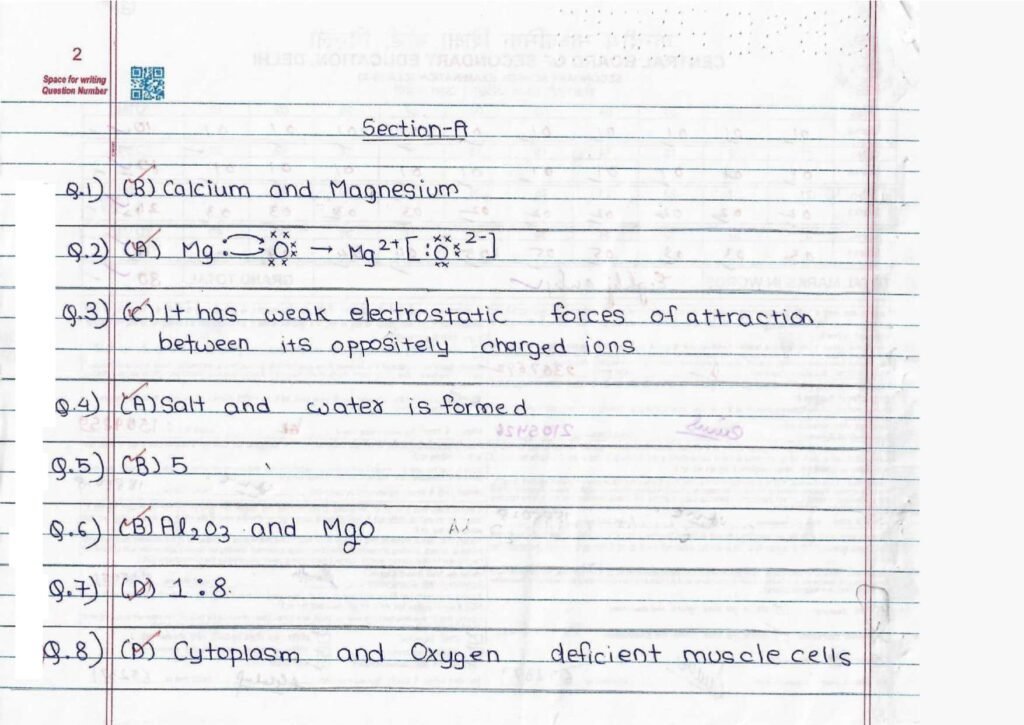
1. The metals obtained from their molten chlorides by the process of electrolytic reduction are:
(A) Gold and silver
(B) Calcium and magnesium
(C) Aluminium and silver
(D) Sodium and iron
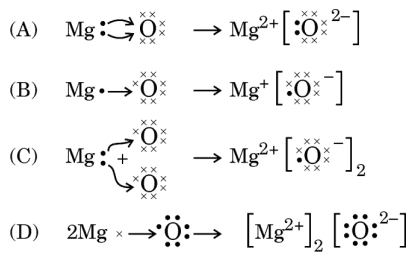
2. The formation of magnesium oxide is correctly shown in option:
3. Reaction between two elements A and B, forms a compound C. A loses electrons and B gains electrons. Which one of the following properties will not be shown by compound C?
(A) It has high melting point.
(B) It is highly soluble in water.
(C) It has weak electrostatic forces of attraction between its oppositely charged ions.
(D) It conducts electricity in its molten state or aqueous solution.
4. Consider the following reactions:
(i) Dilute hydrochloric acid reacts with sodium hydroxide.
(ii) Magnesium oxide reacts with dilute hydrochloric acid.
(iii) Carbon dioxide reacts with sodium hydroxide.
It is found that in each case:
(A) Salt and water is formed.
(B) Neutral salts are formed.
(C) Hydrogen gas is formed.
(D) Acidic salts are formed.
5. Tooth enamel is made up of calcium hydroxyapatite (a crystalline form of calcium phosphate). This chemical starts corroding in the mouth when the pH is:
(A) 7
(B) 5
(C) 10
(D) 14
6. The products formed when Aluminium and Magnesium are burnt in the presence of air respectively are:
(A) Al3O4 and MgO2
(B) Al2O3 and MgO
(C) Al3O4 and MgO
(D) Al2O3 and MgO2
7. Electrolysis of water is a decomposition reaction. The mass ratio (MH: MO) of hydrogen and oxygen gases liberated at the electrodes during electrolysis of water is :
(A) 8:1
(B) 2:1
(C) 1:2
(D) 1:8
8. The breakdown of glucose has taken the following pathway:
(a) Glucose (a) → Pyruvate + Energy (b) → Lactic acid + Energy
The sites 'a' and 'b' respectively are :
(A) Mitochondria and Oxygen deficient muscle cells
(B) Cytoplasm and Oxygen rich muscle cells
(C) Cytoplasm and Yeast cells
(D) Cytoplasm and Oxygen deficient muscle cells
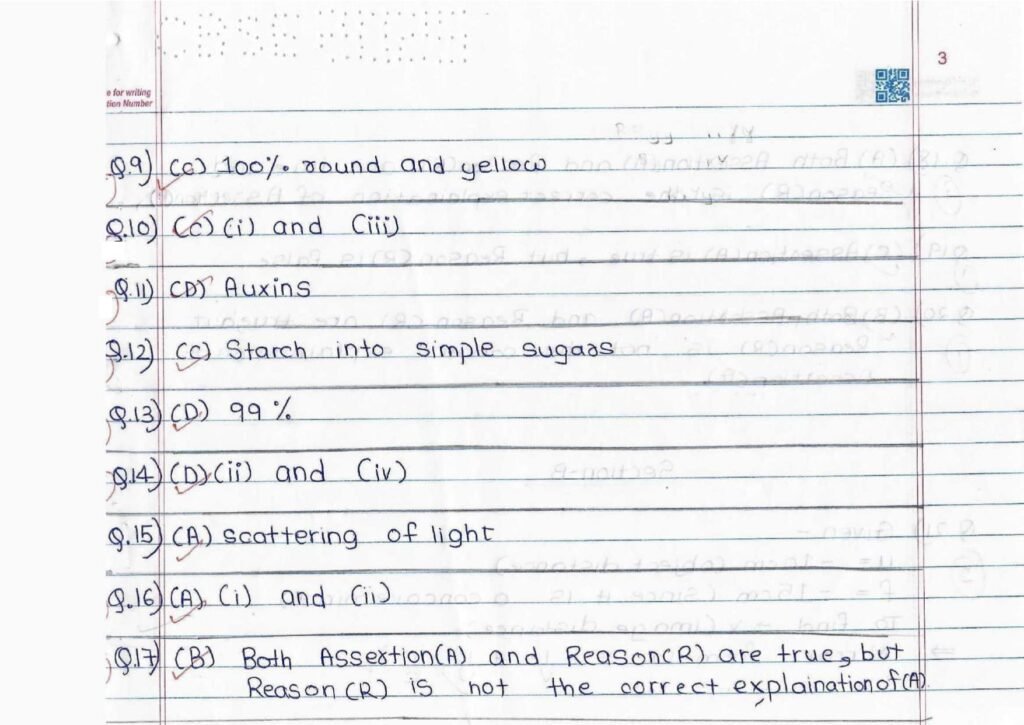
9. If pea plants with round and green seeds (RRyy) are crossed with pea plants having wrinkled and yellow seeds (rrYY), the seeds developed by the plants of F1 generation will be :
(A) 50% round and green
(B) 75% wrinkled and green
(C) 100% round and yellow
(D) 75% wrinkled and yellow
10. The correct/true statement(s) for a bisexual flower is/are:
(i) They possess both stamen and pistil.
(ii) They possess either stamen or pistil.
(iii) They exhibit either self-pollination or cross-pollination.
(iv) They cannot produce fruits on their own.
(A) (i) only
(B) (iv) only
(C) (i) and (iii)
(D) (i) and (iv)
11. The plant hormone whose concentration stimulates the cells to grow longer on the side of the shoot which is away from light is:
(A) Cytokinins
(B) Gibberellins
(C) Adrenaline
(D) Auxins
12. Secretion of less saliva in mouth will effect the conversion of:
(A) proteins into amino acids
(B) fats into fatty acids and glycerol
(C) starch into simple sugars
(D) sugars into alcohol
13. The percentage of solar energy which is not converted into food energy by the leaves of green plants in a terrestrial ecosystem is about:
(A) 1%
(B) 10%
(C) 90%
(D) 99%
14. Which of the following groups do not constitute a food chain?
(i) Wolf, rabbit, grass, lion
(ii) Plankton, man, grasshopper, fish
(iii) Hawk, grass, snake, grasshopper, frog
(iv) Grass, snake, wolf, tiger
(A) (i) and (iv)
(B) (i) and (iii)
(C) (ii) and (iii)
(D) (ii) and (iv)
15. The phenomenon responsible for making the smoke particles visible when a beam of sunlight enters a smoke filled room through a narrow hole is:
(A) scattering of light
(B) dispersion of light
(C) reflection of light
(D) internal reflection of light
16. Mirror 'X' is used to concentrate sunlight in solar furnace and Mirror 'Y' is fitted on the side of the vehicle to see the traffic behind the driver. Which of the following statements are true for the two mirrors ?
(i) The image formed by mirror 'X' is real, diminished and at its focus.
(ii) The image formed by mirror 'Y' is virtual, diminished and erect.
(iii) The image formed by mirror 'X' is virtual, diminished and erect.
(iv) The image formed by mirror 'Y' is real, diminished and at its focus.
(A) (i) and (ii)
(B) (ii) and (iii)
(C) (iii) and (iv)
(D) (i) and (iv)
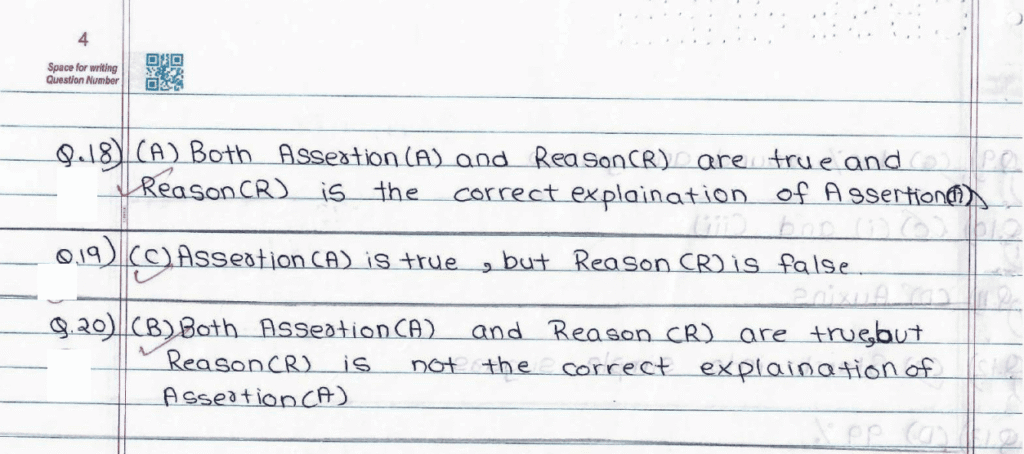
For Questions number 17 to 20, two statements are given - one labelled as Assertion (A) and the other labelled as Reason (R). Select the correct answer to these questions from the codes (A), (B), (C) and (D) as given below.
(A) Both Assertion (A) and Reason (R) are true and Reason (R) is the correct explanation of Assertion (A).
(B) Both Assertion (A) and Reason (R) are true, but Reason (R) is not the correct explanation of Assertion (A).
(C) Assertion (A) is true, but Reason (R) is false.
(D) Assertion (A) is false, but Reason (R) is true.
17. Assertion (A): The amount of ozone in the atmosphere began to drop sharply in the 1980s.
Reason (R): The oxygen atoms combine with molecular oxygen to form ozone.
18. Assertion (A): No two magnetic field lines are found to cross each other.
Reason (R): The compass needle cannot point towards two directions at the point of intersection of two magnetic field lines.
19. Assertion (A): A human child bears all the basic features of human beings.
Reason (R): It looks exactly like its parents, showing very little variations.
20. Assertion (A): Decomposition reactions are generally endothermic reactions.
Reason (R): Decomposition of organic matter into compost is an exothermic process.
SECTION B
Questions no. 21 to 26 are Very Short Answer Type questions.
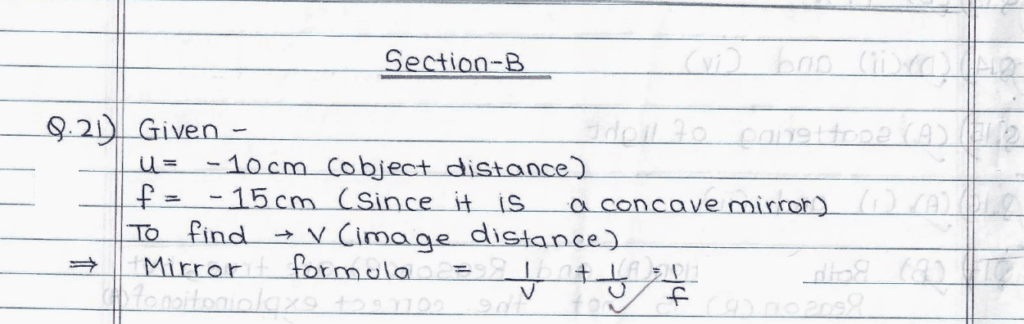
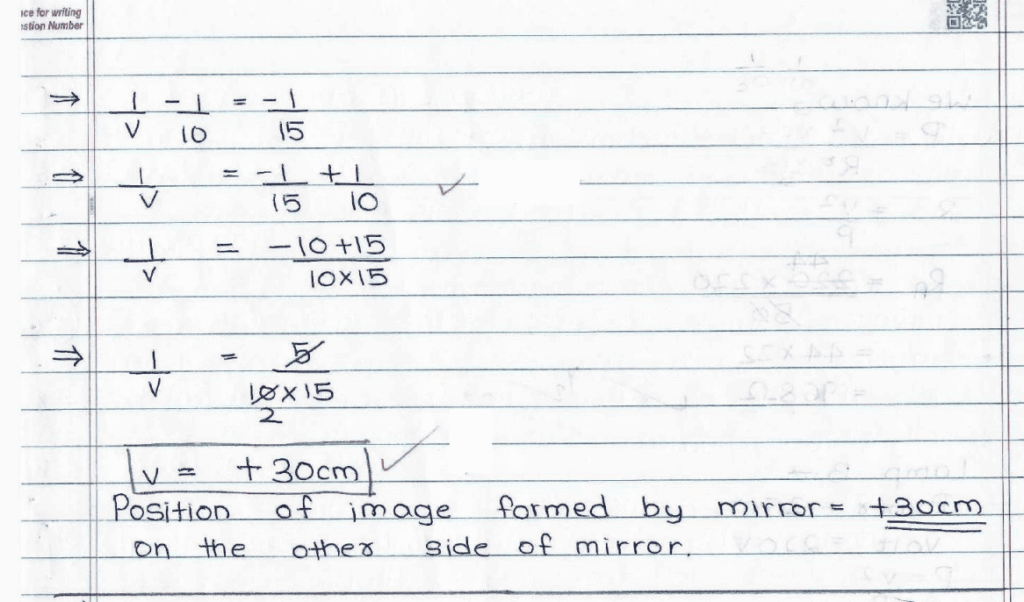
21. An object is placed at a distance of 10 cm in front of a concave mirror of focal length 15 cm. Use mirror formula to determine the position of the image formed by this mirror. (2)
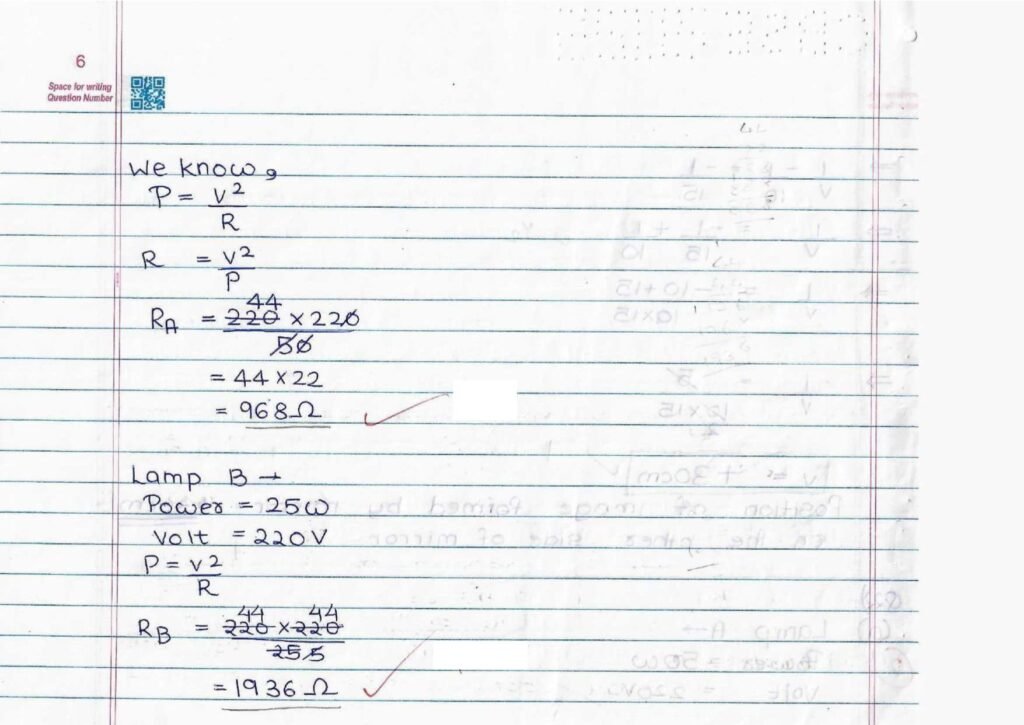
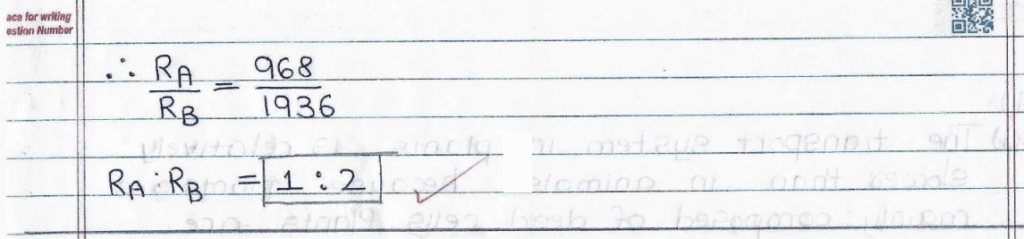
22. (a) Consider two lamps A and B of rating 50 W; 220 V and 25 W; 220 V respectively. Find the ratio of the resistances of the two lamps (i.e. RA : RB). (2)
OR
(b) Heat produced per second due to a current in a resistor of 4 Ω is 400 joules. Calculate the potential difference across the resistor. (2)

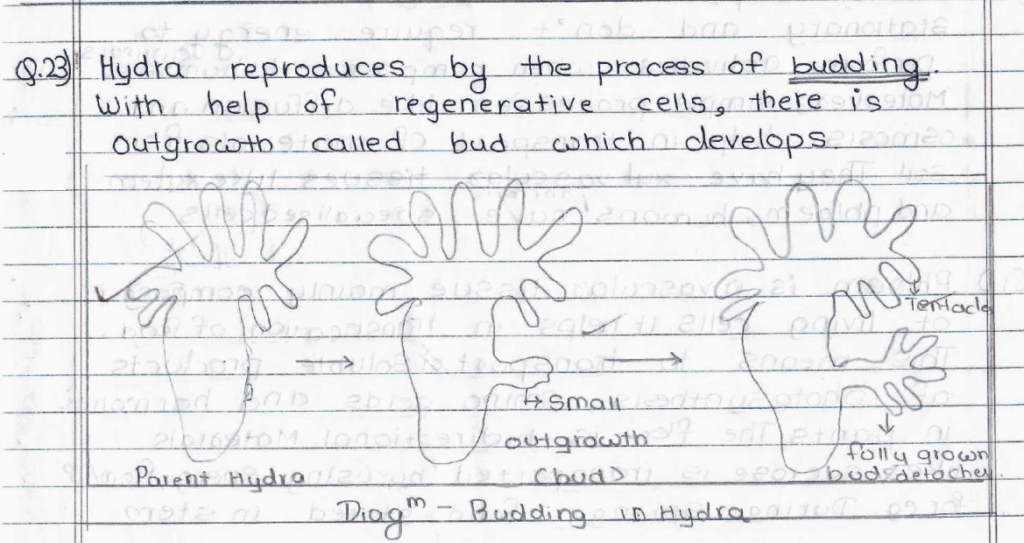
23. Draw labelled diagrams to show different stages of budding in Hydra. (2)
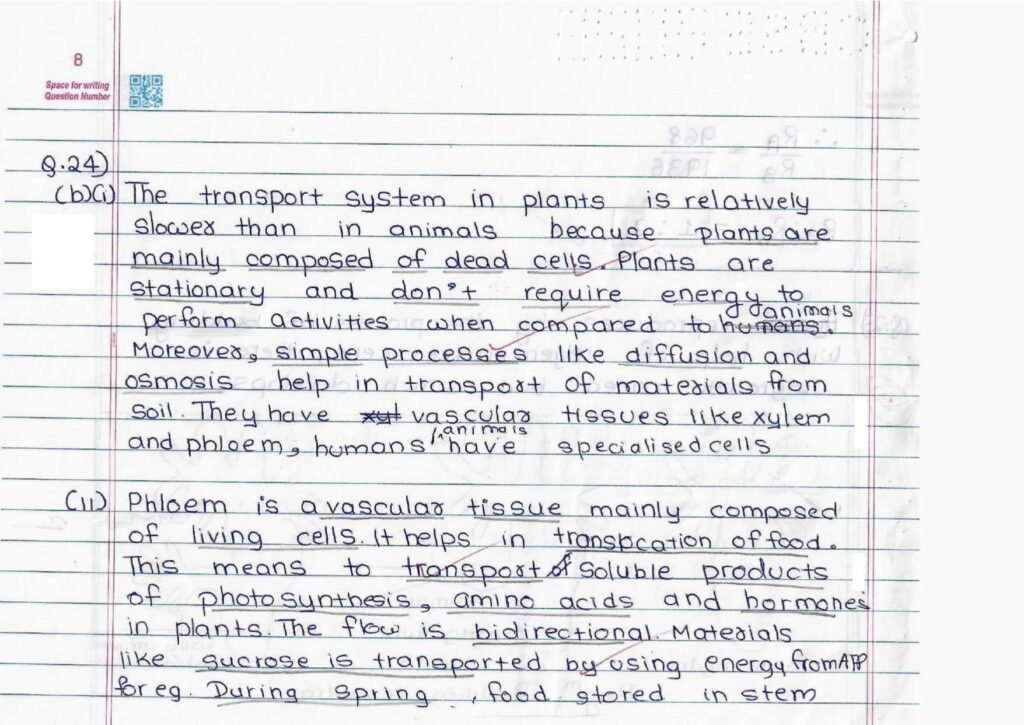
24. (a) Besides minimising the loss of blood, why is it essential to plug any leak in a blood vessel? Name the component of blood which helps in this process and state how this component perform this function.
OR
(b) (i) The transport system in plants is relatively slower than in animals. Give reasons. (2)
(ii) State the role of phloem in the transport of materials in plants.

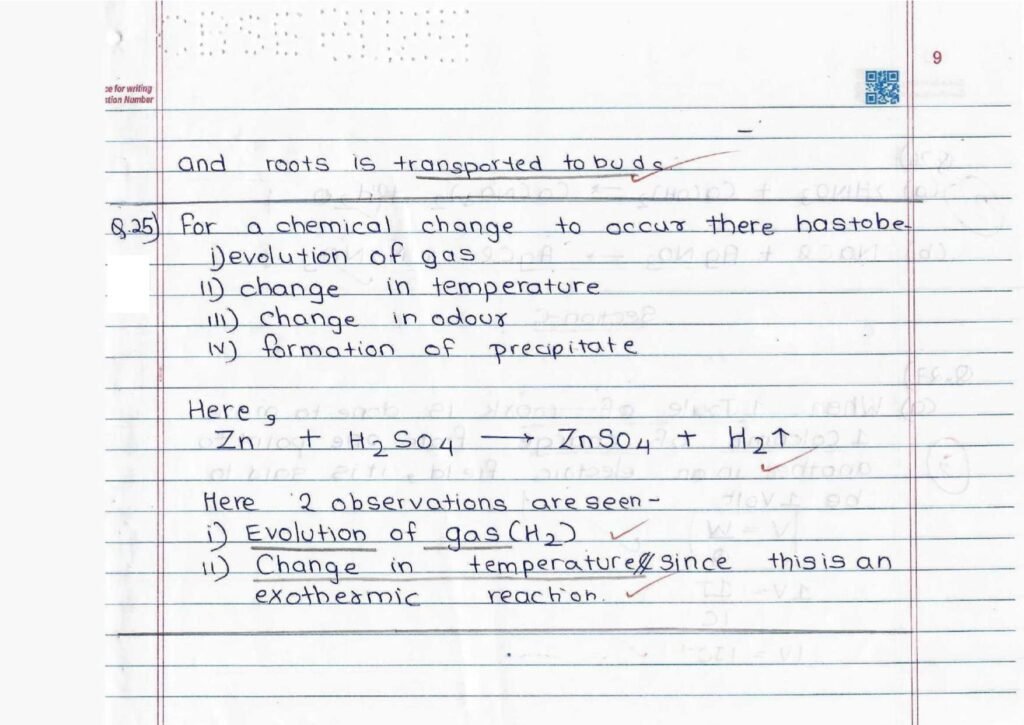
25. A student performs the following experiment in his school laboratory.
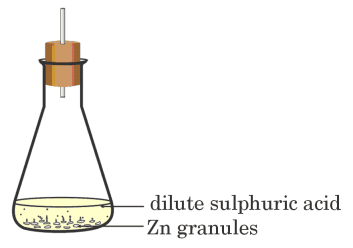
List two observations to justify that in this experiment a chemical change has taken place. (2)
26. Translate the following statements into chemical equations and then balance them: (2)
(a) Nitric acid reacts with calcium hydroxide to form calcium nitrate and water.
(b) Sodium chloride reacts with silver nitrate to form silver chloride and sodium nitrate.

SECTION C
Questions no. 27 to 33 are Short Answer Type questions.
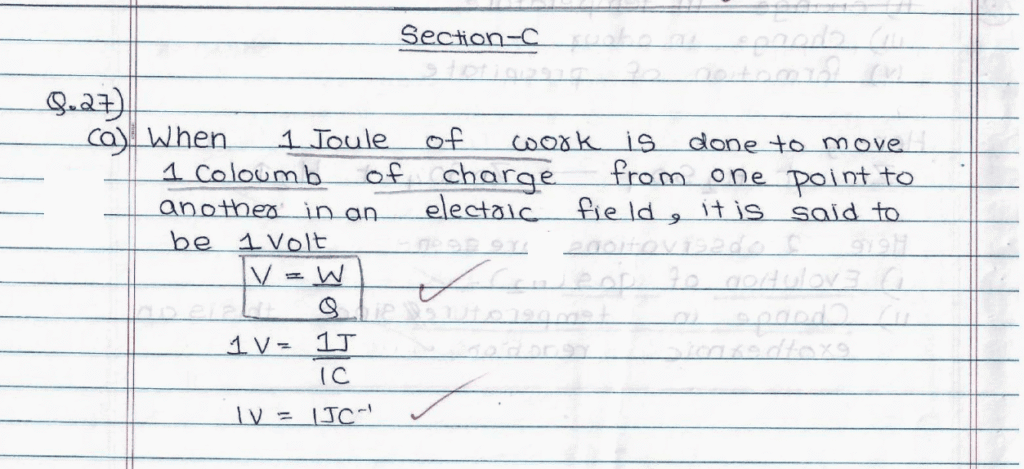
27. (a) Define one volt potential difference between two points in an electric field. (3)
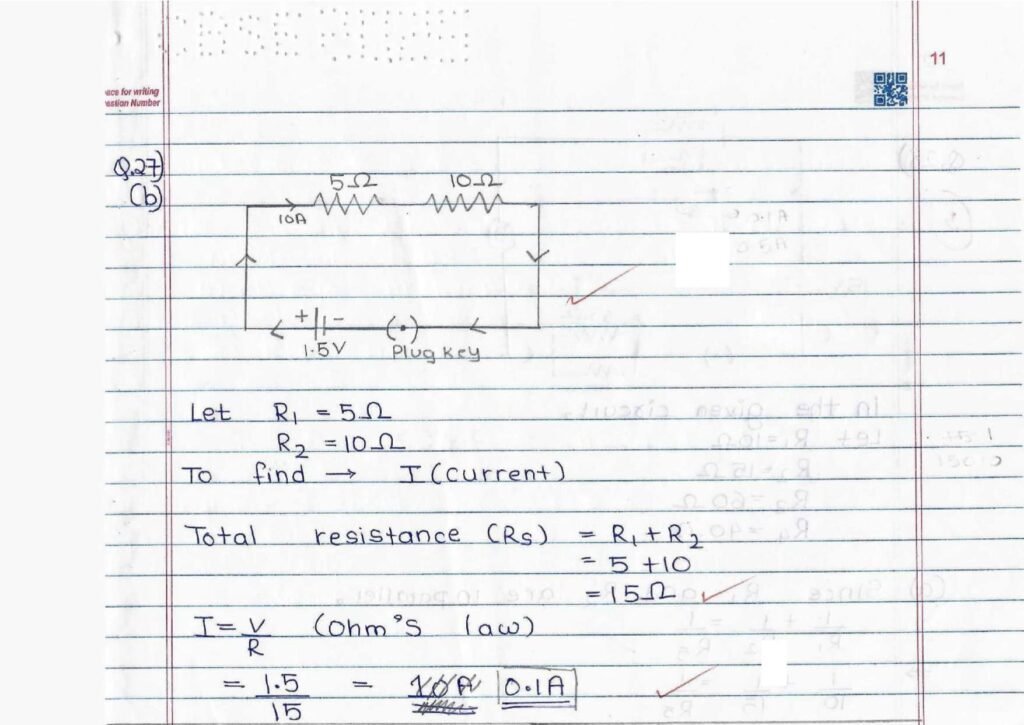
(b) Draw a schematic diagram of an electric circuit of a cell of 1.5 V, 5 Ω and 10 Ω resistor and a plug key, all connected in series. Calculate the current drawn from the cell when the key is closed.
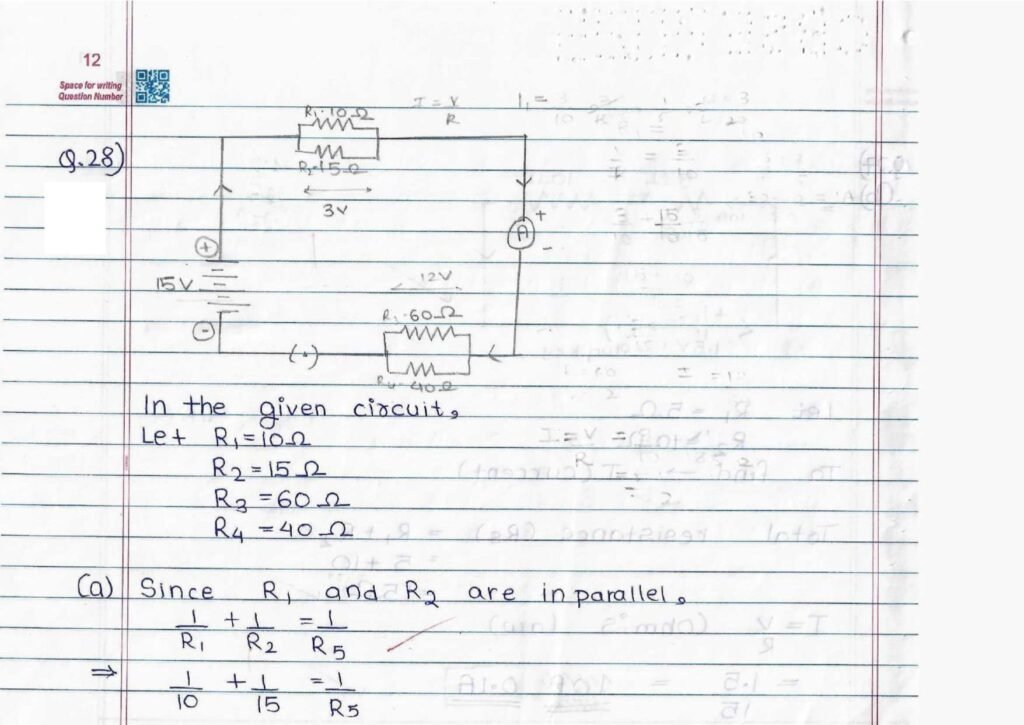
28. Consider the following electric circuit :
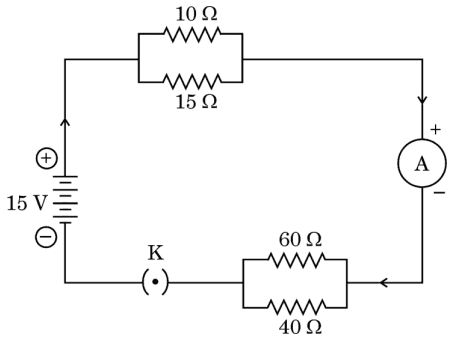
Calculate the values of the following: (3)
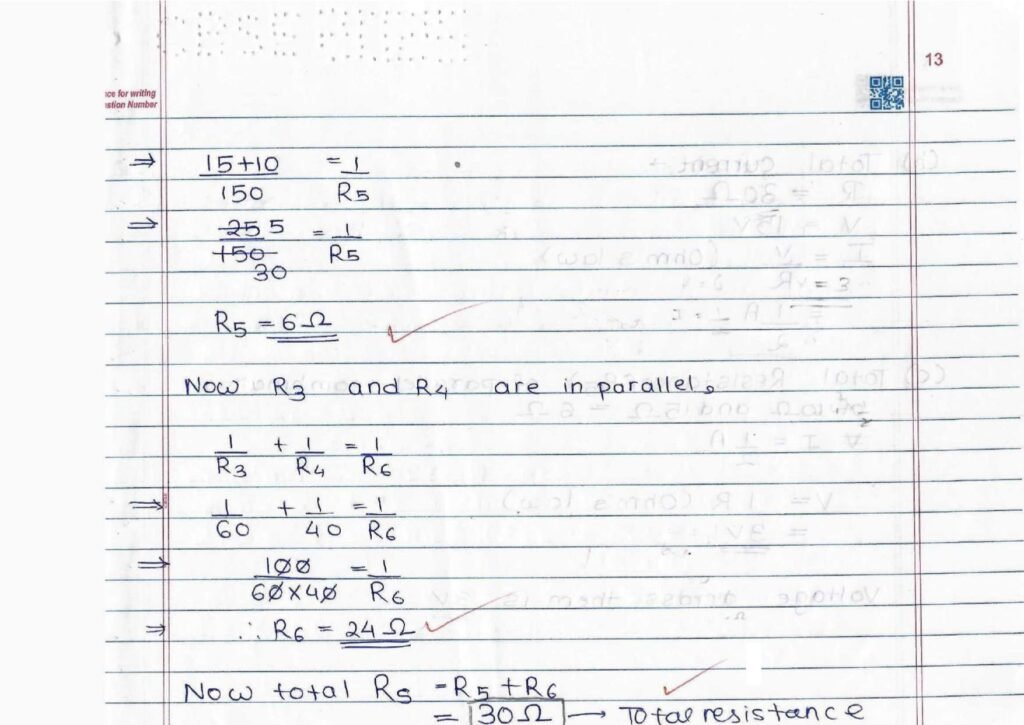
(a) The total resistance of the circuit
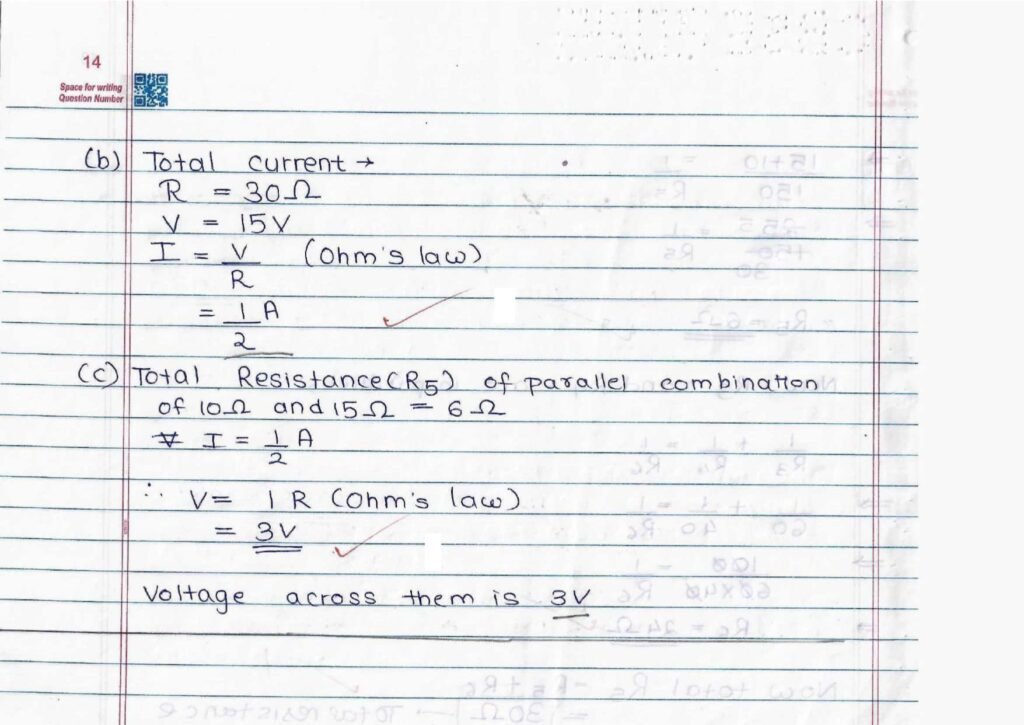
(b) The total current drawn from the source
(c) Potential difference across the parallel combination of 10 Ω and 15 Ω resistors.
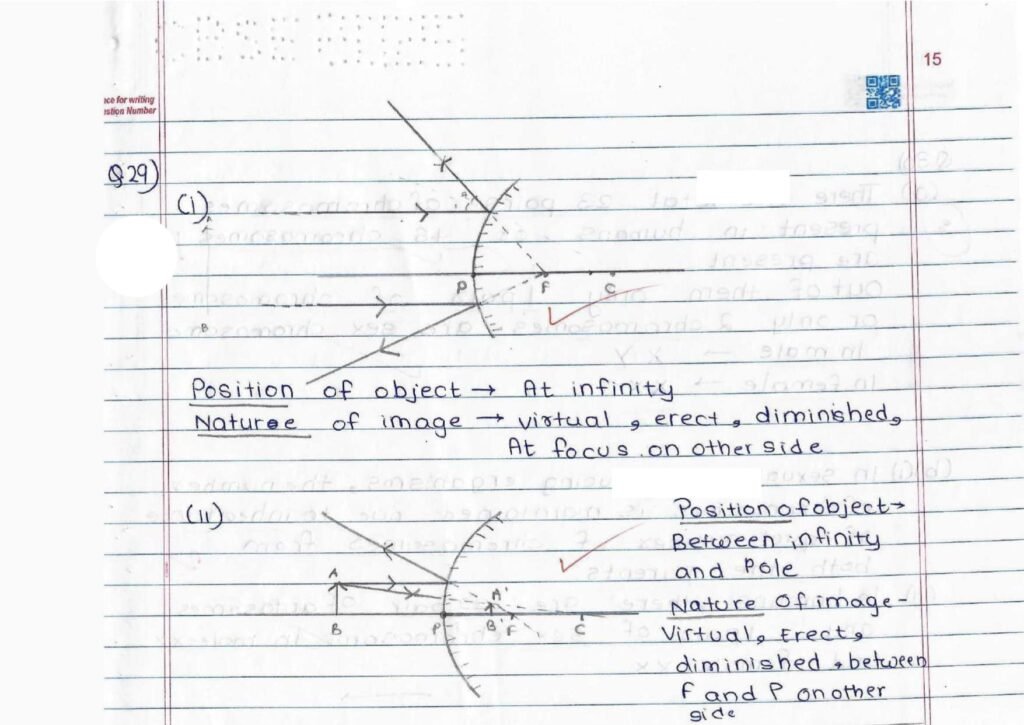
29. Draw ray diagrams to show the nature, position and relative size of the image formed by a convex mirror when the object is placed (i) at infinity and (ii) between infinity and pole P of the mirror. (3)
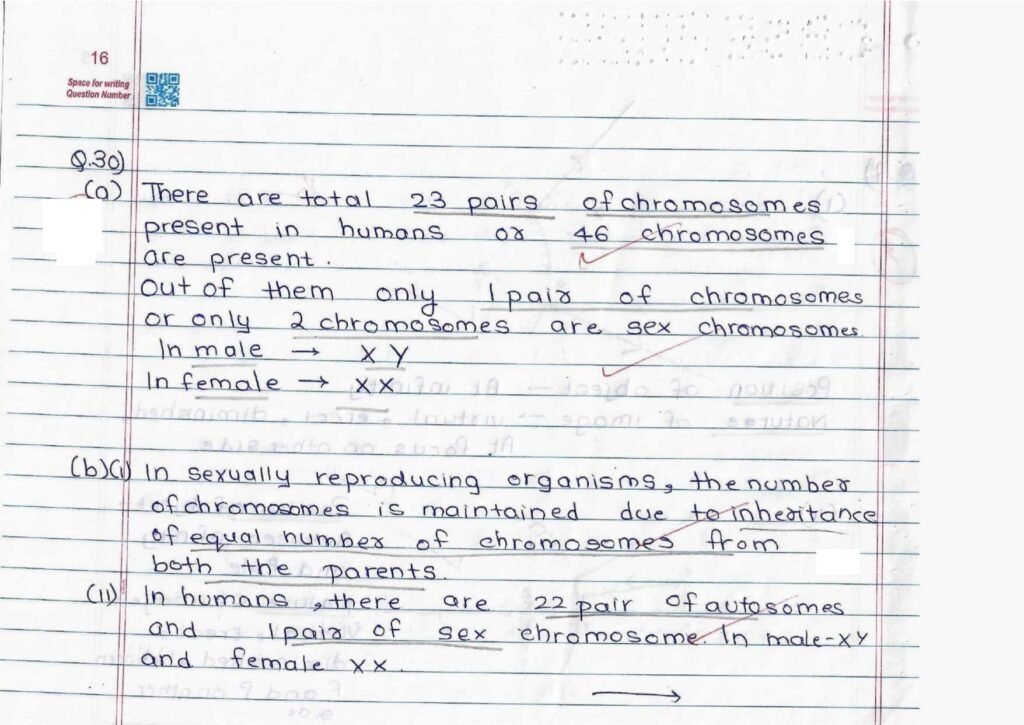
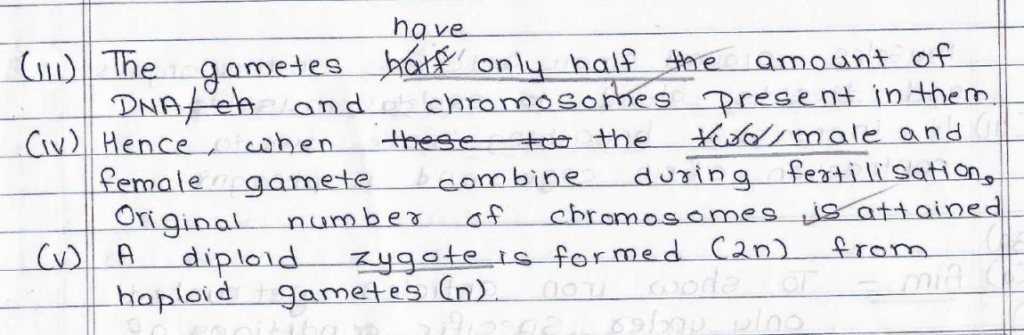
30. (a) How many chromosomes are present in human beings? Out of these how many are sex chromosomes?
(b) Explain how, in sexually reproducing organisms, the number of chromosomes in the progeny is maintained. (3)
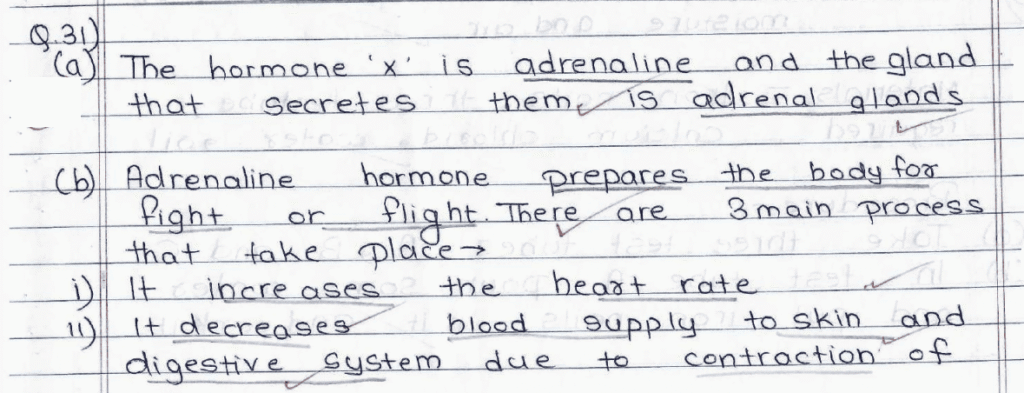
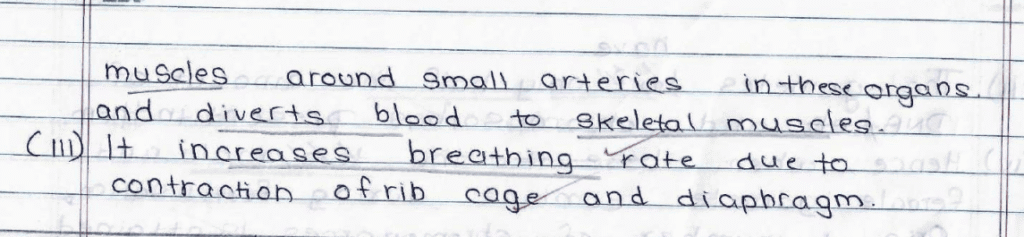
31. A hormone 'X' is secreted in blood when a person is under scary situation.
(a) Identify the hormone 'X' and the gland that secretes it.
(b) Explain its role in dealing with scary or emergency situations. (3)
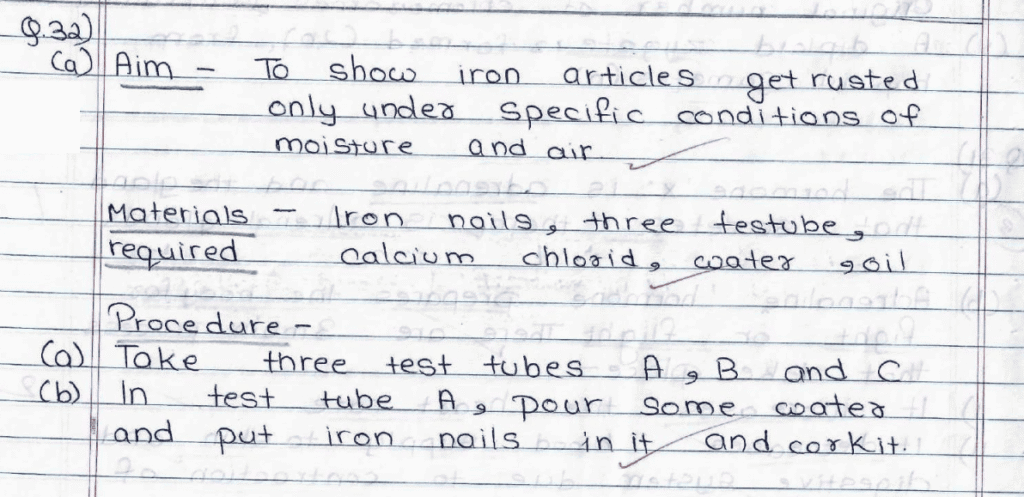
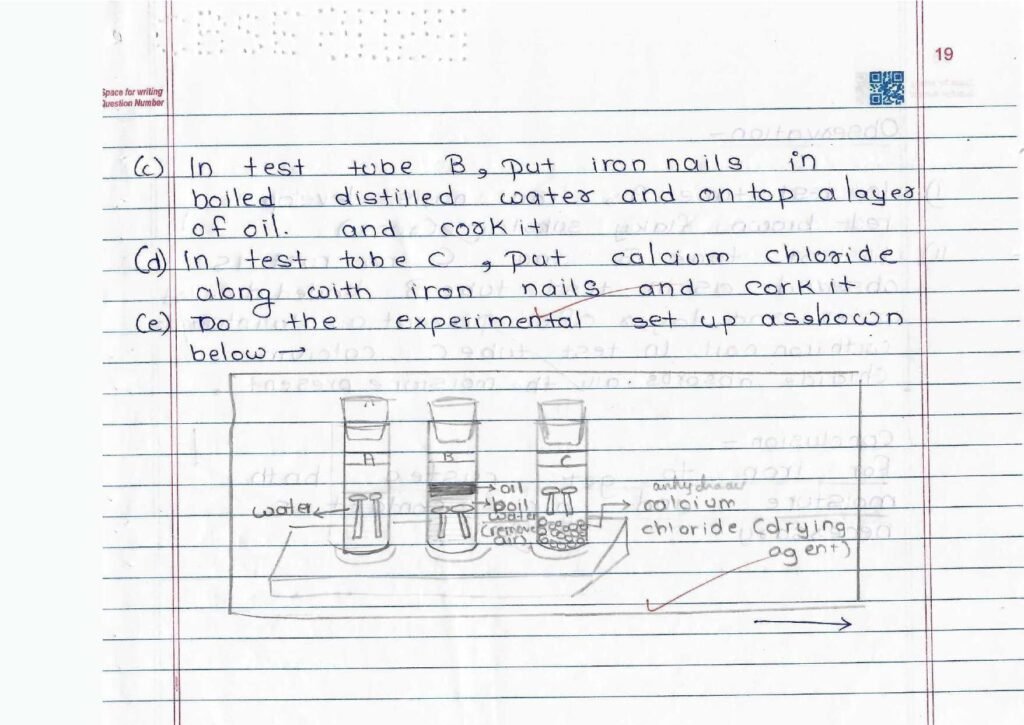
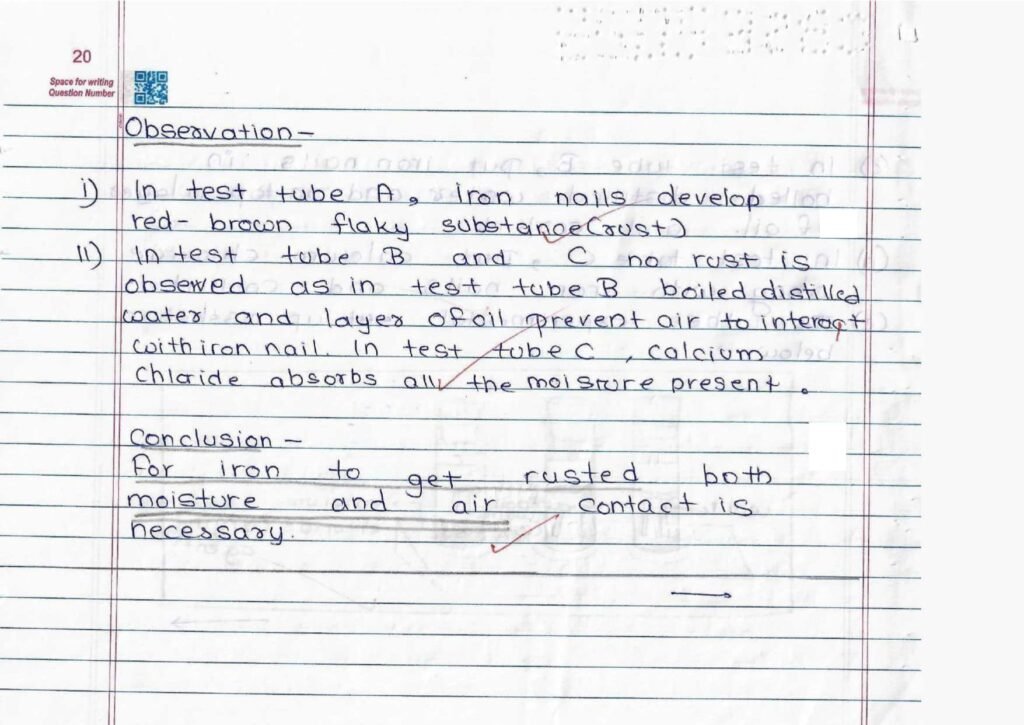
32. (a) With the help of an activity, explain the conditions under which iron articles get rusted. (3)
OR
(b) (i) Name two metals which react violently with cold water. List any three observations which a student notes when these metal are dropped in a beaker containing water.
(ii) Write a test to identify the gas evolved (if any) during the reaction of these metals with water. (3)
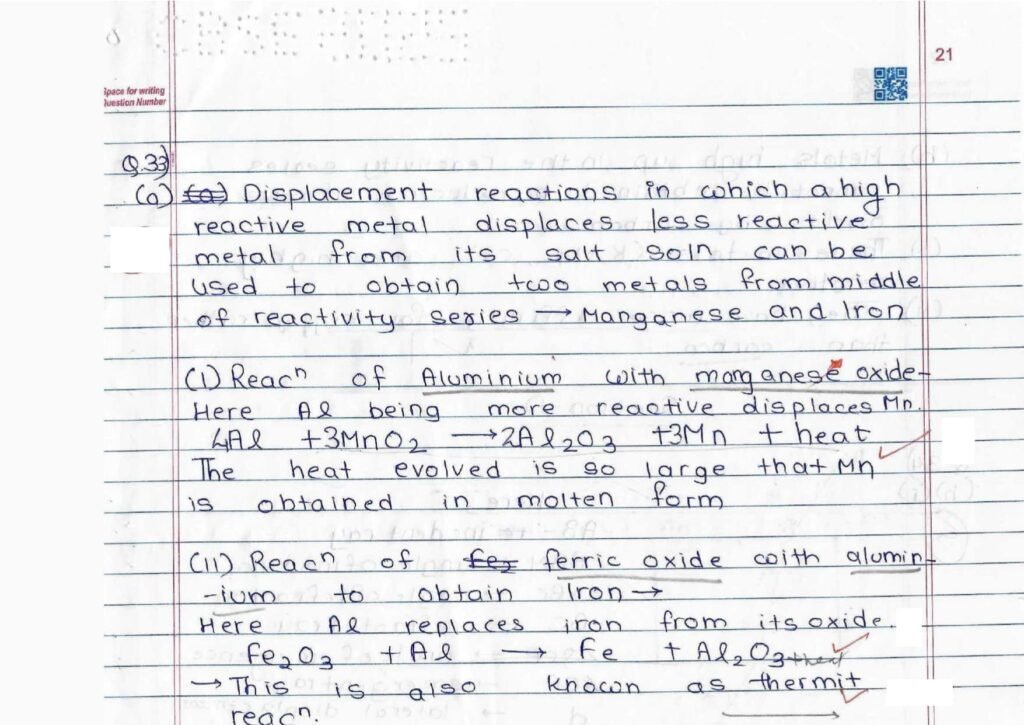
33. (a) "Displacement reactions also play a key role in extracting metals in the middle of the reactivity series." Justify this statement with two examples.
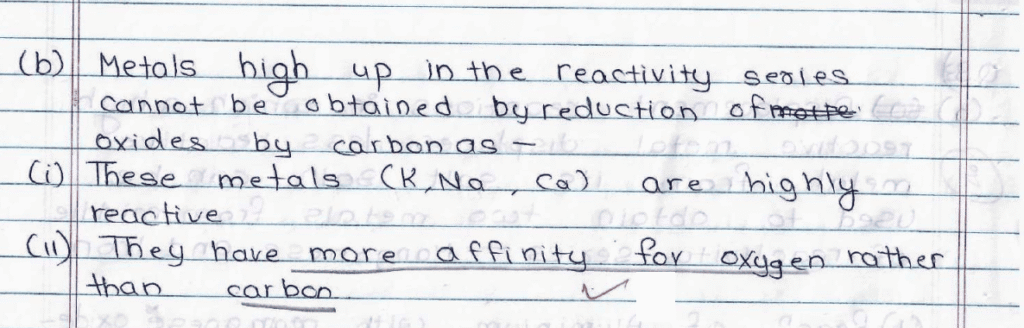
(b) Why can metals high up in the reactivity series not be obtained by reduction of their oxides by carbon ? (3)
SECTION D
Questions no. 34 to 36 are Long Answer Type questions.
34. (a) (i) The power of a lens 'X' is 2.5 D. Name the lens and determine its focal length in cm. For which eye defect of vision will an optician prescribe this type of lens as a corrective lens ?
(ii) "The value of magnification 'm' for a lens is 2." Using new Cartesian Sign Convention and considering that an object is placed at a distance of 20 cm from the optical centre of this lens, state:
(I) the nature of the image formed;
(II) size of the image compared to the size of the object;
(III) position of the image, and
(IV) sign of the height of the image.
(iii) The numerical values of the focal lengths of two lenses A and B are 10 cm and 20 cm respectively. Which one of the two will show higher degree of convergence/divergence ? Give reason to justify your answer. (5)
OR
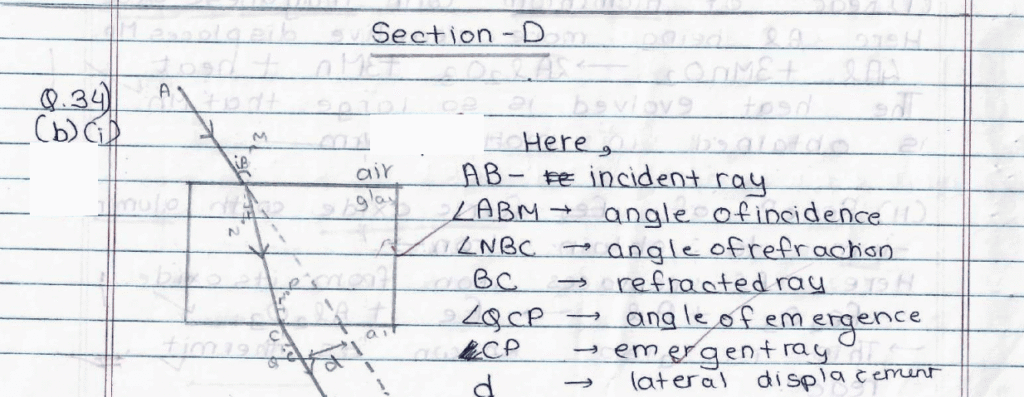
(b) (i) Draw a ray diagram to show the refraction of a ray of light through a rectangular glass slab when it falls obliquely from air into glass.
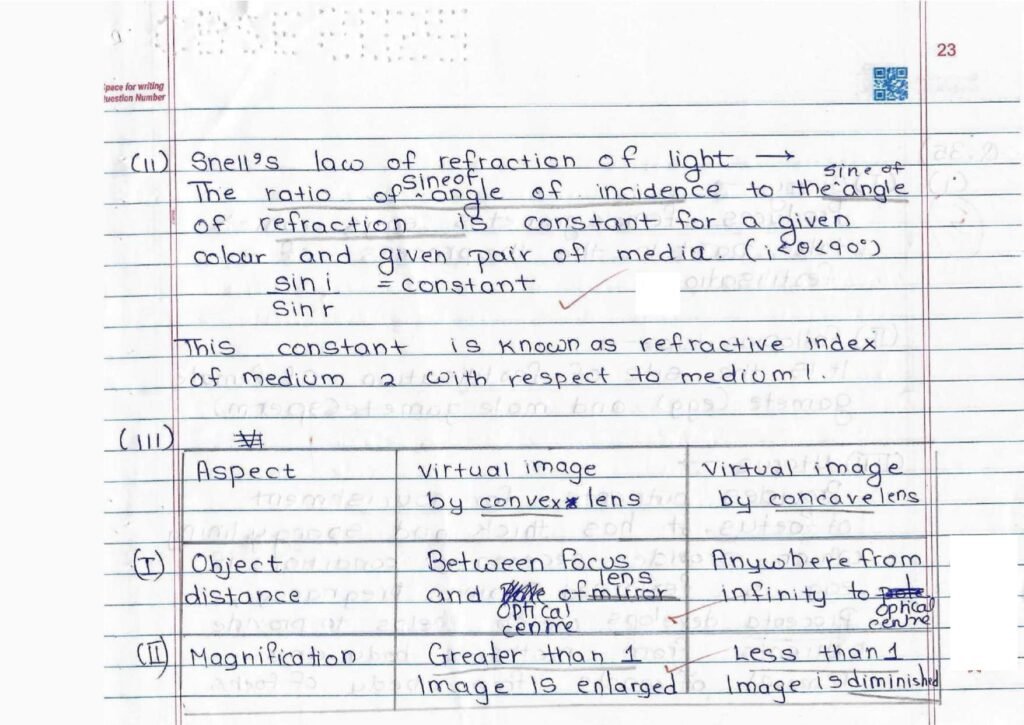
(ii) State Snell's law of refraction of light.
(iii) Differentiate between the virtual images formed by a convex lens and a concave lens on the basis of :
(I) object distance, and
(II) magnification. (5)
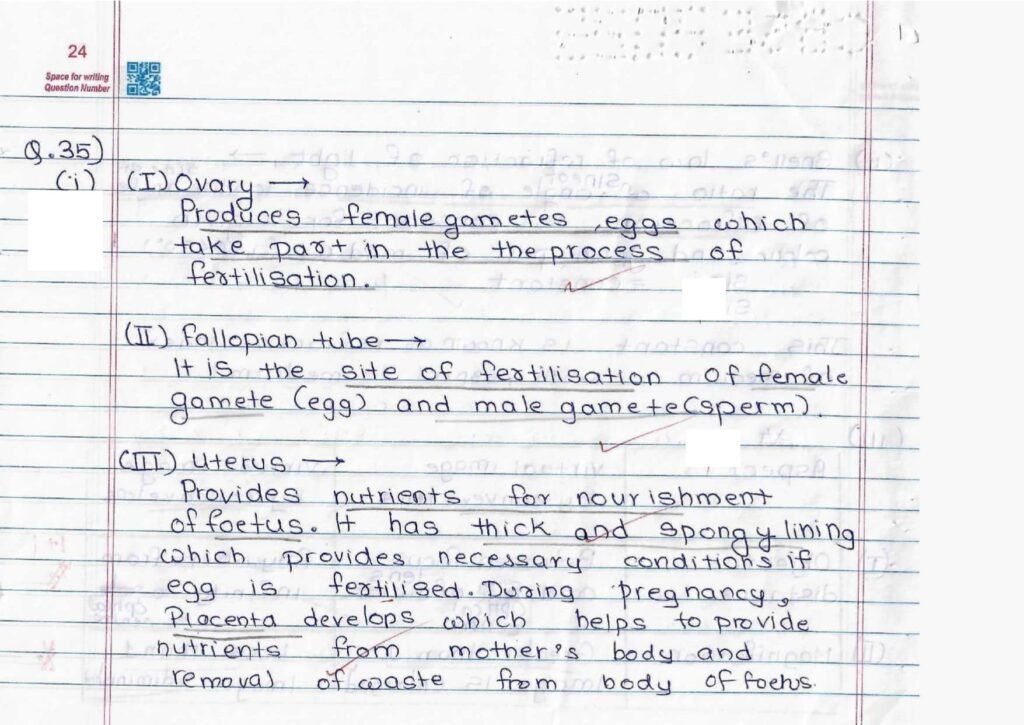
35. (a) (i) Write the functions of the following parts of human female reproductive system:
(I) Ovary
(II) Fallopian tube
(III) Uterus
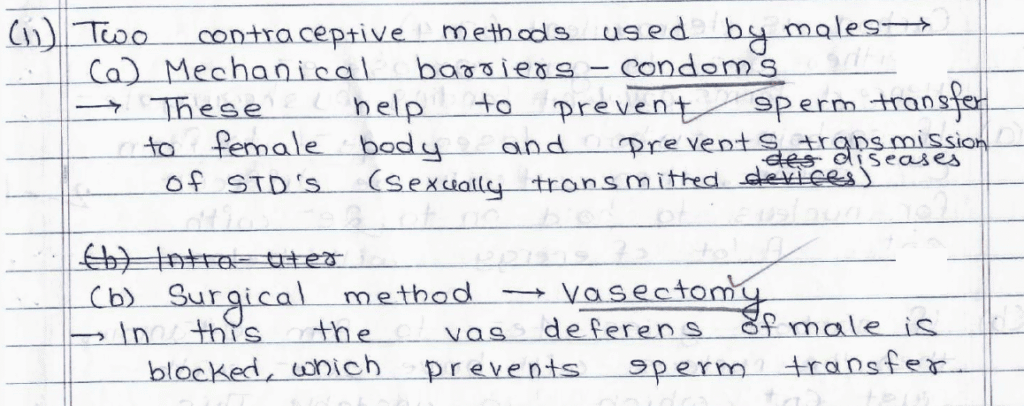
(ii) State briefly two contraceptive methods used by human males. (5)
OR
(b) (i) Differentiate between self-pollination and cross-pollination.
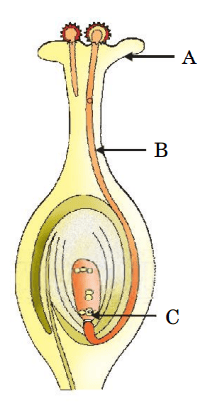
(ii) Identify A, B and C in the diagram given below and write one function of each.
36. (a) (i) Draw electron dot structure of chlorine molecule. (Atomic Number of Chlorine = 17)
(ii) What happens when chlorine reacts with methane in the presence of sunlight? Write the name of the reaction.
(iii) Name the two oxidising agents used for the conversion of alcohols to acids.
(iv) List four differences in properties between covalent compounds and ionic compounds. (5)
OR
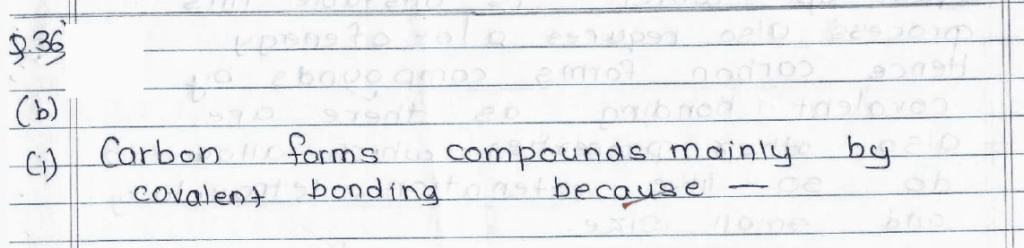
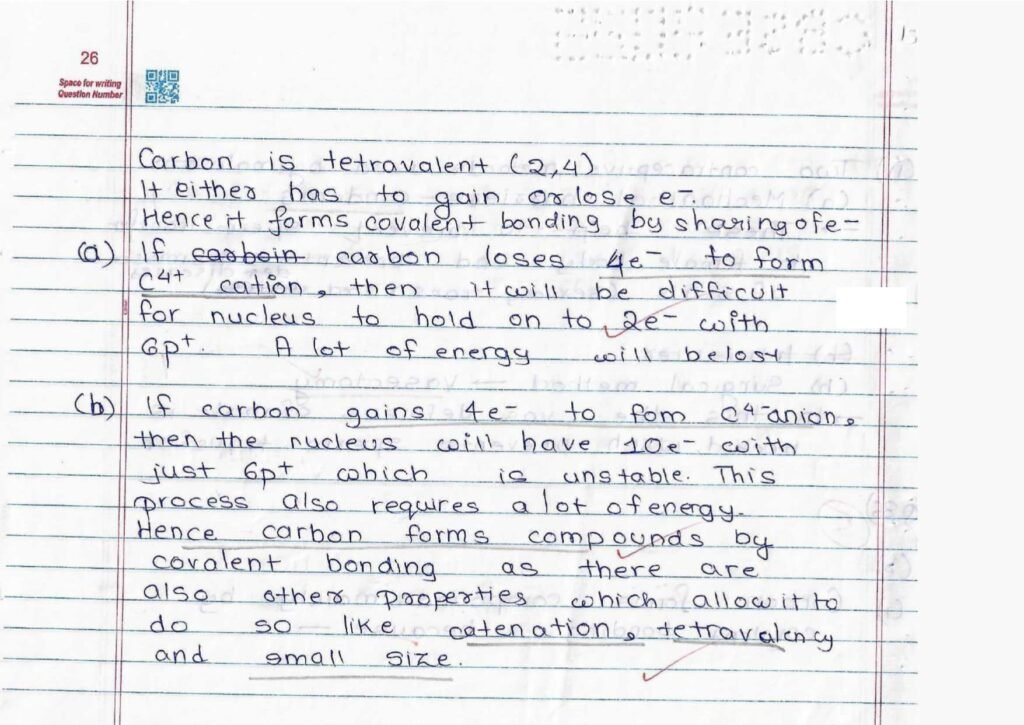
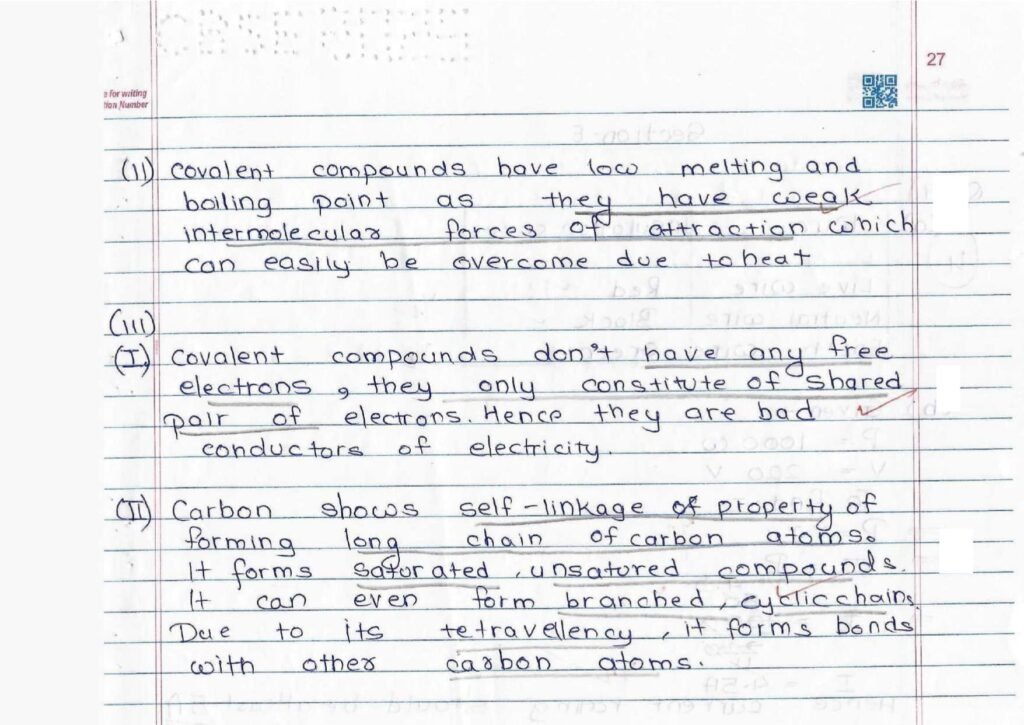
(b) (i) Give reason why carbon forms compounds mainly by covalent bonding.
(ii) Why do covalent compounds have low melting and boiling points.
(iii) Give reason for the following:
I. Covalent compounds are bad conductors of electricity.
II. Carbon shows catenation. (5)
SECTION E
The following questions are Source-based/Case-based questions. Read the case carefully and answer the questions that follow.
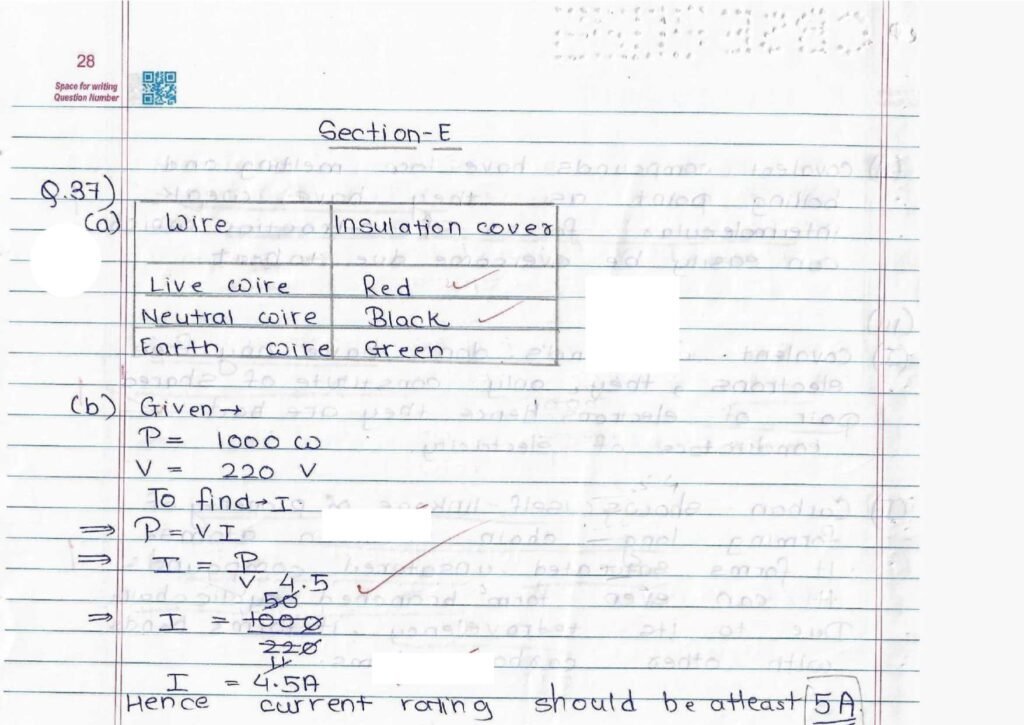
37. In our homes, we receive the supply of electric power through a main supply also called mains, either supported through overhead electric poles or by underground cables. In our country the potential difference between the two wires (live wire and neutral wire) of this supply is 220 V.
(a) Write the colours of the insulation covers of the line wires through which supply comes to our homes. (1)
(b) What should be the current rating of the electric circuit (220 V) so that an electric iron of 1 kW power rating can be operated? (1)
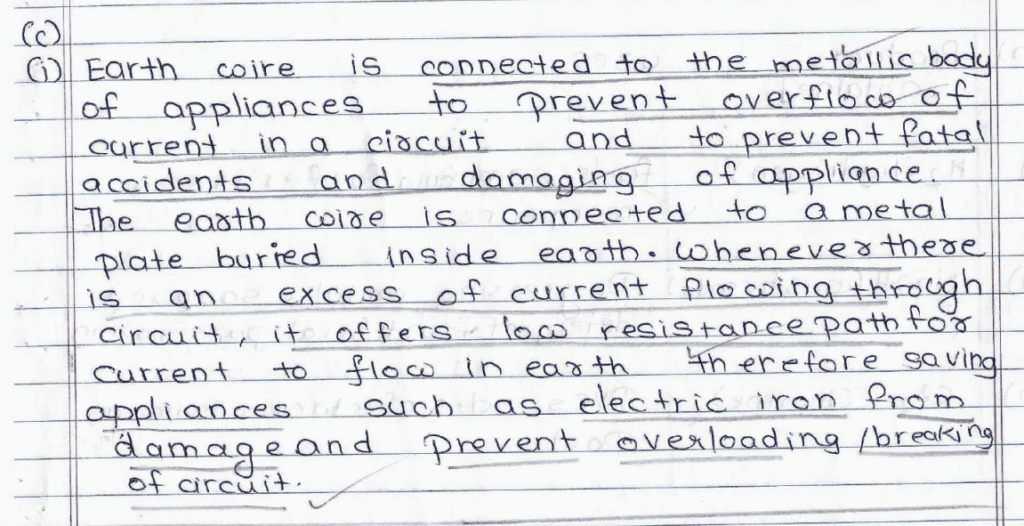
(c) (i) What is the function of the earth wire? State the advantage of the earth wire in domestic electric appliances such as electric iron. (2)
OR
(c) (ii) List two precautions to be taken to avoid electrical accidents. State how these precautions prevent possible damage to the circuit/appliance. (2)
38. Seawater contains many salts dissolved in it. Common salt is separated from these salts. Deposits of solid salt are also found in several parts of the world. These large crystals are often brown due to impurities. This is called rock salt and is mined like coal. The common salt is an important raw material for chemicals of daily use.
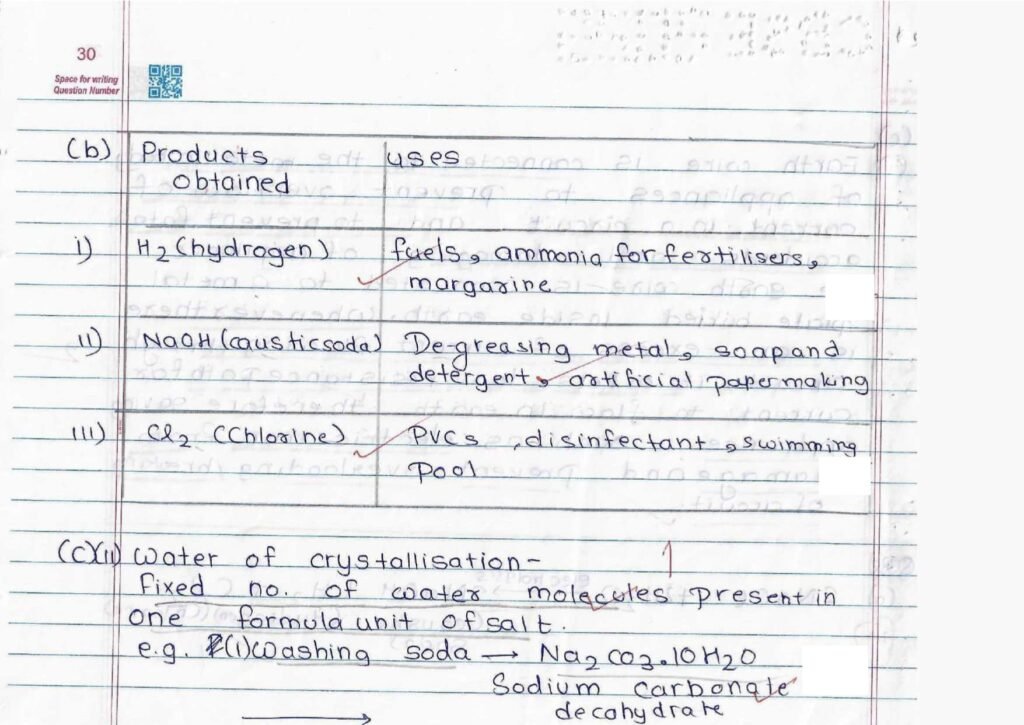
(a) Write balanced chemical equations to show the products formed during electrolysis of brine. (1)
(b) List two uses of any one product obtained during electrolysis of brine. (1)
(c) (i) A mild non-corrosive basic salt 'A', used for faster cooking, is strongly heated to produce a compound 'B', that is used for removing permanent hardness of water. Identify A and B and also write the equation for the reaction that occurs when A is heated. (2)
OR
(c) (ii) Define water of crystallisation. Give two examples of salts that have water of crystallisation. (2)


39. The maintenance functions of all living organisms must go on even when they are not doing anything particular. Even when we are just sitting in a class or even asleep, this maintenance job has to go on. These maintenance processes require energy to prevent damage and break-down of cells and tissues, which is obtained by the individual organism from the food prepared by the autotrophs, called producers.
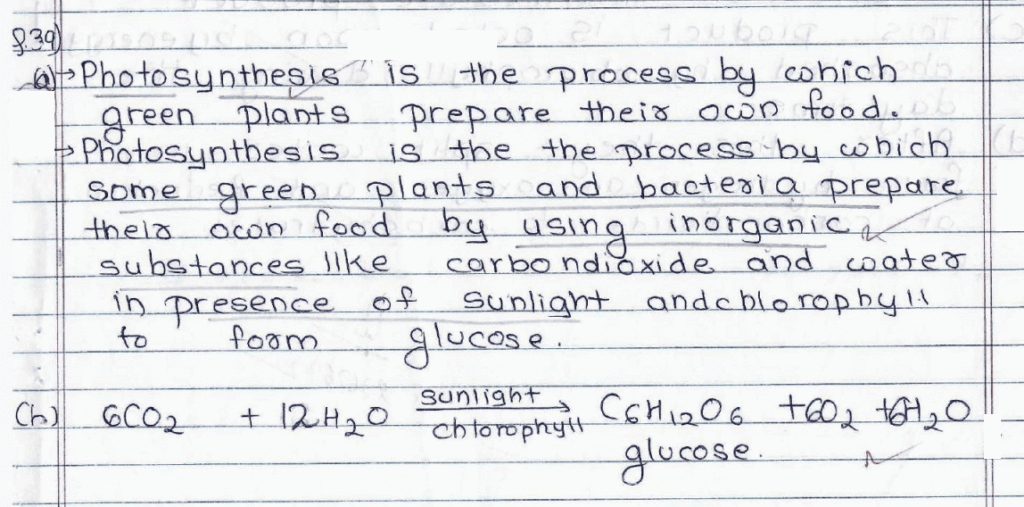
(a) Name and define the process by which green plants prepare food. (1)
(b) Write chemical equation involved in the above process. (1)
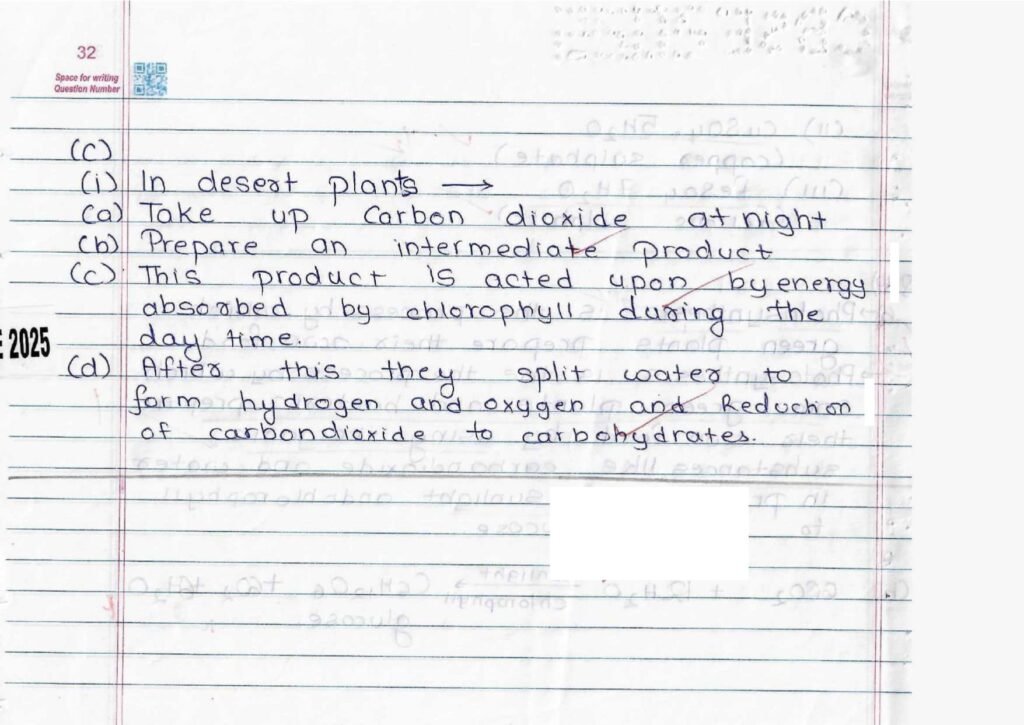
(c) (i) State in proper sequence the events that occur in synthesis of food by desert plants. (2)
OR
(c) (ii) Explain giving reasons what happens to the rate at which the green plants will prepare food
(I) during cloudy weather, and
(II) when stomata get blocked due to dust. (2)
PDF Download Section
1. CBSE Class 10 Science 2025 Question Paper
2. CBSE Class 10 Science 2025 Official Marking Scheme
3. CBSE Class 10 Science 2025 Topper's Answer Sheet
Reviewing the CBSE Class 10 Science Topper Answer Sheet 2025 alongside the official marking scheme is the smartest move you can make before stepping into the exam hall on February 25. It clearly demonstrates that writing point-wise answers, drawing neat pencil diagrams (like the human reproductive system or magnetic field lines), and highlighting final formulas will automatically push your score higher.
Don't just scroll through these PDFs. Download them, try solving Section D or E yourself with a timer, and then cross-check your presentation with the topper's sheet.
Related posts:
 Science Class 10 Important Questions
Control and Coordination Class 10 Top Questions and Answers
Acids, Bases and Salts Class 10 MCQ Quiz – Test Your Knowledge!
Metals and Non-Metals Class 10 MCQ Quiz – Test Your Knowledge!
Life Processes Class 10 MCQ Quiz – Test Your Knowledge!
The Human Eye and the Colourful World Class 10 Science MCQ Quiz – Test Your Knowledge
Electricity Class 10 Science MCQ Quiz – Test Your Knowledge
Magnetic Effects of Electric Current Class 10 Science MCQ Quiz – Test Your Knowledge
Science Class 10 Important Questions
Control and Coordination Class 10 Top Questions and Answers
Acids, Bases and Salts Class 10 MCQ Quiz – Test Your Knowledge!
Metals and Non-Metals Class 10 MCQ Quiz – Test Your Knowledge!
Life Processes Class 10 MCQ Quiz – Test Your Knowledge!
The Human Eye and the Colourful World Class 10 Science MCQ Quiz – Test Your Knowledge
Electricity Class 10 Science MCQ Quiz – Test Your Knowledge
Magnetic Effects of Electric Current Class 10 Science MCQ Quiz – Test Your Knowledge