Looking for The Pot Maker Class 9 Questions and Answers? You have come to the right place. In this article, we have provided complete NCERT Solutions for The Pot Maker, Chapter 2 of the CBSE Class 9 English Kaveri textbook. These solutions are prepared according to the latest NCERT curriculum and CBSE syllabus to help students score better in their examinations.
This comprehensive guide includes answers to Reflect and Respond, Check Your Understanding, Critical Reflection, vocabulary and grammar exercises, as well as important competency-based questions, MCQs, and long-answer questions. All answers are written in simple, student-friendly language, making it easier to understand the chapter and revise before exams.
Students looking for The Pot Maker Class 9 Questions and Answers PDF, NCERT Solutions for Class 9 English Chapter 2, or CBSE Class 9 English Kaveri Chapter 2 Question Answers will find everything they need in one place. Start your preparation with the complete The Pot Maker Class 9 NCERT Solutions below.
Reflect and Respond
I. Look at the pictures given below and identify the vocations. Now, list at least five more vocations.
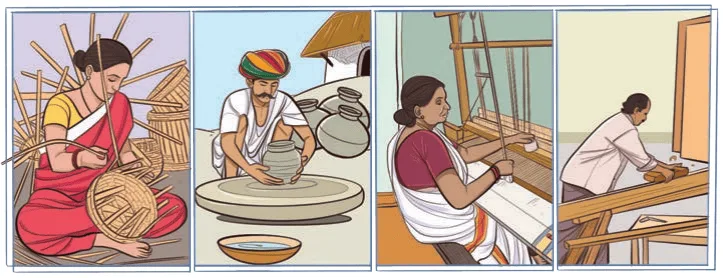
Vocations shown in the pictures:
- Basket Weaver
- Pot Maker (Potter)
- Weaver
- Carpenter
Five more vocations:
- Blacksmith
- Tailor
- Mason
- Farmer
- Goldsmith
II. Work in pairs. Discuss the following questions and share your answers with your classmates and teacher.
1. What is common among these pictures?
Ans. All the pictures show people engaged in traditional skill-based occupations. They use their hands, experience, and creativity to make useful products.
2. We refer to such skill-based work as v__ __ a __ __ o __ s.
Ans. Vocations
3. Mention a few differences between handmade and machine-made products.
Ans.
| Handmade Products | Machine-made Products |
|---|---|
| Made by hand using traditional skills. | Made using machines in factories. |
| Each product is unique. | Products are usually identical. |
| Takes more time to produce. | Produced quickly in large quantities. |
| Requires skilled craftsmanship. | Requires less manual effort. |
| Often more expensive due to labour. | Usually cheaper because of mass production. |
Check Your Understanding – I
I. Do you think pot making is easy? If yes, why? If no, why not?
Ans. No, pot making is not easy. It requires great skill, patience, and hard work. A potter has to collect clay from the riverbank, soften it by pounding, shape it carefully on the wheel, dry it properly, and fire it in a kiln. Even a small mistake can spoil the entire batch of pots.
II. Would Sentila be able to fulfil her dream of becoming a pot maker? Explain.
Ans. Yes, Sentila would be able to fulfil her dream. She was deeply passionate about pottery and never gave up despite many failures. She observed expert potters carefully, learnt from her mother and received guidance from Onula. Her perseverance and determination finally helped her become a skilled pot maker.
III. Do you think Mesoba and Arenla would support Sentila? Give a reason.
Ans. Yes, Mesoba and Arenla would support Sentila. Mesoba assured the village council that Sentila would soon become the best pot maker in the village. Later, Arenla herself began teaching Sentila the process of making pots. Although she initially preferred weaving for her daughter, she eventually fulfilled her responsibility of passing on the traditional skill.
Check Your Understanding – II
I. Do you think Onula's support helped Sentila? If yes, why? If no, why not?
Ans. Yes, Onula's support greatly helped Sentila. She encouraged Sentila when she felt discouraged, taught her the correct techniques of pot making, and boosted her confidence. Onula's guidance enabled Sentila to improve her skills and eventually become a successful pot maker.
II. Sentila observes her mother making pots. What does this tell us about her?
Ans. Sentila's careful observation shows that she was keen, patient, determined, and eager to learn. She paid close attention to every detail of her mother's technique and used those observations to improve her own pottery skills. Her willingness to learn through observation reflects her dedication and perseverance.
III. Arrange the following events of the story in the correct sequence. Share your answer with your classmates and teacher.
| 1. The village council called Mesoba to know about Arenla's unwillingness to teach pottery to Sentila. | |
| 2. Arenla made a new batch of pots and asked Sentila to continue the work as she was unwell. | |
| 3. Sentila observed how other expert potters crafted beautiful pots. | |
| 4. Sentila was passionate about pottery but did not share it with her mother. | |
| 5. Onula guided Sentila in the art of pot making. | |
| 6. Sentila overheard her mother saying that pot making was a tiring job and that she earned very little from it. | |
| 7. Onula observed two rows of pots inside the work shed, which she felt was the work of two people. | |
| 8. Sentila learnt the art of pot making for a year from her mother, but was unsuccessful. | |
| 9. Sentila was able to make pots quickly and skillfully, just one less than her mother's. |
Ans. 4 → 6 → 3 → 1 → 8 → 5 → 2 → 9 → 7
Critical Reflection
I. Read the extracts given below and answer the questions that follow.
1. Pounding the stubborn clay inside bamboo cylinders to soften it, is also tedious. So many times I’ve dropped the mould out of sheer exhaustion and have had to start all over again. It takes months to bring out a batch of pots after so much labour. And the reward? A few rupees. But if Sentila learns weaving, she can make much more money besides providing enough cloth for the family. Weaving is not messy like pot making and can be done indoors in all seasons. Also, the time spent on weaving one shawl is much less and the return is handsome.
(i) Choose the correct reason for the given assertion.
(A): The effort in making pots is far greater than the returns.
- A. The process of pot making is quite tiresome and long, and one hardly earns much.
- B. The process of pot making is exhausting, takes a long time, yet gives a sense of satisfaction.
Ans. Option A.
(ii) Why does Arenla want Sentila to learn weaving?
Ans. Arenla wants Sentila to learn weaving because
- it is less tiring
- can be done indoors in all seasons
- takes less time
- earns more money
- also provides enough cloth for the family.
(iii) State one advantage that weaving has over pot making, as per the extract.
Ans. One advantage of weaving is that it can be done indoors in all seasons. It is also less time-consuming and more profitable than pot making.
(iv) Choose the sentence that uses the word ‘handsome’ in the same way as in the extract.
- A. My father is a handsome man.
- B. They will make a handsome profit selling this property.
Ans. Option B.
(v) ‘And the reward?’ What is the author’s purpose of using a question mark here?
Ans. The question mark emphasises Arenla's disappointment and frustration. It draws attention to the fact that despite months of hard work, the reward is only a few rupees. It highlights the poor financial return from pot making.
2. Onula saw her taking out some clay and the implements from her basket quietly. She watched Sentila’s clumsy efforts to make a pot and noticed that Sentila was too tense. As a result, the clay seemed unable or unwilling to yield the right shape. When Sentila wearily let the misshapen lump fall flat on the ground, Onula went to her and said, “Don't worry, little one, I shall teach you how to make a perfect pot.” Sentila watched in amazement as Onula fashioned a beautiful pot and asked her to try again.
(i) Complete the sentence with an appropriate reason.
Onula feels Sentila’s effort at making a pot is clumsy because _____.
Ans. ...she is too tense and lacks confidence while shaping the clay.
(ii) Choose the correct option to complete the following sentence.
‘Don’t worry, little one, I shall teach you how to make a perfect pot.’
This shows that Onula was _____.
A. sincere and generous
B. forgiving and thoughtful
C. thoughtful and generous
D. forgiving and sincere
Ans. Option (C).
(iii) Which among the following is the effect of a cause?
A. As a result, the clay seemed unable or unwilling to yield the right shape.
B. Onula saw her taking out some clay and the implements from her basket quietly.
Ans. Option (A).
(iv) ‘Onula fashioned a beautiful pot.’ Here, the word ‘fashioned’ means _____. (created/styled).
Ans. created.
(v) How might Sentila have felt when she saw ‘the misshapen lump fall flat on the ground’?
Ans. Sentila must have felt disappointed, frustrated, embarrassed, and discouraged because despite her efforts, she was unable to make a proper pot.
II. Answer the following questions.
1. Describe the process of pot making followed by expert pot makers, as observed by Sentila.
Ans. Sentila observed that expert pot makers first mixed the clay with water and pounded it until it became soft. They then placed the clay on the wheel and skilfully shaped it using their hands and a spatula. After shaping, the pots were left for two or three days, given a final touch to ensure consistency, dried in the sun, and finally fired in a kiln. The fire had to be carefully controlled because over-firing or under-firing could spoil the entire batch.
2. What warning was given to Mesoba by the village council?
Ans. The village council reminded Mesoba that it was Arenla's duty to pass on the traditional skill of pot making to her daughter. They warned that such skills belonged to the whole community and should be taught not only to one's own children but also to anyone willing to learn.
3. How did Sentila feel when she failed at pot making even after a year of training with her mother?
Ans. Sentila felt ashamed, frustrated, and disappointed. Despite practising for nearly a year, she could not shape the clay properly and was unable to learn the craft successfully.
4. ‘Onula stood there for a long time as if trying to absorb a new phenomenon’. Explain.
Ans. Onula saw two identical rows of newly made pots in the work shed. She realised that Sentila had finally mastered the art of pot making and that her work was almost indistinguishable from Arenla's. This remarkable achievement amazed her, making her feel that she had witnessed something extraordinary.
5. ‘The tradition and history of the people did not belong to any individual,’ what does this symbolise?
Ans. This statement symbolises that traditional knowledge and cultural heritage belong to the entire community. Such valuable skills should be preserved and passed on from one generation to the next so that the culture and traditions continue to survive.
6. What is the significance of the concluding line of the story, ‘A new pot maker was born’?
Ans. The concluding line signifies Sentila's transformation into a skilled pot maker. It means:
- Sentila had finally become a skilled pot maker.
- Arenla's traditional knowledge had been successfully passed on.
- The family's pottery tradition would continue.
- Although Arenla died, her art and legacy would live on through Sentila.
7. What is the role of perseverance in pursuing one's dreams? Elaborate with reference to Sentila.
Ans. Sentila's story shows that perseverance is essential for achieving one's dreams. Although she faced opposition, repeated failures, and discouragement, she never gave up. She continued observing expert potters, practised tirelessly, accepted Onula's guidance, and learnt from her mistakes. Her determination and continuous effort eventually helped her become a skilled pot maker. The story teaches that success comes through patience, hard work, and persistence.
Extra Questions
8. "Onula stood there for a long time as if trying to absorb a new phenomenon." What does the new phenomenon refer to?
Ans. It refers to the remarkable transformation of Sentila into a master pot maker almost overnight after years of struggle.
9. "Slowly she walked away from this place of wonder…". Why the work shed is considered as place of wonder by Onula?
Ans. The work shed had become a place of wonder because it showed:
- the passing of knowledge from mother to daughter,
- the birth of a new artist,
- the continuation of a family tradition.
To Onula, this was more than a workshop—it represented the survival of a cultural heritage.
10. Arenla wanted Sentila to become a weaver instead of a pot maker. Do you think her decision was justified? Give reasons with reference to the story.
Ans. Arenla's decision was justified because she wanted a better future for her daughter. She knew that pot making involved long hours of hard physical labour, required collecting clay from distant places, and offered very little financial reward. On the other hand, weaving could be done indoors throughout the year, took less time, and earned more money while also providing clothes for the family. However, Arenla underestimated Sentila's deep passion for pottery. Although her concern for her daughter's well-being was genuine, the story teaches us that a person's interests and talents should also be respected. A balance between livelihood and passion is essential for true happiness.
| Also See: |
| How I Taught My Grandmother to Read Class 9 Questions And Answers |
| Bharat Our Land Class 9 Questions And Answers |
| Gifts of Grace Honouring Our Vocations Class 9 Questions And Answers |
Vocabulary and Structures in Context
I. Read the highlighted words in the following sentences from the text.
- She taught Sentila how to dig the clay with dao, load it on to her carrying basket…
- Sentila was a quick learner and turned the clay into malleable dough. Pounding the stubborn clay inside bamboo cylinders to soften it …
The highlighted words describe the tools and materials required in the process of pot making.
Now, classify the words/phrases given in the box as shown in the table below. One example for each category has been done for you.
| dao dough pounding bamboo clay kiln spatula basket cylinders rotating bed of hay shaping |
| Tools/Implements | Raw Materials | Process |
|---|---|---|
| dao | dough | pounding |
Ans.
| Tools/Implements | Raw Materials | Process |
|---|---|---|
| dao | dough | pounding |
| spatula | clay | shaping |
| basket | bamboo | rotating |
| cylinders | bed of hay |
II. Notice the use of the following words in the text.
| pittance rupees reward return |
These words relate to livelihood and economic aspects that are crucial for any enterprise/ business/ vocation.
Work in pairs and find the meanings of the following words related to economy. You may refer to a dictionary.
| bankrupt credit currency debt fiscal inflation investment interest |
Now, frame sentences using each word.
Ans.
| Word | Meaning |
|---|---|
| Bankrupt | Unable to pay debts; having no money left to continue a business. |
| Credit | Money borrowed or the ability to borrow money. |
| Currency | The official money used in a country. |
| Debt | Money that is owed to someone. |
| Fiscal | Related to government revenue, taxation, or public finance. |
| Inflation | A rise in the prices of goods and services over time. |
| Investment | Money put into a business or asset with the expectation of earning a profit. |
| Interest | The extra amount paid or earned on borrowed or deposited money. |
- The shopkeeper went bankrupt after suffering heavy losses.
- The farmer bought seeds on credit and paid later after the harvest.
- The Indian currency is the rupee.
- He worked hard to repay his debt.
- The government announced a new fiscal policy to improve the economy.
- Due to inflation, the prices of vegetables have increased.
- Education is the best investment for a bright future.
- The bank pays interest on savings accounts.
III. Read the following sentences from the text. The main clause has been underlined and the subordinate clause has been circled/highlighted.
- … she realised that the pot was ready.
- She intuitively sensed that something momentous had happened.
| Subordinate clauses that act like nouns and perform the same functions as subject or object are called noun clauses. |
1. Complete the following sentences with suitable noun clauses.
(i) The elders emphasised that __________________________.
(ii) Mesoba explained why ___________________________________.
(iii) Onula’s promise was that ________________________________.
(iv) Sentila observed her mother carefully when she was shaping the mouth of the pot, which ________________.
(v) The kiln, where _________, required careful attention to prevent over-or-under firing.
Ans. i. The elders emphasised that pot making was a traditional skill that should be passed on from generation to generation.
ii. Mesoba explained why Arenla had not yet taught Sentila pot making, saying that they wanted her to become stronger after her illness.
iii. Onula's promise was that she would teach Sentila how to make a perfect pot.
iv. Sentila observed her mother carefully when she was shaping the mouth of the pot, which helped her learn the correct technique of making the rim.
v. The kiln, where the pots were fired on a bed of hay and dried bamboo, required careful attention to prevent over-or-under firing.
2. Read the following sentences from the text. Underline the main clause and circle the subordinate clause.
(i) Arenla took Sentila to the riverbank where the grey and red clay was found.
(ii) She started on the next one, and like a sprinter who had suddenly found momentum…
(iii) … skills such as pot making, which not only catered to the needs of the people…
Ans.
(i) Arenla took Sentila to the riverbank where the grey and red clay was found.
(ii) She started on the next one, and like a sprinter who had suddenly found momentum…
(iii) … skills such as pot making, which not only catered to the needs of the people…
| Subordinate clauses that act like adjectives and give further description of the noun in the main clause are called adjectival or relative clauses. |
3. Complete the following sentences with suitable relative clauses.
(i) Sentila, whose _____, practised the craft diligently.
(ii) The village council, where ____, sought an explanation for Arenla’s reluctance.
(iii) The potter’s hands, which _____, shaped the clay into beautiful creations.
(iv) Arenla, her mother, wanted her to learn weaving, which __________.
(v) Mesoba went home and discussed the matter with Arenla, who _____.
Ans.
i. Sentila, whose determination never faded, practised the craft diligently.
ii. The village council, where the elders gathered to discuss community matters, sought an explanation for Arenla's reluctance.
iii. The potter's hands, which moved skillfully and steadily, shaped the clay into beautiful creations.
iv. Arenla, her mother, wanted her to learn weaving, which was less tiring and more profitable than pot making.
v. Mesoba went home and discussed the matter with Arenla, who eventually agreed to teach Sentila the traditional art of pot making.
4. Read the highlighted words in the following lines from the text.
- Onula saw her taking out some clay…
- … make as many pots as they could.
- … did not belong to any individual.
- Slowly she walked away from this place of wonder.
- … they would not have enough days of sunshine …
| The highlighted words are determiners. Determiners are words that come before nouns and specify something about their quantity, definiteness, or ownership. |
Here is a list of the most frequently used determiners —
- a, an, the (Articles)
- this, that, these, those (Demonstratives)
- my, our, your, his, her, its, their, one’s (Possessives)
- one, two, three, etc. (Definite numerals)
- some, any, no, all, both, much, many, few, less, several, little (Indefinite numerals)
- each, every, either, neither (Distributives)
(i) Find out some more determiners from the text.
Ans. Some more determiners used in the chapter are:
- the
- a
- an
- her
- his
- their
- our
- this
- that
- these
- those
- another
- every
- many
- few
- all
- any
- one
- two
- some
- enough
- no
- both
(ii) Fill in the banks with suitable determiners.
The first two blanks have been done for you.
A. The florist arranged five bouquets for her clients, that were displayed in ______ elegant floral shop.
B. The carpenter crafted ____ unique tables, and _________ became the centrepiece in ________ furniture collection.
C. ______ of ______ apprentices in______ culinary class demonstrated ______ knife skills during the intense cooking session.
D. ______ of ______ sculptures were displayed at _____ art exhibition, showcasing ______ diverse artistic skills.
Ans. A. The florist arranged five bouquets for her clients, that were displayed in an elegant floral shop.
B. The carpenter crafted three unique tables, and they became the centrepiece in his furniture collection.
C. Each of the apprentices in the culinary class demonstrated their knife skills during the intense cooking session.
D. Some of the sculptures were displayed at the art exhibition, showcasing their diverse artistic skills.
Some Best Books for Class 9 English


Related posts:
 How I Taught My Grandmother to Read Class 9 Questions and Answers | NCERT Kaveri
 Bharat Our Land Question Answers Class 9 English | NCERT Solutions (Kaveri Book)
 Gifts of Grace Honouring Our Vocations Class 9 Question Answers | Kaveri
 Matter in Our Surroundings Class 9 Important Questions
The Fundamental Unit of Life (Class 9) Important Questions
Force and Laws of Motion Class 9 Important Questions
Matter in Our Surroundings Class 9 Important Questions
The Fundamental Unit of Life (Class 9) Important Questions
Force and Laws of Motion Class 9 Important Questions
 Top 15 Major Changes in CBSE Class 9 Curriculum 2026-27
 CBSE 3 Language Formula Explained (R1, R2, R3) – New Rules 2026-27