
CBSE Class 9 Science Chapter 10 Work and Energy is one of the most important chapters from an examination point of view. Questions from this chapter are frequently asked in school exams, unit tests, and annual examinations, especially numericals and concept-based questions. In this post, I have carefully prepared a complete set of important questions and answers from Chapter 10 – Work and Energy, strictly based on the latest CBSE syllabus and NCERT textbook. These questions are strategically chosen in such a way that revising them will help you revise the entire chapter thoroughly. Many students search for separate notes for this chapter, but if you prepare these questions and answers sincerely, there will be no need to study separate notes, as these Q&A themselves work as structured, exam-ready notes. This makes the post highly useful for quick revision, concept clarity, and last-minute exam preparation.
Work and Energy Class 9 Important Questions and Answers
1. When do we say that work is done?
Ans. Two conditions need to be satisfied for work to be done:
- (i) a force should act on an object, and
- (ii) the object must be displaced.
2. Look at the activities listed below. Reason out whether or not work is done in the light of your understanding of the term ‘work’.
- Suma is swimming in a pond.
- A donkey is carrying a load on its back.
- A wind-mill is lifting water from a well.
- A green plant is carrying out photosynthesis.
- An engine is pulling a train.
- Food grains are getting dried in the sun.
- A sailboat is moving due to wind energy.
Ans.
| Activity | Work Done? | Reason |
|---|---|---|
| Swimming in a pond | Yes | Force causes displacement |
| Donkey carrying load | No | No displacement in direction of force |
| Windmill lifting water | Yes | Force lifts water |
| Photosynthesis | No | Chemical process, no displacement |
| Engine pulling train | Yes | Force causes motion |
| Drying grains in sun | No | Heat process, no force displacement |
| Sailboat moving by wind | Yes | Wind force causes motion |
3. Give scientific definition of work. What is positive and negative work?
Ans. Work is defined as the product of the force and displacement.
Work done = force × displacement
W = F x s.
Work done is negative when the force acts opposite to the direction of displacement.
Work done is positive when the force is in the direction of displacement.
4. A force of 7 N acts on an object. The displacement is, say 8 m, in the direction of the force (Fig. 10.3). Let us take it that the force acts on the object through the displacement. What is the work done in this case?
Ans. W= F x s = 7×8 = 56J.
5. An object thrown at a certain angle to the ground moves in a curved path and falls back to the ground. The initial and the final points of the path of the object lie on the same horizontal line. What is the work done by the force of gravity on the object?
Ans. Since the initial and final positions of the object are at the same height, the net work done by gravity is zero.
6. Define 1 J of work.
Ans. 1 J is the amount of work done on an object when a force of 1 N displaces it by 1 m along the line of action of the force.
7. In each of the following a force, F is acting on an object of mass, m. The direction of displacement is from west to east shown by the longer arrow. Observe the diagrams carefully and state whether the work done by the force is negative, positive or zero.

Ans.
| Case | Direction of Force | Direction of Displacement | Work Done |
|---|---|---|---|
| 1 | Perpendicular | East | Zero |
| 2 | Same direction | East | Positive |
| 3 | Opposite direction | East | Negative |
8. A porter lifts a luggage of 15 kg from the ground and puts it on his head 1.5 m above the ground. Calculate the work done by him on the luggage.
Ans. Mass of luggage, m = 15 kg and
displacement, s = 1.5 m
Work done, W = F × s = mg × s
= 15 kg × 10 m s-2 × 1.5 m
= 225 kg m s-2 m
= 225 N m = 225 J
Work done is 225 J.
9. What is the work done by the force of gravity on a satellite moving round the earth? Justify your answer.
Ans. The work done by the force of gravity on a satellite moving round the earth is zero. The force of gravity acts on the satellite along the radius of its orbit, while the displacement is along the tagent to the orbit at any point. Thus the force is perpendicular to the displacement.
10. Define Energy. Write its unit and explain the concept of energy transfer.
Ans.
- Energy is the capacity to do work.
- The SI unit of energy is joule.
- 1kJ=1000J
- The Sun is the biggest natural source of energy.
Energy Transfer
- The object doing the work loses energy
- The object on which work is done gains energy
This shows that energy can be transferred from one object to another.
11. Define mechanical energy.
Ans. The sum of the kinetic and potential energies of an object is called its mechanical energy.
12. What are Forms of Energy?
Ans. Energy exists in many different forms in nature. Some important forms are:
- Mechanical Energy
- Potential Energy (energy due to position)
- Kinetic Energy (energy due to motion)
- Heat Energy
- Chemical Energy
- Electrical Energy
- Light Energy
13. What is the kinetic energy of an object? Write an expression for the kinetic energy of an object.
Ans. Kinetic energy is the energy possessed by an object due to its motion.
The kinetic energy of a body moving with a certain velocity is equal to the work done on it to make it acquire that velocity.
KE = ½ m(v² - u²)
14. The kinetic energy of an object of mass, m moving with a velocity of 5 m s–1 is 25 J. What will be its kinetic energy when its velocity is doubled? What will be its kinetic energy when its velocity is increased three times?
Ans. Given: v = 5 m/s, KE = 25 J.
We know,
KE = ½ mv²
⇒ 25 = ½ x m x 52
⇒ m = 2 kg.
Case 1: When Velocity is doubled, that is, v = 10 m/s
KE = ½ mv² = ½ x 2 x 102 = 100 J
Case 2: When velocity is increased three times, that is, v = 15 m/s
KE = ½ mv² = ½ x 2 x 152 = 225 J.
15. What is the work to be done to increase the velocity of a car from 30 km h–1 to 60 km h–1 if the mass of the car is 1500 kg?
Ans. Given:
- Mass of the car,
- Initial speed, = 30 x 5/18 = 25/3 m/s
- Final speed, = 60 x 5/18 = 50/3 m/s
Work done = Change in kinetic energy
⇒ W = ½ m(v² - u²)
⇒ W = ½ x 1500 x [(50/3)2 - (25/3)2]
⇒ W = ½ x 1500 x [2500/9 - 625/9]
⇒ W = ½ x 1500 x 1875/9 = 156250J
16. Certain force acting on a 20 kg mass changes its velocity from 5 m s–1 to 2 m s–1. Calculate the work done by the force.
Ans. Work done = Change in kinetic energy
W = ½ m(v² - u²)
W=1/2×20×(22−52) = 10 x (4 - 25) = -210 J
The work done is negative because the force reduces the velocity of the object.
17. An object of mass, m is moving with a constant velocity, v. How much work should be done on the object in order to bring the object to rest?
Ans. Work done = Change in kinetic energy
W = ½ m(v² - u²)
Here:
- Initial velocity
- Final velocity
W = ½ m(0² - v²) =−½ mv2
18. Calculate the work required to be done to stop a car of 1500 kg moving at a velocity of 60 km/h?
Ans. Work done = Change in kinetic energy
W = ½ m(v² - u²)
Here:
- Initial velocity u = 60 km/h = 60 x 5/18 = 50/3 m/s
- Final velocity v = 0
W = ½ x 1500 x [0² - (50/3)²] =−750 x 2500/9 = 208333.33 J
19. What is potential energy?
Ans. Potential energy is the energy stored in an object due to its position or configuration (shape).
This energy is stored when work is done on the object.
20. What is gravitational potential energy?
Ans. The gravitational potential energy of an object at a height is the work done in raising it from the ground to that height against gravity.
Gravitational potential energy at height h is given by Ep=mgh.
21. An object of mass 12 kg is at a certain height above the ground. If the potential energy of the object is 480 J, find the height at which the object is with respect to the ground. Given, g = 10 m s–2.
Ans.
Mass of the object, m = 12 kg, potential energy, Ep = 480 J.
Ep = mgh
480 J = 12 kg × 10 m s–2 × h
h = 480/120 = 4 m.
The object is at the height of 4 m.
22. A battery lights a bulb. Describe the energy changes involved in the process.
Ans. Chemical Energy (Battery) → Electrical Energy → Light Energy + Heat Energy
23. What are the various energy transformations that occur when you are riding a bicycle?
Ans. Chemical Energy (Food) → Muscular Energy → Mechanical / Kinetic Energy → Heat Energy
24. Does the transfer of energy take place when you push a huge rock with all your might and fail to move it? Where is the energy you spend going?
Ans. Yes, energy transfer does take place, even though no mechanical work is done on the rock.
When the rock does not move, no work is done on it, but the energy spent by the person is converted into heat and internal energy of the body.
25. Soni says that the acceleration in an object could be zero even when several forces are acting on it. Do you agree with her? Why?
Ans. Yes, because when the forces acting on an object are balanced, the resultant force is zero and hence the acceleration is zero.
26. How does the free fall of an object illustrate the law of conservation of energy?
Ans.
- When an object is kept at a height, it has potential energy (mgh) and zero kinetic energy because it is not moving.
- As the object falls, its height decreases, so potential energy decreases.
- At the same time, its speed increases, so kinetic energy (½mv²) increases.
- Just before reaching the ground, potential energy is minimum and kinetic energy is maximum.
- During the whole fall,
Potential Energy + Kinetic Energy = Constant
This means the loss of potential energy is equal to the gain of kinetic energy.
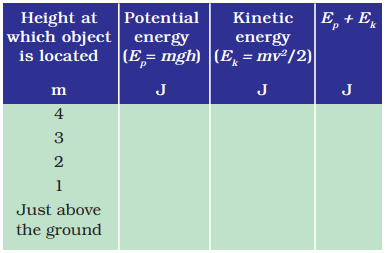
27. An object of mass 20 kg is dropped from a height of 4 m. Fill in the blanks in the following table by computing the potential energy and kinetic energy in each case. For simplifying the calculations, take
the value of g as 10 m s–2.
Ans.
| Height (m) | Potential Energy (J) | Kinetic Energy (J) | Total Energy (J) |
|---|---|---|---|
| 4 | 800 | 0 | 800 |
| 3 | 600 | 200 | 800 |
| 2 | 400 | 400 | 800 |
| 1 | 200 | 600 | 800 |
| Just above ground | 0 | 800 | 800 |
28. The potential energy of a freely falling object decreases progressively. Does this violate the law of conservation of energy? Why?
Ans. No, it does not violate the law of conservation of energy.
As a freely falling object falls, its potential energy decreases, but at the same time its kinetic energy increases. The loss of potential energy is equal to the gain in kinetic energy. Therefore, the total energy (potential energy + kinetic energy) remains constant.
Thus, energy is not destroyed; it is only converted from potential energy to kinetic energy, so the law of conservation of energy is not violated.
29. An object of mass 40 kg is raised to a height of 5 m above the ground. What is its potential energy? If the object is allowed to fall, find its kinetic energy when it is half-way down.
Ans. Given:
- Mass, m=40 kg
- Height, h=5 m
- Take g=10 m s−2
Potential Energy = mgh = 40×10×5 = 2000 J.
At half-way down, PE = mgh = 40 x 10 x 2.5 = 1000 J
At half-way down, total Mechanical Energy = 2000 J
Therefore, at half-way down, KE = 2000 - 1000 = 1000 J.
30. Illustrate the law of conservation of energy by discussing the energy changes which occur when we draw a pendulum bob to one side and allow it to oscillate. Why does the bob eventually come to rest What happens to its energy eventually? Is it a violation of the law of conservation of energy?
Ans. Energy changes during motion:

- At the extreme position, the bob is at the highest point.
- Potential energy is maximum
- Kinetic energy is zero (because velocity is zero)
- As the bob moves towards the mean position,
- Potential energy decreases
- Kinetic energy increases
- At the mean position,
- Kinetic energy is maximum
- Potential energy is minimum
- As the bob moves to the other extreme position,
- Kinetic energy decreases
- Potential energy increases again
Throughout the motion, the sum of potential energy and kinetic energy remains constant, showing that energy is only converted from one form to another.
The bob eventually comes to rest due to air resistance and friction, which convert mechanical energy into heat and sound energy. This does not violate the law of conservation of energy, because energy is only transformed, not destroyed.
31. A freely falling object eventually stops on reaching the ground. What happenes to its kinetic energy?
Ans. When a freely falling object reaches the ground, it stops, so its kinetic energy becomes zero.
The kinetic energy the object had while falling is transferred to the ground and surroundings in the form of:
- Heat (due to impact)
- Sound energy (the thud when it hits)
- Deformation energy (if the object or ground gets slightly deformed)
So, the kinetic energy is not lost; it is transformed into other forms of energy, which is consistent with the law of conservation of energy.
32. Define:
- i. Power
- ii. 1 W of Power
- iii. Average Power
Ans. i. Power is the rate of doing work or rate of energy transfer.
ii. 1 W of power = 1 joule of work done per second (1 J/s)
iii. If power varies with time, average power is:
Average power= Total energy consumed/Total time taken
33. Two girls, each of weight 400 N climb up a rope through a height of 8m. We name one of the girls A and the other B. Girl A takes 20 s while B takes 50 s to accomplish this task. What is the power expended by each girl?
Ans. Girl A: 400 N weight, 8 m height, 20 s → P=400×8/20=160W
Girl B: Same weight, same height, 50 s →P=400×8/50=64W.
34. A boy of mass 50 kg runs up a staircase of 45 steps in 9 s. If the height of each step is 15 cm, find his power. Take g = 10 m s–2.
Ans. Mass = 50 kg
Force = mg = 50 x 10 = 500 N
Displacement = 45 × 0.15 m = 6.75 m
Time = 9 s
P=500×6.75/9=375W
35. A certain household has consumed 250 units of energy during a month. How much energy is this in joules?
Ans. We know: 1 unit = 3.6 x 10⁶ J
⇒ 250 units = 250 x 3.6 x 106 J = 9×10⁸ J.
36. An electric heater is rated 1500 W. How much energy does it use in 10 hours?
Ans. P= W/t
⇒ W = P x t = 1500 x 10 x 60 x 60 = 5.4×10⁷J.
37. Find the energy in joules consumed in 10 hours by four devices of power 500 W each.
Ans. P= W/t
⇒ W = P x t = 4 x 500 x 10 x 60 x 60 = 72000000 J = 7.2 x 10⁷ J.
Also See:
- Canvas of Soil Class 9 English Questions and Answers (Kaveri)
- Winds of Change Class 9 Questions and Answers | Kaveri English Chapter 3
- Cell The Building Block of Life Class 9 Notes | CBSE Science Chapter 2
- Cell The Building Block of Life Class 9 Questions and Answers | NCERT Exploration Chapter 2
- Gifts of Grace Honouring Our Vocations Class 9 Question Answers | Kaveri
- The Pot Maker Class 9 Questions and Answers | NCERT Kaveri English Chapter 2
- Bharat Our Land Question Answers Class 9 English | NCERT Solutions (Kaveri Book)
- How I Taught My Grandmother to Read Class 9 Questions and Answers | NCERT Kaveri
- New Subjects in CBSE Class 9 & 10 (2026-27): Full List & Details
- CBSE 3 Language Formula Explained (R1, R2, R3) – New Rules 2026-27
Mastering Work and Energy requires a clear understanding of concepts such as work done, kinetic energy, potential energy, and the law of conservation of energy. The important questions and answers provided in this post will help students revise the chapter systematically and score better in exams. Students are advised to practice numericals regularly and revise the formulas thoroughly. For best results, revise this chapter multiple times and solve NCERT examples along with these important questions before the exam.
Related posts:
 Matter in Our Surroundings Class 9 Important Questions
Is Matter Around Us Pure? Class 9 Important Questions
The Fundamental Unit of Life (Class 9) Important Questions
Science Class 9 Important Questions
Motion Class 9 Science Important Questions
Force and Laws of Motion Class 9 Important Questions
Gravitation Class 9 Important Questions
Matter in Our Surroundings Class 9 Important Questions
Is Matter Around Us Pure? Class 9 Important Questions
The Fundamental Unit of Life (Class 9) Important Questions
Science Class 9 Important Questions
Motion Class 9 Science Important Questions
Force and Laws of Motion Class 9 Important Questions
Gravitation Class 9 Important Questions
 Atoms and Molecules Class 9 – Most Important Questions and Answers