The Central Board of Secondary Education (CBSE) has released the latest Class 9 Social Science (SST) syllabus for the academic session 2026-27. However, many students and parents find the official syllabus difficult to understand because it is presented in curriculum terminology such as themes, competencies, and learning outcomes.
To make things easier, we have simplified the entire CBSE Class 9 SST syllabus and explained every topic in student-friendly language. This guide will help you understand exactly what you need to study throughout the year.
Overview of CBSE Class 9 SST Syllabus 2026-27
The Class 9 CBSE syllabus for Social Science (SST) is crucial for board exams and sets the foundation for higher classes. The 2026-27 syllabus includes competency-based questions, increased focus on application-based learning, and internal assessments.
| Board | CBSE |
| Class | 9 |
| Session | 2026-27 |
| Subject | SST |
| Books | NCERT Social Science Part 1 and 2 |
| Content-Type | Syllabus/Curriculum |
| Official Website | https://cbseacademic.nic.in |
CBSE Class 9 Social Science Syllabus (2026-27)
Total Marks: 80 (Theory) + 20 (Internal Assessment) = 100 Marks
The syllabus is divided into two parts and includes topics from:
- Geography
- History
- Political Science
- Economics
Part 1 Syllabus
1. Understanding Social Science
This introductory unit helps students understand:
- What Social Science is
- Why Social Science is important
- Scope of Geography, History, Political Science and Economics
- Relationship between society, environment, economy and governance
- Values such as diversity, inclusiveness, sustainability and equality
What You Will Learn
You will understand how different social science subjects are connected and why studying society is important in everyday life.
2. Shaping of the Earth's Surface
Topics Covered
- Plate Tectonic Theory
- Interior of the Earth
- Weathering and Erosion
- Rivers, Winds, Glaciers and Underground Water
- Formation of Landforms
- Earthquakes
- Landslides
- Avalanches
- Glacial Lake Outburst Floods (GLOF)
- Dust Storms
What You Will Learn
- How continents and tectonic plates move
- How mountains, valleys and other landforms are formed
- Causes of earthquakes and landslides
- Disaster mitigation measures
3. Atmosphere and Climate
Topics Covered
- Structure of the Atmosphere
- Composition of the Atmosphere
- Weather and Climate
- Indian Seasons
- Monsoon
- Climate Change
- Floods
- Carbon Footprint
What You Will Learn
- Different layers of the atmosphere
- How monsoons affect India
- Causes and effects of climate change
- Understanding climatic data through graphs and charts
4. Early Humans and Beginning of Civilisation
Topics Covered
- Human evolution
- Archaeological Ages
- Human Ancestors
- Palaeolithic Age
- Mesolithic Age
- Neolithic Revolution
- Beginning of Agriculture
- Domestication of Plants and Animals
- Harappan Civilization
- Mesopotamian Civilization
- Egyptian Civilization
- Chinese Civilization
What You Will Learn
- How humans lived before written records
- Transition from hunting-gathering to farming
- Development of early cities and civilizations
- Trade, crafts and cultural diversity
5. State and Society (Up to 1000 CE)
Topics Covered
- Vedic Age
- Vedic Society and Political Institutions
- Administrative Structure of Early Empires
- Ancient Indian Education System
- Knowledge Traditions
- Traders and Trade Routes
- Guilds and Merchants
- Crafts and Industries
What You Will Learn
- Features of Vedic society
- Development of early Indian empires
- Ancient Indian education and knowledge systems
- Growth of trade and commerce
6. Democracy
Topics Covered
- Meaning of Democracy
- Features of Democracy
- Types of Democracy
- Roots of Democracy in India
- Challenges to Democracy
- Democratic Systems Around the World
What You Will Learn
- Key principles of democracy
- India's democratic traditions
- Parliamentary and Presidential systems
- Democratic practices in different countries
7. Elections
Topics Covered
- Importance of Elections
- Electoral Systems
- Delimitation Commission
- Election Commission of India
- Constituencies
- Electoral Rolls
- Enumerators
- Party System in India
- Coalition Government
- Anti-Defection Law
What You Will Learn
- How elections are conducted in India
- Role of the Election Commission
- Political parties and coalition governments
- Electoral laws and processes
8. Building Blocks in Economics
Topics Covered
- Scarcity of Resources
- Choice and Opportunity Cost
- What Economists Do
- What to Produce
- How to Produce
- For Whom to Produce
- Market Economy
- Planned Economy
- Mixed Economy
- Welfare Economy
What You Will Learn
- Why resources are limited
- Economic decision-making
- Different economic systems
- Importance of welfare measures
9. The Price Puzzle: What Drives the Market
Topics Covered
- Law of Demand
- Law of Supply
- Market Equilibrium
- Price Ceilings
- Shortages and Surpluses
- Market Failures
- Externalities
- Information Asymmetry
- Public Goods
What You Will Learn
- How prices are determined
- Demand and supply relationship
- Reasons behind market failures
- Government intervention in markets
Part 2 Syllabus
10. Oceans and Life
Topics Covered
- Ocean Relief Features
- Waves
- Tides
- Ocean Currents
- Marine Resources
- Navigation
- Fishing and Livelihoods
- Cyclones
- Tsunamis
- Early Warning Systems
- Maritime Rules and Regulations
What You Will Learn
- Movement of ocean water
- Importance of marine resources
- Impact of oceans on climate
- Disaster preparedness and management
11. Life on Earth
Topics Covered
- Biomes
- Biosphere Reserves
- Forests
- Ecotourism
- Forest Dwellers
- Wildlife Conservation
- Government Initiatives
What You Will Learn
- Major biomes of the world
- Biodiversity conservation
- Sustainable tourism
- Forest ecosystem management
12. Resistance and Resilience (1000 CE–1700 CE)
Topics Covered
- Resistance Movements
- Alliances and Confederacies
- Regional Kingdoms
- Art and Architecture
- Languages and Literature
- Bhakti Tradition
- Forts and Fortifications
- Economic Expansion
What You Will Learn
- Contributions of regional kingdoms
- Cultural developments in medieval India
- Importance of forts and defense systems
- Continuity of Indian civilization
13. India and the World-I (1900 BCE–1200 CE)
Topics Covered
- Trade with Mesopotamia
- Trade with Greece and Rome
- Trade with China
- Trade with Southeast Asia
- Cultural Exchanges
- Indian Knowledge Systems
- Mathematics
- Astronomy
- Medicine
- Religion
What You Will Learn
- India's global connections in ancient times
- Trade routes and major ports
- Spread of Indian culture abroad
- Contributions of India to world knowledge
14. Authority
Topics Covered
- Kautilya's Ideas on Authority
- Shukraniti
- Danda and Nyaya
- Justice and Security
- Democratic Institutions
- Types of Authority
- Role of Citizens
What You Will Learn
- Foundations of authority in Indian thought
- Relationship between justice and governance
- Citizen responsibilities in democracy
- Different forms of authority
15. From Ideas to Startups
Topics Covered
- Entrepreneurship
- Resources Required for Business
- Successful Entrepreneur Case Studies
- Creative Destruction
- Startup Ecosystem in India
- Make in India
- MSMEs
- Unorganised Sector
- Business Plans
- Basic Accounting Concepts
What You Will Learn
- How businesses are started
- Importance of entrepreneurship
- India's startup ecosystem
- Basic business and accounting concepts
16. Smart Ways to Manage Your Finances
Topics Covered
- Personal Financial Management
- Inflation
- Purchasing Power
- Simple Interest
- Compound Interest
- Budgeting
- Savings Options
- Fixed Deposits
- Stocks
- Bonds
- Mutual Funds
- Insurance
- Income Tax
What You Will Learn
- Managing money effectively
- Importance of saving and investing
- Understanding risk and return
- Basics of taxation and insurance
CBSE Class 9 SST Internal Assessment 2026-27
The Internal Assessment carries 20 marks.
| Assessment Type | Marks |
|---|---|
| Periodic Test | 5 |
| Multiple Assessment | 5 |
| Subject Enrichment Activity (Project Work) | 5 |
| Portfolio | 5 |
| Total | 20 |
Activities may include:
- Quizzes
- Debates
- Viva
- Group Discussions
- Project Work
- Field Visit Reports
- Concept Maps
- Visual Presentations
- Peer Assessment
Prescribed Books (NCERT)
- Social Science-Part 1
- Social Science-Part 2
Best Study Tips for CBSE Class 9 SST
- Balance the Subjects: Divide study time equally among History, Geography, Political Science, and Economics (20 marks each), with extra focus on weaker areas.
- Daily Revision: Spend 1-2 hours daily—30 minutes per subject, plus 15-20 minutes on map work.
- Stick to NCERT: Use NCERT textbooks as your primary resource—they cover the full syllabus and align with exam questions.
- Map Practice: Master 5-10 map items daily for 5 easy marks.
- Sample Papers: Solve past papers to get used to question types (MCQs, long answers) and manage 3 hours effectively.
Download CBSE Class 9 SST Syllabus 2026-27 PDF
Click the button below to download the official CBSE syllabus PDF for 2026-27.
📂 Download CBSE Class 9 SST Syllabus PDF
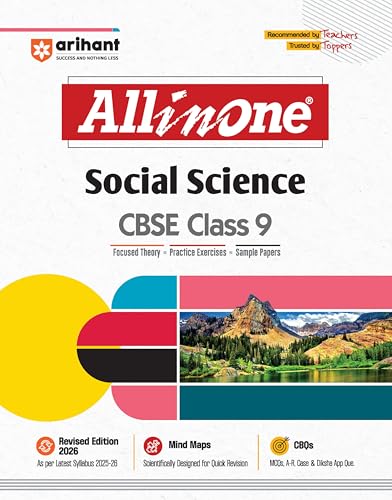
Best Books for CBSE Class 9
Related Guides
CBSE Class 9 English Syllabus 2026-27
CBSE Class 9 Maths Syllabus 2026-27
CBSE Class 9 Computer Applications Syllabus 2026-27
CBSE Class 9 Science Syllabus 2026-27
CBSE Class 9 Hindi R1 Syllabus 2026-27
CBSE Class 9 Hindi R2 Syllabus 2026-27
Stay Updated!
Join our Telegram/WhatsApp group for CBSE updates, free notes, and exam tips!
Bookmark this page & keep revising smartly!
Frequently Asked Questions
Has the CBSE Class 9 Social Science syllabus changed for 2026-27?
Yes. CBSE has introduced a revised Social Science syllabus for Class 9 for the 2026-27 academic session. The new syllabus includes topics such as entrepreneurship, personal finance, authority, climate change, financial literacy, and startups, along with Geography, History, Political Science, and Economics.
How many chapters are there in the CBSE Class 9 SST syllabus 2026-27?
The syllabus is divided into 16 major themes across two parts. These themes cover Geography, History, Political Science, and Economics and are further divided into multiple subtopics.
Is the entire SST syllabus coming in the annual examination?
Students should follow the syllabus and exam guidelines issued by their school and CBSE. Typically, schools may conduct periodic tests on selected portions, while the annual examination covers the prescribed syllabus taught during the academic year.
Which book should I study for the Class 9 SST syllabus 2026-27?
CBSE has prescribed:
NCERT Social Science Part 1
NCERT Social Science Part 2
Students should primarily focus on NCERT textbooks because CBSE examination questions are based on the prescribed curriculum.
How can I complete the entire Class 9 SST syllabus before exams?
A practical approach is:
Complete NCERT reading chapter by chapter.
Make short notes for every topic.
Practice maps and diagrams regularly.
Revise one subject every week.
Solve sample papers and previous school exam papers.
Consistent revision is more effective than last-minute preparation.
Related posts:
 CBSE Class 9 Maths Syllabus 2026-27: Download PDF & Full Exam Pattern
 CBSE Class 9 Science Syllabus 2026-27: Download PDF & Full Exam Pattern
 CBSE Class 9 English Syllabus 2026-27: Download PDF & Full Exam Pattern
 CBSE Class 9 Hindi Course A (R-1) Syllabus 2026-27: Download PDF & Full Exam Pattern
 CBSE Class 9 Hindi Course B (R-2) Syllabus 2026-27: Download PDF & Full Exam Pattern
 CBSE Class 9 Computer Applications Syllabus 2026-27: Download PDF & Full Exam Pattern
 CBSE 3 Language Formula Explained (R1, R2, R3) – New Rules 2026-27
 Top 15 Major Changes in CBSE Class 9 Curriculum 2026-27