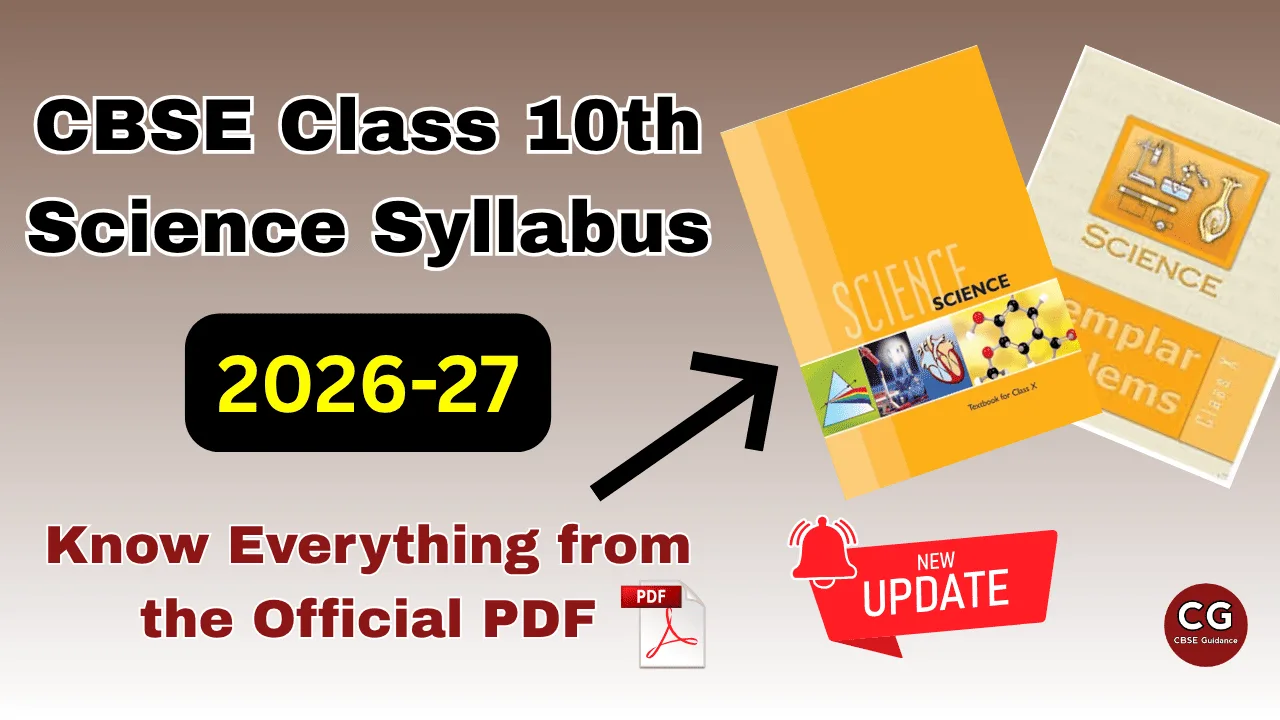
Latest CBSE Class 10 Science Syllabus 2026-27 – Get the official syllabus with a chapter-wise breakdown, marking scheme, and expert study tips. Download the official PDF at the end!
Overview of CBSE Class 10 Science Syllabus 2026-27
The Class 10 CBSE syllabus for Science is crucial for board exams and sets the foundation for higher classes. The 2026-27 syllabus includes competency-based questions, increased focus on application-based learning, and internal assessments.
| Board | CBSE |
| Class | 10 |
| Session | 2026-27 |
| Subject | Science |
| Content-Type | Syllabus/Curriculum |
| Official Website | https://cbseacademic.nic.in |
Course Structure: Class X (2026-27)
Annual Examination
Time: 3 Hours
Total Marks: 80 (Theory) + 20 (Internal Assessment) = 100
| Unit No. | Unit Name | Marks |
|---|---|---|
| I | Chemical Substances - Nature and Behaviour | 25 |
| II | World of Living | 25 |
| III | Natural Phenomena | 12 |
| IV | Effects of Current | 13 |
| V | Natural Resources | 05 |
| Total | 80 | |
| Internal Assessment | 20 | |
| Grand Total | 100 |
Detailed Syllabus
Theme 1: Materials
Unit I: Chemical Substances – Nature and Behaviour
1. Chemical Reactions and Equations
- Chemical reactions & writing chemical equations
- Balanced chemical equations
- Types of reactions:
- Combination reaction
- Decomposition reaction
- Displacement reaction
- Double displacement reaction
- Precipitation reaction
- Endothermic & exothermic reactions
- Oxidation and reduction
2. Acids, Bases and Salts
- Definitions:
- Acids → produce H⁺ ions
- Bases → produce OH⁻ ions
- Identification using indicators
- Chemical properties, examples, and uses
- Neutralization reaction
- pH scale (basic idea only, no logarithms)
- Importance of pH in everyday life
Important Compounds (Preparation, Properties & Uses):
- Sodium Hydroxide (NaOH)
- Bleaching Powder
- Baking Soda (NaHCO₃)
- Washing Soda (Na₂CO₃·10H₂O)
- Plaster of Paris (CaSO₄·½H₂O)
3. Metals and Non-metals
- Physical and chemical properties
- Reactivity series
- Ionic compounds:
- Formation
- Properties
- Basic metallurgical processes
- Corrosion and its prevention
4. Carbon and Its Compounds
- Covalent bonding:
- Formation
- Properties
- Versatile nature of carbon
- Hydrocarbons:
- Saturated (alkanes)
- Unsaturated (alkenes, alkynes)
- Homologous series
Nomenclature:
- Alkanes, alkenes, alkynes
- Functional groups:
- Halogens
- Alcohols
- Aldehydes
- Ketones
Chemical Properties:
- Combustion
- Oxidation
- Addition reactions
- Substitution reactions
Important Compounds:
- Ethanol (properties & uses)
- Ethanoic acid (properties & uses)
- Soaps and detergents
Theme 2: The World of the Living
Unit II: World of Living
1. Life Processes
- Concept of living beings
- Basic processes:
- Nutrition
- Respiration
- Transport
- Excretion (in plants and animals)
2. Control and Coordination
In Plants:
- Tropic movements
- Plant hormones (introduction)
In Animals:
- Nervous system
- Types of actions:
- Voluntary
- Involuntary
- Reflex actions
- Chemical coordination:
- Animal hormones
3. Reproduction
- In plants and animals:
- Asexual reproduction
- Sexual reproduction
- Reproductive health:
- Importance of family planning
- Safe sex vs HIV/AIDS
- Women’s health & childbearing
4. Heredity
- Basic concept of heredity
- Mendel’s laws of inheritance
- Sex determination (introductory level)
Theme 3: Natural Phenomena
Unit III: Light
1. Reflection of Light
- Reflection by curved surfaces
- Spherical mirrors:
- Centre of curvature
- Principal axis
- Principal focus
- Focal length
- Mirror formula (no derivation)
- Magnification
2. Refraction of Light
- Laws of refraction
- Refractive index
3. Lenses
- Refraction through spherical lenses
- Image formation
- Lens formula (no derivation)
- Magnification
- Power of a lens
4. Human Eye & Optical Phenomena
- Structure and functioning of the human eye
- Defects of vision and correction
- Applications of mirrors and lenses
5. Optical Effects
- Refraction through prism
- Dispersion of light
- Scattering of light
- Applications in daily life
Theme 4: How Things Work
Unit IV: Effects of Current
1. Electricity
- Electric current & potential difference
- Ohm’s Law
- Resistance & resistivity
- Factors affecting resistance
2. Electric Circuits
- Series combination of resistors
- Parallel combination of resistors
- Applications in daily life
3. Heating Effect of Current
- Heating effect
- Applications (e.g., heaters, irons)
4. Electric Power
- Relationship between:
- Power (P)
- Voltage (V)
- Current (I)
- Resistance (R)
5. Magnetic Effects of Current
- Magnetic field & field lines
- Field due to:
- Current-carrying conductor
- Coil/solenoid
- Force on conductor
- Fleming’s Left Hand Rule
6. AC and DC
- Direct current (DC)
- Alternating current (AC)
- Frequency of AC
- Advantages of AC over DC
7. Domestic Electric Circuits
- Household wiring basics
- Safety measures
Theme 5: Natural Resources
Unit V: Environment
1. Our Environment
- Ecosystem
- Environmental problems
- Ozone layer depletion
2. Waste Management
- Waste production
- Solutions
- Biodegradable vs non-biodegradable substances
Practicals
Practical work goes hand-in-hand with theory lessons. Here’s the list of experiments:
- pH Testing: Test pH of HCl, NaOH, Ethanoic acid, Lemon juice, Water, etc.
- Properties of Acids/Bases: Reactions with litmus, zinc, sodium carbonate.
- Types of Reactions: Combination, Decomposition, Displacement, Double Displacement.
- Reactivity Series: Zn, Fe, Cu, Al with salt solutions.
- Ohm’s Law: Voltage vs. Current graph, Resistance.
- Resistors: Series and Parallel combinations.
- Stomata: Temporary leaf peel mount.
- Respiration: Show CO₂ release.
- Ethanoic Acid Properties: Odour, solubility, litmus test, reaction with NaHCO₃.
- Soap Cleaning: Soft vs. Hard water.
- Focal Length: Concave mirror and Convex lens.
- Refraction: Light through a glass slab.
- Reproduction: Binary fission (Amoeba), Budding (Yeast, Hydra).
- Prism: Path of light.
- Dicot Seed: Identify embryo parts (e.g., pea).
Question Paper Design (Theory)
Total Marks: 80
| Competency | Percentage |
|---|---|
| Knowledge and Understanding | 50% |
| Application of Knowledge | 30% |
| Analyze, Evaluate, Create | 20% |
- Question Types: Objective (MCQs), Assertion-Reasoning, Short Answer (SA), Long Answer (LA), Case-based questions.
- Internal Choice: About 33% of the paper.
Internal Assessment (20 Marks)
- Periodic Tests: 5 + 5 = 10 marks
- Practical Work: 5 marks
- Portfolio: 5 marks
Prescribed Books
- Science Textbooks (Class X) – NCERT
- Laboratory Manuals (Class X) – NCERT
- Exemplar Problems (Class X) – NCERT
- Assessment of Practical Skills (Class X) – CBSE
Best Study Tips for CBSE Class 10 Science
Stick to NCERT – Most board exam questions are from NCERT.
Understand Key Concepts – Focus on clarity, not just memorization.
Solve PYQs – Practice previous year questions for pattern insights.
Revise Regularly – Make quick notes for last-minute revision.
Bonus: CBSE Class 10 Science Important Questions & Answers
Download CBSE Class 10 Science Syllabus 2026-27 PDF
Click the button below to download the official CBSE syllabus PDF for 2026-27.
📂 Download CBSE Class 10 Science Syllabus PDF
🔍 Related Guides
- CBSE Class 10 English Language & Literature Syllabus 2026-27
- CBSE Class 10 Mathematics Syllabus 2026-27
- CBSE Class 10 Social Science Syllabus 2026-27
Stay Updated!
Join our Telegram/WhatsApp group for CBSE updates, free notes, and exam tips!
Bookmark this page & keep revising smartly!
Frequently Asked Questions (FAQs)
Are practicals mandatory for Class 10 Science?
Yes, practicals are a key part of the syllabus and should be conducted alongside theory classes. They contribute 5 marks to the internal assessment through subject enrichment activities.
Is there anything in the NCERT textbook that won’t be tested?
Yes, information in the boxes within NCERT textbooks is for conceptual clarity and won’t be assessed in the final exam.
What books should I use to prepare for Class 10 Science?
Recommended books include:
NCERT Science Textbooks (Class X)
NCERT Laboratory Manuals (Class X)
NCERT Exemplar Problems (Class X)
CBSE Assessment of Practical Skills (Class X).
What are competency-based questions in Class 10 CBSE 2026 syllabus?
These are application-based questions like case studies, MCQs, and assertion-reasoning questions.
Related posts:
 CBSE Class 10 SST Syllabus 2025-26: Download PDF & Full Exam Pattern
 CBSE Class 10 Hindi A Syllabus 2025-26: Download PDF & Full Exam Pattern
 CBSE Class 10 Hindi B Syllabus 2025-26: Download PDF & Full Exam Pattern
 CBSE Class 10 Computer Applications Syllabus 2025-26: Download PDF & Full Exam Pattern
 CBSE Class 10 English Syllabus 2026-27: Download PDF & Full Exam Pattern
 CBSE Class 10 Maths Syllabus 2026-27: Download PDF & Full Exam Pattern
 CBSE Class 10 Maths Syllabus 2025-26: Download PDF & Full Exam Pattern
 CBSE Class 10 Science Syllabus 2025-26: Download PDF & Full Exam Pattern