You can study for months, solve sample papers, and still walk out of your CBSE Board Exam 2026 feeling confident, and yet lose marks because of something painfully avoidable: how you filled your OMR sheet or wrote in your answer sheet.
This is not “extra advice” or a small formality. In board exams, your answers don’t only depend on what you know; they also depend on whether your responses are scannable (for OMR) and easy to evaluate (for the answer booklet).
A single wrong bubble in the booklet code, a half-filled circle, writing answers in the wrong place, or confusing question numbering can create errors you won’t get a chance to fix later. This guide is written as a one-page, exam-day-ready manual so you can protect your marks and avoid the most common mistakes students make under pressure.
OMR Sheet vs Answer Sheet: What Is Checked by Machine vs Human?
Before you learn the rules, understand how CBSE evaluates different parts of your paper:
OMR Sheet (Machine Scanned)
OMR stands for Optical Mark Recognition. Your answers are read by a scanner, not a person. That means:
- The scanner does not “understand your intention”
- It only detects clean, dark, correctly placed marks
- It can treat stray marks as responses or reject unclear markings
Answer Sheet / Main Answer Booklet (Human Checked)
Your long answers are checked by an examiner. Here:
- Presentation matters
- Steps and logic matter
- Wrong numbering or wrong placement can reduce marks even if your content is correct
Simple takeaway: OMR needs precision. The answer sheet needs clarity and structure.
CBSE Board Exam 2026 OMR Sheet Filling Rules (Step-by-Step)
1) Use only a Blue or Black Ballpoint Pen
For OMR sheets, you must use:
- Blue or black ballpoint pen only
Avoid:
- Gel pens (smudging risk)
- Fountain/ink pens (bleeding risk)
- Pencil (not accepted)
- Marker/sketch pen (too thick)
Why this matters: OMR scanners detect marks based on darkness and shape. Smudged ink or light shading can confuse the scanner, leading to incorrect readings.
2) Fill Candidate Details Like It’s a Legal Document
Many students treat this as a formality. It isn’t. Incorrect details can create identity mismatches.
You may need to fill out or verify:
- Roll number
- Subject code
- Centre number
- Question paper set / booklet code
- Name (sometimes)
- Signature
Golden rule
Fill in these details before you start answering. Because later, when you’re stressed or short on time, you’re more likely to make mistakes.
3) The Booklet Code Mistake That Can Cost You Marks
This is one of the most dangerous errors.
Your question paper usually has a set code/booklet code, such as:
- A / B / C / D
or - 01 / 02 / 03 / 04
(or another printed code)
You must fill in the same code correctly on your OMR.
Common student mistakes
- Copying the code from someone else
- Assuming everyone has the same set
- Filling the wrong bubble in a hurry
- Leaving the code blank
Why it matters: The answer key mapping can differ by set. If your booklet code is wrong, your correct answers can be evaluated against the wrong key.
4) How to Mark Answers Properly (Only One Correct Method)
For each MCQ:
Correct method:
- Darken only one bubble
- Fill it fully
- Keep it inside the circle
- Make it dark and clean
Wrong methods:
- Tick mark
- Cross mark
- Half-filled bubble
- Circle outline only
- Dot in the middle
- Two options marked “lightly”
If you mark two bubbles
Even if one is correct, scanners usually treat it as:
multiple response → invalid → 0 marks
5) Avoid Stray Marks and Sheet Damage
Do not:
- Scribble on the side
- Do rough work on the OMR
- Test your pen on the OMR
- Fold, crumple, tear, staple, or wrinkle it
Why it matters: The scanner can read unintended marks as answers. Physical damage can also affect scanning accuracy.
6) Can You Change an OMR Answer? (Reality Check)
In most board exam settings, you should assume: Once marked, it cannot be changed safely.
Do not:
- Scratch the bubble
- Use whitener
- Overwrite
- Try to “cancel” a marked option
Even if it looks corrected to you, the scanner may still read it as marked.
If you accidentally mark the wrong option:
Inform the invigilator immediately and follow instructions. Do not assume a replacement sheet will be given.
7) Smart Time Strategy for OMR (To Avoid Last-Minute Panic)
Most bubbling mistakes happen in the last 10 minutes. Use a strategy that keeps you in control.
Method A (Best for most students)
- Solve questions on the question paper first
- Circle your chosen options lightly on the paper
- Fill OMR after every 5–10 questions
This reduces misalignment between the question number and the bubble.
Method B (Best if you mis-copy often)
- Solve and fill OMR immediately question-by-question
- Stay extremely alert for question numbering
Never leave OMR filling for the last 2 minutes.
That’s where most students lose marks due to a mismatch.
CBSE Sample OMR Sheet for Class X and XII:
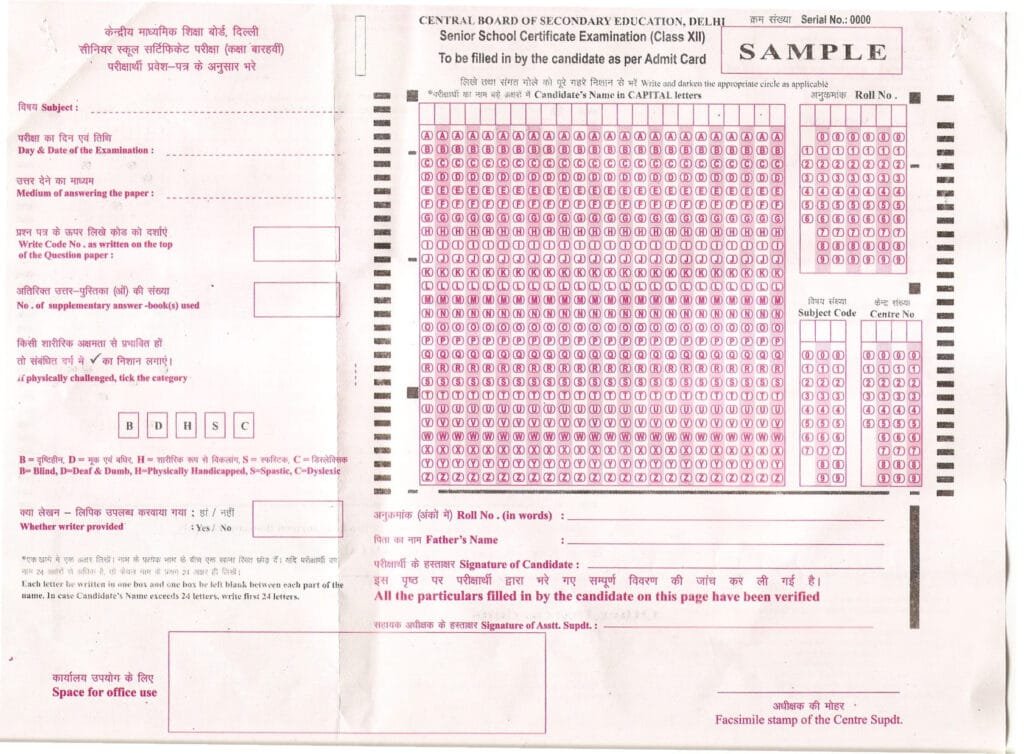
CBSE OMR Sheet Filled for Class X & XII
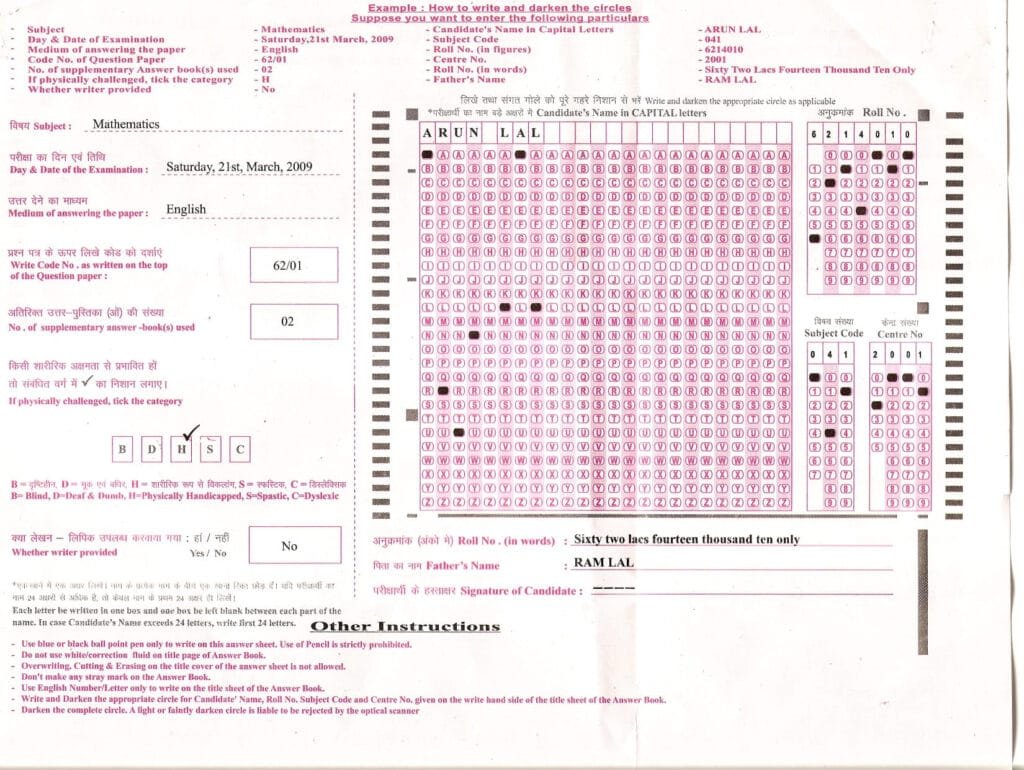
CBSE Sample OMR Sheet for Class 10 and 12 PDF Download: Click Here
CBSE Answer Sheet Filling Rules (Long Answers, Case Studies, Numericals)
1) Fill the First Page Details Neatly
Your answer booklet may have:
- Roll number
- Subject
- Set code
- Candidate signature
- Invigilator signature
Fill only what is required.
Do not write extra things like phone number, motivational quotes, or school details unless asked.
2) Question Numbering: The Biggest Reason Students Lose Marks
Even a correct answer can lose marks if the examiner can’t locate it properly.
Correct numbering format
Write exactly like the question paper:
- Q2 (a), Q2 (b), Q3, etc.
Mistakes to avoid
- Writing “2a” randomly without clarity
- Missing subparts
- Writing Q5 answer under Q6
- Mixing answers from different sections
Remember: Examiners check many copies quickly. Clear numbering helps them award marks accurately.
3) Write Answers in the Correct Section and Order
CBSE papers often have sections like:
- Section A: MCQs
- Section B: Short answers
- Section C: Long answers
- Section D: Case-based
- Section E: Competency-based
Follow the paper flow. Attempt answers in order unless you have a strong reason not to.
Important:
Do not write two answers for the same question “just in case” unless the paper clearly says to attempt both.
4) Presentation Rules That Actually Improve Marks
A good presentation makes your answer easy to check.
Use:
- Short paragraphs
- Bullet points where appropriate
- Headings for long answers
- Underlining keywords lightly
- Neat spacing between parts
Avoid:
- One huge paragraph for everything
- Too much overwriting
- Messy cancellations and repeated cutting
5) For Maths/Physics/Accounts: Never Skip Steps
Even if your final answer is wrong, you can still get step marks.
Best structure:
- Formula
- Substitution
- Calculation
- Final answer (boxed)
Also:
- Write units where required
- Keep calculations aligned so the examiner can follow your work
6) Diagrams, Maps, Graphs: Don’t Lose Easy Marks
If your subject needs diagrams or maps:
Do:
- Draw clearly (not tiny)
- Label neatly
- Mention the scale if required
- Use a pencil where allowed
Don’t:
- Leave diagrams unlabelled
- Draw unclear figures
- Skip titles like “Ray diagram” or “Circuit diagram” where relevant
7) Handling Extra Space the Right Way
If you finish an answer early:
- Don’t leave confusing blank gaps mid-answer
- Don’t write irrelevant filler lines to “look longer”
- If you leave a page unused (when required), draw a clean line across it
Never tear pages, fold the booklet, or damage it.
Common Mistakes to Avoid
| Mistake | What Happens |
| Using pencil/gel pen on OMR | Sheet may not scan properly |
| Marking two options | Question becomes invalid |
| Wrong roll number/booklet code | Identity mismatch or wrong evaluation |
| Stray marks on OMR | Scanner may misread responses |
| Wrong question numbering | Examiner may miss your answer |
| Skipping steps in numericals | You lose step marks |
| Writing answers in wrong section | Answer may not be evaluated properly |
Last 5-Minute Checklist Before Submission
OMR Checklist
- Roll number filled correctly
- Booklet/set code matched correctly
- One bubble per question only
- No stray marks
- OMR sheet not folded or torn
Answer Sheet Checklist
- Question numbering correct
- All parts attempted
- Final answers clearly written
- Steps shown in numericals
- Supplementary sheets attached properly (if used)
Also See:
- CBSE Class 10 2nd Board Datesheet 2026 Out – Check Exam Dates Now!
- CBSE Class 10 Result 2026 Expected Date Updates
- CBSE Class 12 English 2025 Topper Answer Sheet PDF Download: Essential Resources for 2026 Exam Prep
- CBSE Class 10 Second Board Exam 2026: Who is Eligible? (Official Rules)
- CBSE Board Exam 2026: Reporting Time, Gate Closing Time & Dress Code
Your Knowledge Deserves Safe Marks
You don’t lose marks only because you didn’t study. Sometimes, you lose marks because your answers didn’t reach the examiner or scanner in the correct format.
That’s the harsh truth of board exams, but also the best opportunity.
Because these mistakes are 100% preventable. If you fill your OMR with discipline, match your booklet code correctly, write answers with clean numbering, and present your steps clearly, you protect your marks before checking even begins.
So yes, revise chapters the day before the exam. But also revise this: how to write the paper like a topper.
Because in CBSE Board Exams 2026, the smartest students aren’t only the ones who know the answers, they’re the ones who make sure their answers are counted.
Related posts:
 CBSE Class 10 Passing Criteria: All You Need to Know (2025-26)
 What Happens If You Fail in One or More Subjects in CBSE Class 10?
 CBSE Academic Calendar 2025–26: Exam Dates, Holidays & Key Updates
 CBSE Class 12 Date Sheet 2026 Released: Revised Exam Schedule
 CBSE Clarifies How to Write Answers in 2026 Boards — Avoid This Costly Error
 CBSE Class 10 & 12 Admit Card 2026: Release Date, Download Link & Instructions
 What to Do After Class 10th – A Complete Guide for Students & Parents
 Half-Yearly Exams vs Pre-Boards – What’s the Difference & What Matters More?
ADiL