Latest CBSE Class 9 Maths Syllabus 2026-27 – Get the official syllabus with a chapter-wise breakdown, marking scheme, and expert study tips. Download the official PDF at the end!
The Central Board of Secondary Education (CBSE) has introduced a refreshed Mathematics curriculum for Class 9 for the academic session 2026-27. The new syllabus is designed to make mathematics more meaningful, activity-based, and connected to real life.
Unlike the traditional approach that focused mainly on memorising formulas and solving routine problems, the new curriculum encourages students to explore ideas, identify patterns, ask questions, and understand why mathematical concepts work.
This guide simplifies the official curriculum and explains everything students, parents, and teachers need to know.
Overview of CBSE Class 9 Maths Syllabus 2026-27
The Class 9 CBSE syllabus for Mathematics is crucial for board exams and sets the foundation for higher classes. The 2026-27 syllabus includes competency-based questions, increased focus on application-based learning, and internal assessments.
| Board | CBSE |
| Class | 9 |
| Session | 2026-27 |
| Subject | Maths |
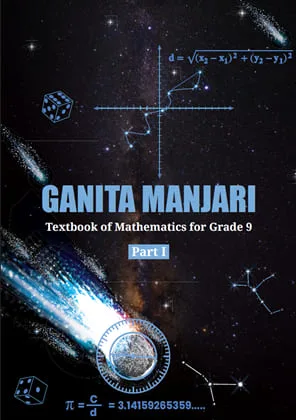
| Book Name | Ganita Manjari |
| Content-Type | Syllabus/Curriculum |
| Official Website | https://cbseacademic.nic.in |
CBSE Class 9 Mathematics Syllabus (2026-27)
Total Marks: 80
Exam Duration: 3 Hours
Unit-wise Marks Distribution
| Unit | Unit Name | Marks |
|---|---|---|
| I | Number Systems | 07 |
| II | Algebra | 20 |
| III | Coordinate Geometry | 04 |
| IV | Geometry | 25 |
| V | Mensuration | 14 |
| VI | Statistics and Probability | 10 |
| Total | 80 |
In addition to the written examination, students will also have 20 marks of Internal Assessment.
Internal Assessment Pattern
| Component | Marks |
| Pen Paper Test | 5 |
| Multiple Assessment | 5 |
| Portfolio | 5 |
| Lab Practical Activities | 5 |
| Total | 20 |
Students should understand that classroom participation, projects, and practical activities will now contribute to their overall performance.
Unit-wise Explanation
Unit 1: Number System
A. Number System
Topics Covered
- Rational numbers
- Representation on the number line
- Density of rational numbers
- Finding rational numbers between two numbers
- Decimal representation
- Introduction to irrational numbers
- Proof that √2 and √3 are irrational
- Square root spiral
What students should focus on
This unit builds a strong foundation for higher mathematics. Instead of simply learning definitions, students will understand how different types of numbers are connected and why irrational numbers exist.
Unit 2: Algebra
This is one of the largest sections of the syllabus.
A. Introduction to Polynomials
Students will learn:
- Algebraic expressions
- What is a polynomial
- Degree of a polynomial
- Linear polynomials
- Real-life applications
- Linear growth and decay
- Understanding slope and y-intercept
The emphasis is on recognising patterns and modelling everyday situations mathematically.
B. Sequences and Progressions
New concepts include:
- Understanding sequences
- General and recursive rules
- Arithmetic Progressions (AP)
- nth term of an AP
- Practical applications of AP
- Sum of first n natural numbers
- Geometric Progressions (GP)
- nth term of GP
- Applications in fractals
- Tower of Hanoi puzzle
This chapter introduces mathematical thinking through patterns and logical reasoning.
C. Exploring Algebraic Identities
Topics include:
- Revising algebraic identities
- Geometrical visualisation of identities
- Factorisation using identities
- Algebra tiles
- Simplifying rational expressions
- Discovering new identities
Students will not only memorise formulas but also understand how they are formed.
D. Linear Equations in Two Variables
Students will study:
- Real-life situations involving two variables
- Graphical representation
- Slope-intercept form
- Drawing graphs
- Pair of linear equations
- Graphical solutions
- Consistent and inconsistent solutions
- Substitution method
- Elimination method
This chapter connects algebra with graphs and problem-solving.
Unit 3: Coordinate Geometry
A. Coordinate Geometry
Topics include:
- History of coordinate geometry
- Cartesian plane
- Plotting points
- Distance between two points
- Midpoint formula
Students will learn how geometry and algebra work together.
Unit 4: Geometry
This is the highest-weightage unit carrying 25 marks.
A. Introduction to Euclid's Geometry
Students will explore:
- History of geometry
- Baudhayana's Sulbasutras
- Euclid's definitions
- Axioms and postulates
The curriculum also introduces the historical development of mathematical ideas.
B. Lines and Angles
Topics include:
- Rays and angles
- Angle measurement
- Intersecting lines
- Pairs of angles
- Theorems on intersecting and parallel lines
C. Triangles: Congruence Theorems
Students will study:
- Practical applications
- Conditions for congruence
- Theorems
- Converse of propositions
- Real-life problems
Proof-based learning becomes more important here.
D. Quadrilaterals
Topics include:
- Properties of parallelograms
- Theorems and proofs
- Midpoint theorem
- Central symmetry
E. Circles
Students will learn:
- Parts of a circle
- Chords and angles
- Perpendicular bisectors
- Distance of chords from the centre
- Angles subtended by arcs
- Cyclicity of points
The chapter combines practical understanding with geometric reasoning.
Unit 5: Mensuration (27 Periods)
A. Area and Perimeter
Topics include:
- Perimeter of different shapes
- Circumference of a circle
- Introduction to Pi and its irrationality
- Arc length
- Area of rectangles, triangles and parallelograms
- Heron's Formula
- Area of a circle
- Sector of a circle
- Brahmagupta's Formula
- Relationship between Heron's and Brahmagupta's formulas
Ancient Indian mathematical contributions are also highlighted.
B. Surface Area and Volume
Students will study:
- Spheres
- Hemispheres
- Right circular cones
The focus is on understanding and applying formulas.
Unit 6: Statistics and Probability (24 Periods)
A. Statistics
Topics include:
- Graphical representation of data
- Measures of central tendency
B. Introduction to Probability
Students will learn:
- Randomness
- Probability scale
- Empirical probability
- Experimental data
- Sample space
- Events
- Tree diagrams
- Probability tables
The syllabus encourages practical experiments instead of rote learning.
Question Paper Pattern
The board is heavily prioritizing understanding and application over rote learning. Here is how the 80-mark paper is designed:
| Typology of Questions | Skills Tested | Marks | Weightage |
| Remembering & Understanding | Recalling facts, terms, stating main ideas, interpreting concepts. | 43 | ~54% |
| Applying | Solving problems in new situations using acquired knowledge and rules. | 19 | ~24% |
| Analysing, Evaluating & Creating | Breaking down information, making judgments, finding evidence, proposing alternative solutions. | 18 | ~22% |
| Total | 80 | 100% |
New Philosophy of the NCERT Mathematics Book
The introduction to the new textbook sends a very important message.
Students are encouraged to:
- Think before looking at solutions
- Explore patterns
- Draw diagrams
- Discuss problems with classmates
- Learn through mistakes
- Develop mathematical reasoning
- Understand why concepts work instead of only learning procedures
The book also contains "Think and Reflect" questions to develop deeper understanding.
In simple words, the new curriculum wants students to become mathematical thinkers rather than formula learners.
Mathematics Advanced Level (Optional)
Students who choose the optional Advanced Mathematics pathway will also study:
- Sets
- Logarithms
- Relations and Functions
- Coordinate Geometry
- Combinatorics
- Exploring Some More Progressions
Assessment Pattern
- Additional 25-mark Board Examination
- Duration: 1 Hour
- Questions will be based entirely on Higher Order Thinking Skills (HOTS)
This option is intended for students who wish to study mathematics at a deeper level and may benefit those planning to pursue STEM-related careers.
Download Mathematics Advanced Class 9 Book PDF
Best Study Tips for CBSE Class 9 Maths
- Focus on understanding concepts instead of memorising formulas.
- Practice drawing graphs and geometric figures.
- Solve Think and Reflect questions seriously.
- Discuss difficult problems with friends and teachers.
- Learn proofs step by step.
- Practice application-based questions regularly.
Download CBSE Class 9 Maths Syllabus 2026-27 PDF
Click the button below to download the official CBSE syllabus PDF for 2026-27.
📂 Download CBSE Class 9 Maths Syllabus PDF
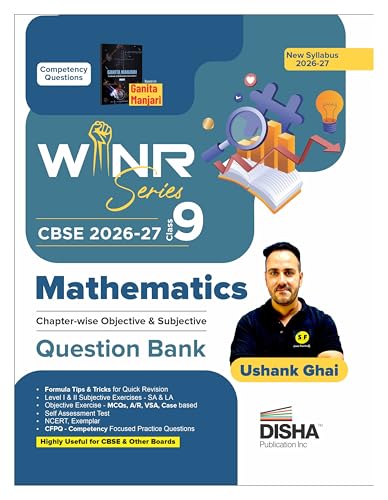
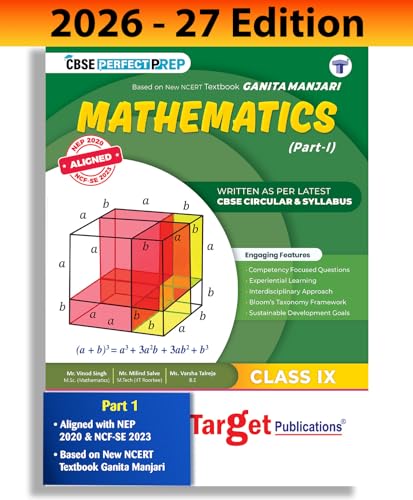
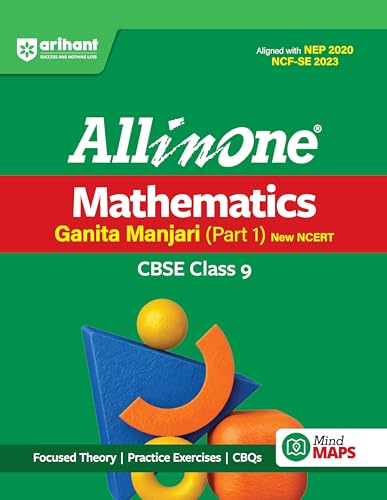
Best Books for CBSE Class 9 Maths
Related Guides
CBSE Class 9 English R1 and R2 Syllabus 2026-27
CBSE Class 9 Computer Applications Syllabus 2026-27
CBSE Class 9 Science Syllabus 2026-27
CBSE Class 9 Hindi R1 Syllabus 2026-27
CBSE Class 9 Hindi R2 Syllabus 2026-27
CBSE Class 9 SST Syllabus 2026-27
Stay Updated!
Join our Telegram/WhatsApp group for CBSE updates, free notes, and exam tips!
Bookmark this page & keep revising smartly!
Frequently Asked Questions
What topics are included in Number Systems?
It covers: Rational numbers
Representation on the number line
Density of rational numbers
Finding rational numbers between two numbers
Decimal representation
Introduction to irrational numbers
Proof that √2 and √3 are irrational
Square root spiral
How much weightage does application-based questions have?
Application questions carry 19 marks (24%), testing real-life problem-solving skills.
Is the NCERT textbook enough for preparation?
Yes, the NCERT Class 9 Maths book Ganita Manjari covers the entire syllabus and is sufficient for scoring well.
How much time should I spend daily on Maths?
Spend 1-2 hours daily—split between revising concepts (30 minutes) and solving problems (1 hour).
Related posts:
 CBSE Class 9 English Syllabus 2026-27: Download PDF & Full Exam Pattern
 CBSE Class 9 Science Syllabus 2026-27: Download PDF & Full Exam Pattern
 CBSE Class 9 SST Syllabus 2026-27: Download PDF & Full Exam Pattern
 CBSE Class 9 Hindi Course A (R-1) Syllabus 2026-27: Download PDF & Full Exam Pattern
 CBSE Class 9 Hindi Course B (R-2) Syllabus 2026-27: Download PDF & Full Exam Pattern
 CBSE Class 9 Computer Applications Syllabus 2026-27: Download PDF & Full Exam Pattern
 CBSE 3 Language Formula Explained (R1, R2, R3) – New Rules 2026-27
 Top 15 Major Changes in CBSE Class 9 Curriculum 2026-27