
In this post, you will find complete and easy-to-understand question answers for Chapter 4 – Vitamin-M from the CBSE Class 9 English textbook Kaveri. The solutions cover all the important textbook exercises, including Reflect and Respond, Check Your Understanding, Critical Reflection, and Vocabulary and Structures in Context. These answers are written in simple language to help students understand the chapter, prepare for their exams, and complete their NCERT textbook exercises confidently.
Reflect and Respond
I. From your experience with an elderly person at home or in your neighbourhood, complete the following graphic organiser.
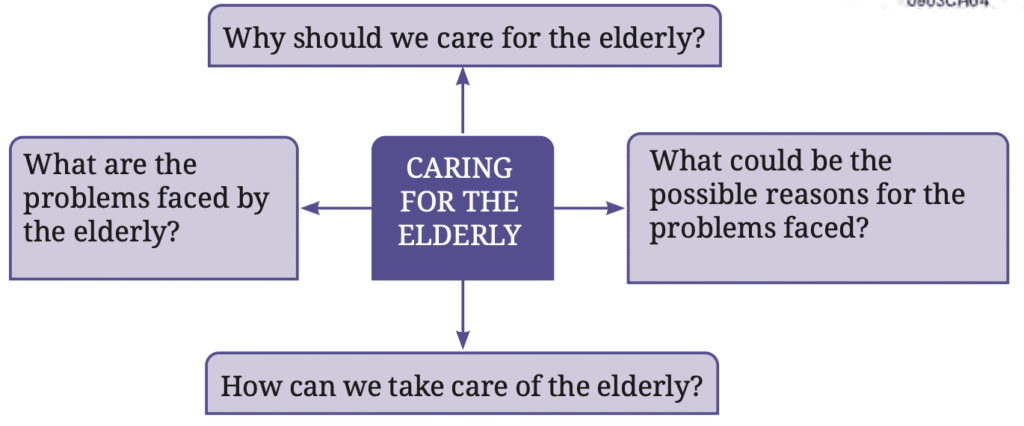
1. Why should we care for the elderly?
- They have cared for us.
- They have valuable knowledge and experience.
- They deserve love, respect and attention.
- They need our support and care.
2. What are the problems faced by the elderly?
- Poor health and physical weakness.
- Weak eyesight and hearing.
- Memory loss.
- Loneliness and neglect.
- Difficulty doing daily activities.
3. What could be the possible reasons for the problems faced?
- Ageing and health issues.
- Lack of proper medical care.
- Living alone or away from family.
- Lack of love and emotional support.
- Financial difficulties.
4. How can we take care of the elderly?
- Spend time with them.
- Listen to them patiently.
- Help them with daily activities.
- Take care of their health and medicines.
- Treat them with love and respect.
- Make them feel valued and included.
II. Fill in the table given below. You may check your answers with the help of a dictionary.
| Word | Not heard this word before | Heard but don't know meaning | I know this word. It has something to do with… | Meaning |
|---|---|---|---|---|
| 1. Frail | Old age, weakness and poor health | Physically weak or delicate | ||
| 2. Shuddered | Fear, cold or disgust | Trembled suddenly and involuntarily | ||
| 3. Poky | A small or cramped room or place | Uncomfortably small or cramped | ||
| 4. Forbid | Rules and restrictions | To order someone not to do something; to prohibit | ||
| 5. Pottering | Moving around and doing small tasks | Moving about slowly while doing small activities | ||
| 6. Winced | Pain or discomfort | Made a facial expression because of sudden pain or discomfort |
Check Your Understanding – Part I
I. Why did Grandpa dislike living in the city with his daughter?
Grandpa disliked the noise and busy life of the city. He missed his peaceful brick house, its garden and the big mango tree.
II. Why did Vidya not want her father to go out alone?
Ans. Vidya was worried about his safety because he had memory problems. Once, he had fallen in the garden and remained there all night without anyone to help him. In the city, he got lost and had accidentally taken a double dose of his medicines.
III. Was Ravi in favour of his mother treating Grandpa like a child? How can you say so?
Ans. No, Ravi was not in favour of it. He felt uncomfortable/embarrassed when his mother spoke to Grandpa as if he were a child.
IV. Would Ravi be able to keep up his promise to his mother?
Ans. No. Ravi secretly followed Grandpa when he went out because he wanted to make sure that Grandpa remained safe.
Check Your Understanding – Part II
I. Complete the flow chart by describing Grandpa’s day out.
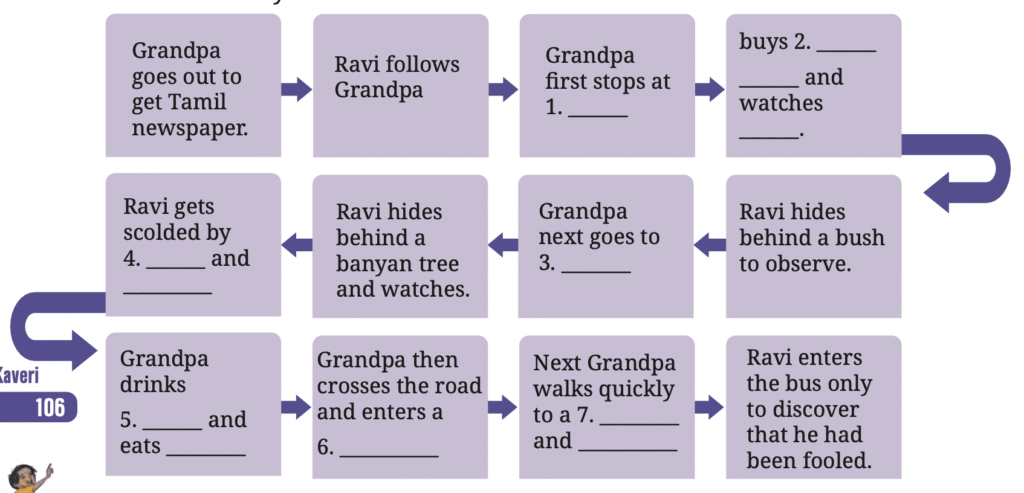
Ans.
- Children’s park
- Peanuts; children playing
- Tea stall
- The vendors; the lady selling plastic combs
- Sugary tea; bananas and ice cream
- Barber shop
- Bus stop; boards a bus
II. Was Grandpa lost as feared by Ravi’s mother?
Ans. No. Grandpa was not lost. He had safely returned home while Ravi was searching for him.
III. How would Ravi feel after seeing Grandpa?
Ans. Ravi would feel relieved and happy to see Grandpa safe. He would also feel affectionate towards him.
IV. Do you think Ravi’s mother will get to know about what had happened?
Ans. No, she would probably not know the whole incident because Grandpa did not tell her that Ravi had secretly followed him. Instead, Grandpa told her that Ravi had disappeared.
Check Your Understanding – Part III
I. Describe how Ravi’s emotional reaction upon finding Grandpa safe at home reveals his feelings towards his grandfather.
Ans. Ravi felt great relief and happiness on finding Grandpa safe. He was overcome with affection and gently hugged him. This shows his deep love, care and concern for his grandfather.
II. What might be the significance of Grandpa’s habit of giving gifts to everyone on his birthday rather than receiving them?
Ans. It shows that Grandpa was generous and loving. He found happiness in giving gifts to his family members rather than receiving them.
III. Why do you think Grandpa gave Ravi a detective story book as a gift? What might this suggest about Grandpa’s awareness of Ravi’s actions earlier in the day?
Ans. Grandpa gave Ravi a detective storybook because he knew Ravi was interested in detective work. It also suggests that Grandpa was aware that Ravi had secretly followed him throughout the day.
Critical Reflection
I. Read the extracts given below and answer the questions that follow.
1. Grandpa hated the noise and bustle of city life and when they were on their own, he often spoke longingly of his small brick house in town. “Such a wonderful place…! With that big mango tree in the garden! It is so quiet that at dusk you can even hear a leaf fall!” But then Grandpa had slipped and fallen in the garden late one evening while he was pottering around and lain outside all night because there was no one at home to help him up.
(i) Choose the emotion displayed by the Grandfather.
A. regretful
B. apologetic
C. nostalgic
D. wistful
Ans. Option (C)
(ii) Complete the following sentence with a reason.
Grandpa hated the busy and noisy city life because ___________.
Ans. he preferred the peaceful and quiet surroundings of his old house.
(iii) Why did Grandpa come to the city despite his dislike for city life?
Ans. Grandpa came to the city because he had fallen in the garden and remained there all night without anyone to help him. His daughter brought him to the city for his safety.
(iv) Choose an expression similar in meaning to, ‘you can even hear a leaf fall’.
A. end of one’s life
B. arrival of autumn
C. sign of good luck
D. pin drop silence
Ans. Option (D)
(v) State one advantage and one disadvantage of the Grandfather living in the house in town.
Ans.
- Advantage: He could enjoy peaceful surroundings and spend time in his garden.
- Disadvantage: He lived alone, so there was no one to help him in an emergency.
2. “I had a quiet morning, but I don’t know about Ravi. He just disappeared instead of staying at home to look after me like you told him to,” answered Grandpa coolly, while Ravi just looked confused and embarrassed.
Grandpa had another surprise for Ravi. A gift-wrapped parcel!
“But, Papa, Ravi’s birthday was three months ago. Have you forgotten?” exclaimed Ravi’s mother, impatiently.
(i) Choose the option that displays the tone of the Grandfather’s response.
A. apologetic
B. hurtful
C. calm
D. puzzled
Ans. Option (C)
(ii) Why was Ravi confused and embarrassed?
Ans. Ravi was confused because Grandpa said he had a quiet morning, although Ravi had secretly followed him throughout the day. He was embarrassed because Grandpa indirectly revealed that he had disappeared.
(iii) Complete the sentence with a suitable reason. Ravi’s mother was impatient because _________________.
Ans. Ravi’s mother was impatient because she thought Grandpa had forgotten Ravi’s birthday, which had taken place three months earlier.
(iv) State whether the following sentence is true or false.
Grandfather forgot that Ravi’s birthday was three months ago.
Ans. False.
(v) Why did Grandpa say he didn’t know what kind of morning Ravi might have had?
Ans. Grandpa said this because Ravi had disappeared instead of staying at home to look after him. He was indirectly teasing Ravi for secretly following him.
II. Answer the following questions.
1. Grandpa is portrayed as a person with failing memory in the beginning of the story. Give two evidences to disprove the statement.
Ans.
- He remembered thousands of chess games and gave Ravi useful tips while playing chess.
- He remembered his birthday and gave gifts to all his family members.
2. Give two characteristic traits of each of the following characters.
(i) Grandfather
(ii) Ravi
(iii) Ravi’s mother
Ans.
(i) Grandfather
- Generous and loving.
- Intelligent and clever.
(ii) Ravi
- Caring and affectionate.
- Curious and adventurous.
(iii) Ravi’s mother
- Caring and protective.
- Concerned and responsible.
3. Why was Ravi worried about what Grandfather had at the tea stall?
Ans. Ravi was worried because Grandpa drank sugary tea, ate bananas and had ice cream, although his mother had forbidden him from having these things.
4. Do you think it was easy for Ravi to follow his Grandfather? If yes, why? If no, why not?
Ans. No, it was not easy for Ravi to follow his grandfather. He had to follow him secretly without being noticed. At the children's park, he had to hide behind a bush and even crawl out to avoid being caught. At the tea stall, the vendors questioned him and forced him to change his hiding place. He also had to hide behind a car and carefully watch Grandpa. Therefore, following his grandfather was quite difficult, tiring and embarrassing for Ravi.
5. ‘Ravi is a good detective’. Give one argument in favour of and against the given statement.
Ans.
- In favour: Ravi cleverly followed Grandpa secretly and kept track of his movements.
- Against: He was fooled when a stranger wearing Grandpa’s yellow cap boarded the bus.
6. Was Grandfather aware that Ravi was following him? How do you know?
Ans. Yes, Grandpa was probably aware that Ravi was following him. He indirectly teased Ravi about disappearing and later gifted him a detective storybook, suggesting that he knew about Ravi’s actions.
7. In your opinion, who needs Vitamin-M? And why?
Ans. Ravi’s mother, Vidya, needs Vitamin-M because she forgot her father's birthday, even though she had marked it on the calendar. Grandpa remembered it and surprised everyone with gifts.
8. Some people believe society shows bias based on age (being young or old). Give an example where you might have experienced or observed such discrimination, when opinions were disregarded because of age.
Ans. Sometimes, elderly people are not allowed to make their own decisions because younger family members think they are too old to understand things. Similarly, children’s opinions are sometimes ignored because adults think they are too young. Everyone should be treated with respect, regardless of age.
Vocabulary and Structures in Context
I. Classify the words given in the box on the next page into movement words in Column 1 and sound words in Column 2. One example has been done for you.
| pottering boomed twirling crouch bustle crawl creeping thudded ducked shrieks zigzagging whirr evicted briskly sprinting grunted jumping darted trailing snoring |
| Column 1 – Movement words | Column 2 – Sound words |
|---|---|
| Pottering | Bustle |
| Twirling | Boomed |
| Crouch | Shrieks |
| Crawl | Thudded |
| Creeping | Whirr |
| Ducked | Grunted |
| Zigzagging | Snoring |
| Evicted | |
| Briskly | |
| Sprinting | |
| Jumping | |
| Darted | |
| Trailing |
Now, fill in the blanks with appropriate words from Column 1 or Column 2.
Detective Shankar, 1. _____________ the mysterious suspect through the dimly lit side lanes, away from the 2. _____________ of the city, quickened his pace 3. _____________. The suspect’s heavy footsteps 4. _______________ across the street, unaware of the pursuit. Shankar 5. _____________ his magnifying glass had to 6. ______________ behind the market stalls, 7. ______________ through the lanes to avoid being seen. Shankar 8. ______________ when he hit himself against a pole. This alarmed the suspect and he 9. ______________ into the night leaving only the distant 10. ______________ of the sleeping city behind.
Ans. Detective Shankar, trailing the mysterious suspect through the dimly lit side lanes, away from the bustle of the city, quickened his pace briskly. The suspect’s heavy footsteps thudded across the street, unaware of the pursuit. Shankar, twirling his magnifying glass, had to crouch behind the market stalls, creeping through the lanes to avoid being seen. Shankar grunted when he hit himself against a pole. This alarmed the suspect and he darted into the night leaving only the distant snoring of the sleeping city behind.
II. Study the highlighted word in the given sentence from the text and fill in the boxes with synonymous words. You may refer to a dictionary.
Off he went, twirling his walking stick jauntily, leaving Ravi in a dilemma.

Ans. QUANDARY, PREDICAMENT.
III. Fill in the table given below. Check your answers with the help of a dictionary.
| Word | Meaning | Part of Speech | Synonym | Antonym |
|---|---|---|---|---|
| 1. Craftily | ||||
| 2. Dilemma | ||||
| 3. Furious | ||||
| 4. Boomed | ||||
| 5. Humiliation | ||||
| 6. Attire |
Ans.
| Word | Meaning | Part of Speech | Synonym | Antonym |
|---|---|---|---|---|
| 1. Craftily | In a clever and secretive way | Adverb | Slyly | Honestly |
| 2. Dilemma | A difficult situation requiring a choice | Noun | Predicament | Solution |
| 3. Furious | Extremely angry | Adjective | Enraged | Calm |
| 4. Boomed | Made a loud, deep sound | Verb | Thundered | Whispered |
| 5. Humiliation | A feeling of shame or embarrassment | Noun | Embarrassment | Pride |
| 6. Attire | Clothes or garments | Noun | Outfit | Undress |
IV Match the emotions/expressions in Column 1 with their meanings in Column 2. One meaning is extra.
| Column 1 | Correct match |
|---|---|
| 1. Embarrassed | (i) Affected severely by an unpleasant feeling |
| 2. Countered | (ii) To be confused |
| 3. Flushed | (iii) Expression of emotion |
| 4. Stricken | (iv) Reply to an argument |
| 5. Gleam | (v) Felt uncomfortable |
| (vi) Became red in the face |
Ans.
| Column 1 | Correct match |
|---|---|
| 1. Embarrassed | (v) Felt uncomfortable |
| 2. Countered | (iv) Reply to an argument |
| 3. Flushed | (vi) Became red in the face |
| 4. Stricken | (i) Affected severely by an unpleasant feeling |
| 5. Gleam | (iii) Expression of emotion |
V Read the highlighted words in the following phrases from the story. Now, revisit the story and underline the prepositions.
- I’ll just walk across to the corner shop…
- … he felt a shadow fall over him…
- …the vendors sitting under the tree…
- Ravi took position behind a big banyan…
| Prepositions are words used to show the relationship of a noun or pronoun to other words in a sentence, often indicating direction, location, time, or manner. |
Now, fill in the blanks with appropriate prepositions.
I walked (i) _____________ (through, between, against) the village, crossed a bridge (ii) _____________ (over , under, beside) a brook, and found a quiet garden (iii) _____________ (among, near, across) a cottage. Sitting on a bench (iv) _____________ (on, at, in) the garden, I enjoyed the peaceful surroundings. Later, I strolled (v) _____________ (beside, through, along) a riverbank, exploring the forest and heading (vi) _________________ (into, towards, beyond) the unknown.
Ans. I walked through the village, crossed a bridge over a brook, and found a quiet garden near a cottage. Sitting on a bench in the garden, I enjoyed the peaceful surroundings. Later, I strolled along a riverbank, exploring the forest and heading into the unknown.
VI. Read the following dialogues from the story.
- “Shall we play chess or watch the cricket match on TV, Grandpa?” asked Ravi.
- “Who are you?” said the little boy’s mother.
- “What did you both do today?” asked Ravi’s mother.
- “Have you forgotten?” countered Grandpa.
- A small child came up to him and asked, “Are you playing hide and seek?”
Now, choose the correct answer .
A. The words in the quotes are (i) _____________ (exclamatory/interrogative) sentences.
B. Sentences 1, 4, and 5 are (ii) _____________ (Wh-/Yes, No type) interrogative sentences.
C. Sentences 2 and 3 are (iii) ______________ (Wh-/Yes, No type) interrogative sentences.
So, there are (iv) _____________ (two/three) types of interrogative sentences.
| Blank | Answer |
|---|---|
| (i) | Interrogative |
| (ii) | Yes/No |
| (iii) | Wh- |
| (iv) | Two |
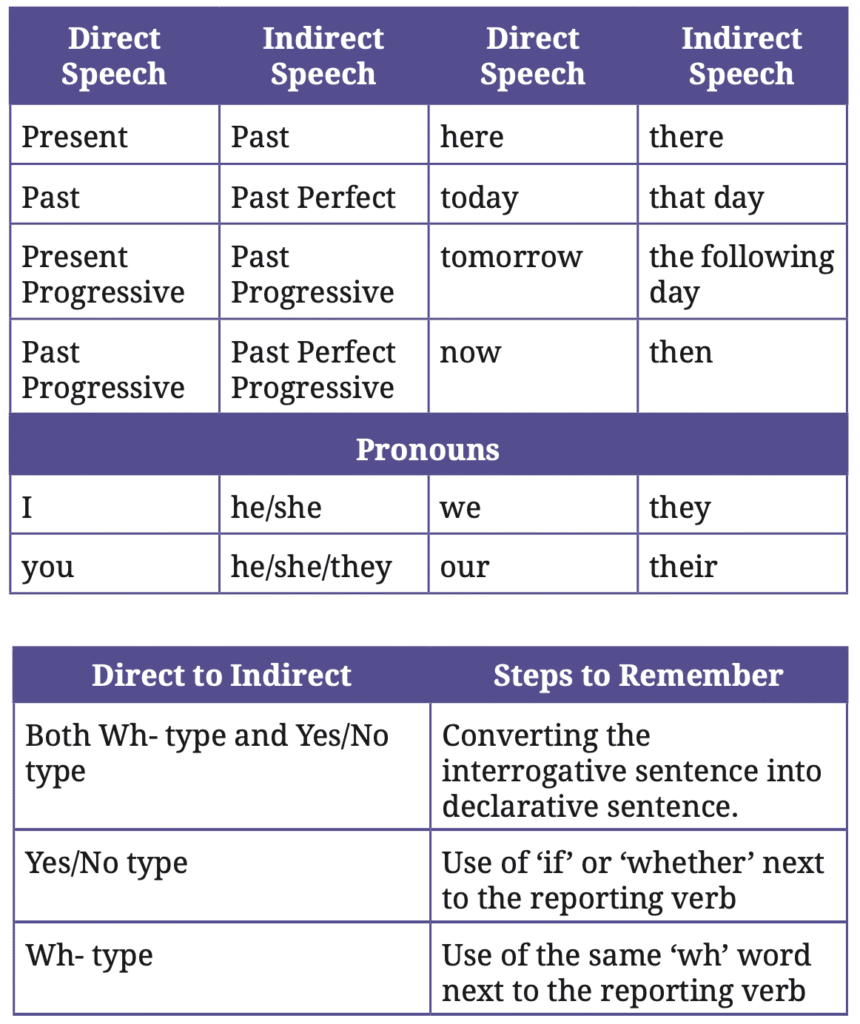
| The words in quotes are the exact words of the speaker, hence known as direct speech. In indirect speech or reported speech, somebody else reports these words at some other time and at some other place. |
D. Let us have a quick glance at a few guidelines to remind you of the changes while transforming from direct form of speech to indirect. You can ask your teacher for more inputs.
VII Read the following conversation.
Arvind Do you help in taking care of your grandparents at home?
Priya Yes, I do. We take turns making sure they're alright. Do you have grandparents living with you?
Arvind No. My parents and I visit my grandpa every weekend. How do you manage your grandparents’ medical needs?
Priya We have a schedule for giving medications and visits to the doctor.
Now, complete the following sentences in reported speech.
Arvind asked Priya if she 1. _______________ for which Priya replied in the affirmative and said that they 2. _____________.
Priya further asked Arvind 3. _____________. Arvind replied in the negative and said that 4. _____________ every weekend.
He further enquired 5. _____________. Priya responded by saying that they 6. __________.
Ans. Arvind asked Priya if she helped in taking care of her grandparents at home, for which Priya replied in the affirmative and said that they took turns making sure they were alright.
Priya further asked Arvind if he had grandparents living with him. Arvind replied in the negative and said that he and his parents visited his grandpa every weekend.
He further enquired how they managed their grandparents’ medical needs. Priya responded by saying that they had a schedule for giving medications and visits to the doctor.
Best Books for Class 9 English
Related posts:
 How I Taught My Grandmother to Read Class 9 Questions and Answers | NCERT Kaveri
 Bharat Our Land Question Answers Class 9 English | NCERT Solutions (Kaveri Book)
 The Pot Maker Class 9 Questions and Answers | NCERT Kaveri English Chapter 2
 Gifts of Grace Honouring Our Vocations Class 9 Question Answers | Kaveri
 Winds of Change Class 9 Questions and Answers | Kaveri English Chapter 3
 Canvas of Soil Class 9 English Questions and Answers (Kaveri)
 The Fundamental Unit of Life (Class 9) Important Questions
Force and Laws of Motion Class 9 Important Questions