Canvas of Soil Class 9 English Questions and Answers provides complete and easy-to-understand solutions to the poem “Canvas of Soil” by Maya Anthony, from the NCERT Class 9 English Kaveri textbook. In this poem, the poet beautifully compares a garden to a painting, with the earth as a palette, seeds as brushstrokes, and garden plots as canvases. This post covers the Reflect and Respond, Check Your Understanding, Critical Reflection, and Vocabulary in Context sections with clear explanations and exam-oriented answers. Students can use these Canvas of Soil Class 9 questions and answers to understand the poem, revise important concepts, and prepare effectively for their English examination.
Table of Contents
Reflect and Respond
I. Work in pairs. Discuss what all you see in a garden. Think of the colours you see and where you see them. Share your responses with your teacher.
Ans. A garden has many beautiful things such as flowers, trees, plants, grass, leaves, butterflies and birds. We can see different colours such as
- green in the leaves and grass,
- red and pink in flowers,
- yellow in flowers and sunlight,
- blue in the sky, and
- brown in the soil and tree trunks.
II. Look at the picture of a garden and a painting given below. Speak about any similarities between the garden and the painting.
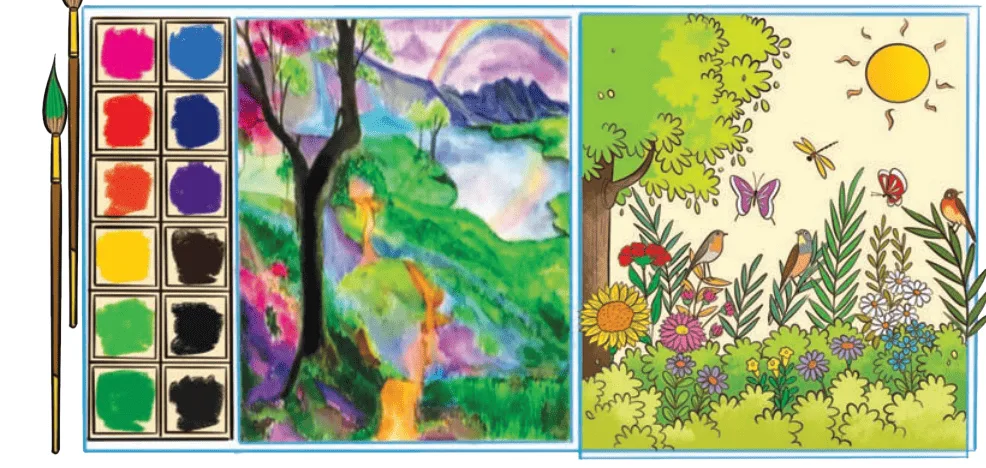
Speak using the following:
- Just as a garden ______________, similarly, a painting ______________.
- A garden and a painting, both ________.
- ______________ is common to both a garden and a painting.
- Like a garden, a painting too __________.
Ans.
- Just as a garden has many colours and beautiful patterns, similarly, a painting has many colours and beautiful patterns.
- A garden and a painting both are colourful and pleasing to the eyes.
- Colours and beauty are common to both a garden and a painting.
- Like a garden, a painting too creates a beautiful picture that can be enjoyed and appreciated.
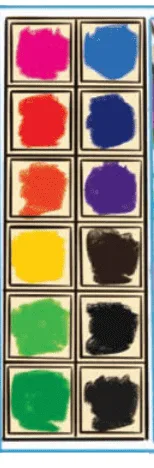
III. Let us acquaint ourselves with the meanings of palette, hue, and canvas.
- Palette: a thin oval or rectangular board or tablet that a painter holds and mixes colours on.
- Hue: shade of a colour
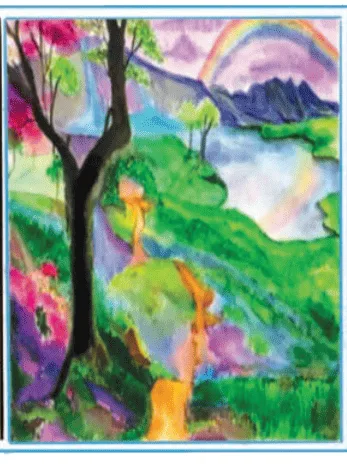
- Canvas: (here) painting
Now, look at the painting given above and identify palette, canvas, and select a hue.
Ans.

Check Your Understanding
I. Read the poem again and complete the summary of each stanza by filling in the blanks.
1. The ______________ is portrayed as a rich palette where gardeners’ __ __ __ a __ s flourish in the form of ______________ , awaiting spring.
2. The garden flowers ______________ into a beautiful display of different b __ __ __ __ __ m s, resembling a ______________ by Mother Nature, in the light of morning.
3. Each garden is likened to a wide __ __ n __ __ s, integrating art and __________. Through the efforts of gardeners, gardens transform into still-life ______________.
Ans. 1. The earth is portrayed as a rich palette where gardeners’ dreams flourish in the form of seeds, awaiting spring.
2. The garden flowers bloom into a beautiful display of different blossoms, resembling a painting by Mother Nature, in the light of morning.
3. Each garden is likened to a wide canvas, integrating art and life. Through the efforts of gardeners, gardens transform into still-life paintings.
II. Select the appropriate title for each stanza from those given below. There are two extra titles.
- Nature’s Work of Art
- Sweet-smelling Blossoms
- Gardens as Living Canvases
- Earth and Possibilities
- The Painter’s Canvas
Ans.
| Stanza | Appropriate Title |
|---|---|
| 1 | 4. Earth and Possibilities |
| 2 | 1. Nature’s Work of Art |
| 3 | 3. Gardens as Living Canvases |
III. Match the poetic devices in Column 1 to the examples in Column 2. Discuss your responses in pairs. Then share the responses with your classmates and teacher.
| Column 1 | Column 2 |
| 1. Imagery [mind pictures] | (i) appreciative |
| 2. Metaphor [comparison without use of ‘like’ or ‘as’] | (ii) AABB |
| 3. Rhyme Scheme | (iii) ‘Blossoms bloom’ |
| 4. Tone [what the poet feels] | (iv) colours, brushstrokes, blossoms, shades of green |
| 5. Mood [what the reader feels] | (v) a gardener |
| 6. Speaker | (vi) garden as a painting, plot as canvas, seeds as brushstrokes |
| 7. Alliteration [same consonant sound] | (vii) joyful |
Ans.
| Column 1 – Poetic Device | Column 2 – Example |
|---|---|
| 1. Imagery | (iv) colours, brushstrokes, blossoms, shades of green |
| 2. Metaphor | (vi) garden as a painting, plot as canvas, seeds as brushstrokes |
| 3. Rhyme Scheme | (ii) AABB |
| 4. Tone | (i) appreciative |
| 5. Mood | (vii) joyful |
| 6. Speaker | (v) a gardener |
| 7. Alliteration | (iii) “Blossoms bloom” |
What is an allegory?
An allegory is a literary device in which something described in a poem or story has two levels of meaning:
- Surface meaning – the direct or literal meaning.
- Deeper meaning – a larger idea or message represented by the same thing.
In Canvas of Soil, the surface meaning is about a garden, gardeners, seeds, flowers and colours. At a deeper level, the garden can represent important aspects of life and nature.
| Surface meaning | Deeper meaning |
|---|---|
| Seeds grow into plants | Life develops and grows |
| Flowers bloom and change with seasons | Life goes through different stages |
| Different colours exist together | Diversity can create beauty |
| Gardeners carefully nurture plants | Growth requires care and effort |
| Garden becomes beautiful | Life can become meaningful and beautiful |
Critical Reflection
I. Read the given extracts from the poem and answer the questions that follow.
1. Brushstrokes of seeds, planted true,
Awaiting spring’s vibrant hue.
i. The poet has used a metaphor in ‘Brushstrokes of seeds’. Which option from those given below uses a metaphor?
A. Her mother’s heart heard her heartfelt request with kindness.
B. She has a heart of gold.
C. Her heart did a dance of joy on seeing the new doll.
D. She has a very kind heart.
Ans. Option (B)
(ii) Complete the sentence appropriately.
The phrase ‘planted true’ is significant because it implies __________.
Ans. The phrase “planted true” implies that the seeds have been carefully and properly planted with the hope that they will grow successfully.
(iii) Why has the poet used the word ‘hue’ instead of ‘colours’ in the extract?
Ans. The poet uses “hue” because:
- it means a shade or particular colour and is closely associated with the language of painting.
- It strengthens the poem's central comparison between a garden and a painting.
- It also fits naturally with the poetic expression “vibrant hue.”
(iv) Complete the following analogy correctly with a word from the extract.
Summer: hot :: Spring : _________
Ans. Vibrant
(v) Read the Assertion (A) and the Reason (R) and select the option that is correctly suited.
- (A): Gardeners wait for Spring.
- (R): Gardens are worth painting in Spring.
A. Both (A) and (R) are true and (R) is the correct explanation of (A).
B. Both (A) and (R) are true but (R) is not the correct explanation of (A).
C. (A) is true but (R) is false.
D. (A) is false but (R) is true.
Ans. Option (B). [The gardener waits for spring because the seeds planted earlier are expected to grow and produce colourful flowers. Spring's beauty may make gardens look particularly attractive, but that is not the reason why gardeners have to wait for spring.]
2. Each plot, a canvas wide,
Where art and life coincide.
(i) What does ‘Each plot’ refer to in this extract?
Ans. “Each plot” refers to each individual piece or section of land in a garden where plants and flowers are grown.
(ii) Select which option imitates the rhyme scheme of the extract.
A. beautiful and clear
laughter and cheer
B. beautiful and clear
laughter and tears
Ans. Option (A)
(iii) Select the line from the extract that conveys that gardening blends aesthetic beauty with natural growth.
Ans. “Where art and life coincide.”
(iv) Complete the following sentence appropriately.
The plot is likened to a canvas suggesting that _____________.
Ans. The plot is likened to a canvas suggesting that a gardener uses the land creatively to create a beautiful living work of art.
(v) Why has the poet most likely used the word ‘wide’ instead of ‘long’ in ‘canvas wide’?
Ans. The word “wide” emphasises the broad, open space of a garden plot, making it resemble a painter's wide canvas. It also creates a more vivid picture of a garden spread out before the observer.
II. Give reasons for the comparisons made by the poet in the poem.
- A painter is compared to a gardener because ______________.
- A palette is like earth as __________________.
- The brushstrokes are like seeds because _________________.
- A canvas is similar to a garden plot as __________________.
Ans. 1. A painter and a gardener both create beauty through creativity and careful work. A painter uses colours and brushstrokes on a canvas, while a gardener uses seeds, plants and flowers to create a beautiful garden.
2. A palette is like earth because a painter uses a palette to mix colours, while a gardener uses the earth to plant and grow different plants and flowers that provide a variety of colours.
3. Brushstrokes are like seeds because both are used to create something beautiful. Brushstrokes help a painter create a painting, while seeds grow into plants and flowers that create a beautiful garden.
4. A canvas is similar to a garden plot because both provide a space on which an artist can create something beautiful. A painter creates a painting on a canvas, while a gardener creates a living work of art on a garden plot.
III. Answer the following questions.
1. How does the metaphor ‘Brushstrokes of seeds’, enhance the understanding of gardening as an art form?
Ans. The metaphor “Brushstrokes of seeds” presents the gardener as an artist. Just as a painter carefully places brushstrokes on a canvas to create a painting, a gardener carefully plants seeds in the soil to create a beautiful garden. The metaphor therefore helps us see gardening as a creative art form, where seeds are the gardener's artistic strokes.
2. What can you infer about the poet’s perspective on the relationship between nature and creativity
from the following lines?
‘Each plot, a canvas wide,
Where art and life coincide.’
Ans. The poet believes that nature and human creativity can work together to create beauty. A garden is naturally living, but the gardener's creativity and effort help shape it into an artistic arrangement. Thus, the poet sees gardening as a meeting point between nature, art and life.
3. Do you think the imagery in the poem successfully paints a vivid picture in the reader’s mind? If yes, why? If no, why not?
Ans. Yes, the imagery successfully creates a vivid picture in the reader's mind. The poet uses words such as “blossoms,” “morning light,” “shades of green, red, and blue,” “brushstrokes,” and “canvas” to help the reader visualise the colourful garden. These sensory and painting-related images make the garden appear like a beautiful work of art.
4. Support the view that the poet’s mention of the colour yellow, besides red, blue and green, would have lent effectively to the imagery.
Ans. The colour yellow would have added another bright and lively shade to the garden's imagery. Along with red, blue and green, yellow would create greater colour contrast and variety, making the imagined garden appear even more vibrant and visually appealing.
5. Considering the line ‘Gardens become paintings still’, what can you interpret about the poet’s view on the timelessness of nature’s beauty?
Ans. The line suggests that the poet sees nature's beauty as something worthy of being preserved and admired like a painting. Although a garden is living and constantly changing, its beauty can leave a lasting impression, much like a beautiful painting. The poet therefore presents nature as an enduring source of artistic beauty.
6. Justify the title of the poem, ‘Canvas of Soil’.
Ans. The title “Canvas of Soil” is appropriate because the poem compares a garden to a painting. The soil is like a canvas, seeds are like brushstrokes, and flowers and plants provide the colours that make the garden beautiful. The gardener acts like an artist who uses the soil as a space to create a living work of art. Therefore, “Canvas of Soil” perfectly captures the poem's central idea of gardening as an art form.
Vocabulary in Context
I. The poet refers to the shades of green, red, and blue in the poem. Let us read some of the names of different shades of these colours.
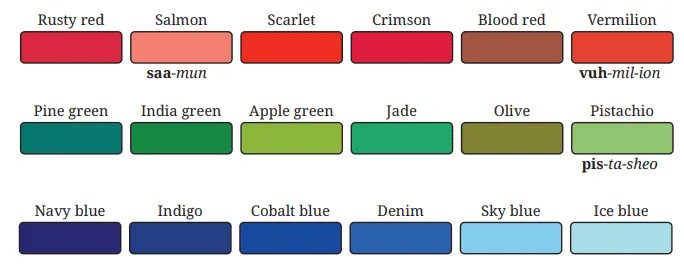
Now, Discuss in pairs, any two things that you can associate with these colours.
II. You have studied painting-related words like palette, brushstrokes, shades, hue, colours, and canvas.
Now, read the following paragraph and discuss in pairs what the underlined painting-related words might
mean. Discuss this way:
I think ____________ means ____________ because the passage talks about ____________.
Example: I think portrait means a picture of someone’s face because the passage talks about capturing a
friend’s features.
In the art studio, young painters eagerly approached their easels, each framing a canvas that they had to work on. The teacher encouraged them to experiment with a diverse tonal range, playing with shades and hues to bring their paintings to life. One student focused on a detailed portrait, capturing his friend’s features, first with careful underpainting and then filling the final colours. Another student worked on a mural, depicting a Spring Day on the right wall of the classroom. The room continued to buzz with artistic energy.
Ans.
| Word | Meaning in context | Why? |
|---|---|---|
| Easels | Stands used to hold a canvas while painting | The young painters approach them with their canvases. |
| Canvas | A surface on which a painting is made | Each student has a canvas to work on. |
| Tonal range | The range of light and dark shades in a painting | The students experiment with different shades and tones. |
| Shades | Different variations of a colour | The students use different shades to make their paintings lively. |
| Hues | Particular shades or colours | They use different hues to bring their paintings to life. |
| Portrait | A painting or picture representing a person | The student captures his friend's features. |
| Underpainting | An initial layer of colour or paint applied before the final colours | The student first works with underpainting and then adds the final colours. |
| Mural | A large painting made directly on a wall | The student paints a Spring Day on the classroom wall. |
Related posts:
 How I Taught My Grandmother to Read Class 9 Questions and Answers | NCERT Kaveri
 Bharat Our Land Question Answers Class 9 English | NCERT Solutions (Kaveri Book)
 The Pot Maker Class 9 Questions and Answers | NCERT Kaveri English Chapter 2
 Gifts of Grace Honouring Our Vocations Class 9 Question Answers | Kaveri
 Winds of Change Class 9 Questions and Answers | Kaveri English Chapter 3
 The Fundamental Unit of Life (Class 9) Important Questions
Force and Laws of Motion Class 9 Important Questions
The Fundamental Unit of Life (Class 9) Important Questions
Force and Laws of Motion Class 9 Important Questions
 Top 15 Major Changes in CBSE Class 9 Curriculum 2026-27