
Latest CBSE Class 9 English (Language & Literature) Syllabus 2026-27 – Get the official syllabus with a chapter-wise breakdown, marking scheme, and expert study tips. Download the official PDF at the end!
If you have tried reading through the official CBSE Class 9 English syllabus for the 2026-27 session, you might have felt a bit overwhelmed. The official document is packed with pedagogical guidelines that can take a lot of effort to decode.
To make things simple and save you time, we have broken down the entire syllabus into an easy-to-understand format perfectly optimized for your exam preparation. This year, CBSE has restructured English into two levels: Language R1 and Language R2.
In this post we will explain exactly what chapters you need to read, the grammar topics you must master, and provide a clear, side-by-side comparison of the R1 and R2 exam patterns. You will also find the official PDF download link at the end of the page.
| Particulars | Details |
|---|---|
| Class | Class 9 |
| Subject | English |
| Board | CBSE |
| Session | 2026–27 |
| Levels | R1 & R2 |
| Prescribed Book | Kaveri – Textbook of English for Grade 9 |
| Total Marks | 100 |
| Theory + Internal | 80 + 20 Marks |
The Prescribed Textbook & Chapters to Study
For the 2026-27 session, there is a single, common textbook prescribed for both Language R1 and R2.
- Textbook Name: Kaveri: Textbook of English for Grade 9.
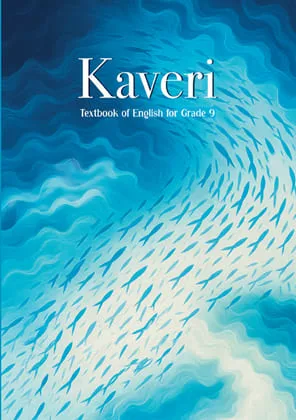
The book is structured into eight thematic units, each containing a prose piece and a corresponding poem. Here are the exact chapters you need to prepare:
- Unit 1: Prose: How I Taught My Grandmother to Read
- Poem: Bharat Our Land
- Unit 2: Prose: The Pot Maker
- Poem: Gifts of Grace: Honouring Our Vocations
- Unit 3: Prose: Winds of Change
- Poem: Canvas of Soil
- Unit 4: Prose: Vitamin-M
- Poem: I Cannot Remember My Mother
- Unit 5: Prose: The World of Limitless Possibilities
- Poem: Nine Gold Medals
- Unit 6: Play: Twin Melodies
- Poem: A Friend Found in Music
- Unit 7: Prose: Carrier of Words
- Poem: Words
- Unit 8: Prose: Follow That Dream
Common Grammar Syllabus (R1 & R2)
Whether you opt for Language R1 or R2, the core grammar concepts you need to study remain exactly the same. Grammar and vocabulary learning will be reinforced through editing tasks, sentence transformation, and contextual exercises. Here are the topics you must master:
- Sequence of Tenses in different contexts of communication.
- Modal Auxiliaries (expressing ability, obligation, permission, possibility, and advice).
- Reported Speech (including statements, questions, commands, and requests).
- Conditional Clauses (Type 1).
- Subject–Verb Concord.
- Determiners.
- Clauses (Noun Clauses and Relative Clauses).
R1 vs. R2: The Exam Pattern Comparison
While the total marks remain the same (80 Marks Theory + 20 Marks Internal), the way you are tested changes depending on whether you choose Language R1 or R2.
Here is the overall section weightage for both levels:
| Section | Marks |
|---|---|
| A – Reading Skills | 20 |
| B – Writing + Grammar | 30 |
| C – Literature | 30 |
| D – Internal Assessment | 20 |
| Total | 100 Marks |
Here is a side-by-side comparison to help you understand the specific differences in the question paper design:
| Exam Section | Language R1 | Language R2 |
| Reading Skills (Section A) | Passage 1: Descriptive/Discursive (10 Marks) Passage 2: Case-Based (10 Marks) | Passage 1: Factual/Literary (12 Marks) Passage 2: Case-Based (8 Marks) |
| Grammar Testing (Section B) | 10 Marks Total: • Editing/Omitting (4 Marks) • Sentence Rearrangement (3 Marks) • Sentence Transformation (3 Marks) | 10 Marks Total: • Paragraph Completion (4 Marks) • Sentence Rearrangement (3 Marks) • Sentence Transformation (3 Marks) |
| Writing Task 1 (Short) | Notice / Informal Invitation 3 Marks (Up to 50 words) | Notice / Poster 4 Marks (Up to 50 words) |
| Writing Task 2 (Formal) | Letter to Editor / Formal E-mail 5 Marks (120-150 words) | Letter to Editor / Formal E-mail 5 Marks (120-150 words) |
| Writing Task 3 (Article) | Factual Description / Magazine Article 5 Marks (120-150 words) | Speech / Magazine Article 5 Marks (120-150 words) |
| Writing Task 4 (Essay) | Descriptive / Narrative Essay 7 Marks (200-250 words) | Narrative Essay 6 Marks (150-180 words) |
| Literature Extracts (Section C) | 10 Marks Total: • 1 Extract from Drama/Prose (5 Marks) • 1 Extract from Poetry (5 Marks) | 15 Marks Total: • 1 Extract from Prose (5 Marks) • 1 Extract from Drama (5 Marks) • 1 Extract from Poetry (5 Marks) |
| Literature Q&A (Section C) | 20 Marks Total: • 5 Short Answers (10 Marks) • 1 Long Answer: Extrapolation (5 Marks) • 1 Long Answer: Theme/Plot/Character (5 Marks) | 15 Marks Total: • 5 Short Answers (10 Marks) • 1 Long Answer: Extrapolation / Theme / Character (5 Marks) |
| Internal Assessment (Section D) | 20 Marks Total: Periodic Tests (5), Multiple Assessment (5), Portfolio (5), Subject Enrichment (5) | 20 Marks Total: Periodic Tests (5), Multiple Assessment (5), Portfolio (5), Subject Enrichment (5) |
Best Study Tips for CBSE Class 9 English
- Divide Your Time: Focus on Literature (40 marks) first, then split time between Reading (20 marks) and Writing & Grammar (20 marks).
- Daily Practice: Spend 1-1.5 hours daily—30 minutes on reading, 30 minutes on writing/grammar, and 30 minutes on literature.
- Stick to NCERT: Use NCERT book 'Kaveri' as your core texts—they’re all you need for Section C.
- Time Management: Allocate 45 minutes for Reading, 45 minutes for Writing & Grammar, and 1 hour for Literature in practice papers.
- Sample Papers: Solve CBSE sample papers to master question types (MCQs, short/long answers).
- Internal Marks: Participate in speaking activities (e.g., debates) and submit neat project work (e.g., skit) for 20 marks.
- Quick Revision: Use a notebook for grammar rules, new words, and literature summaries.
Download CBSE Class 9 English Syllabus 2026-27 PDF
Click the button below to download the official CBSE syllabus PDF for 2026-27.
📂 Download CBSE Class 9 English Syllabus PDF
🔍 Related Guides
CBSE Class 9 SST Syllabus 2026-27
CBSE Class 9 Maths Syllabus 2026-27
CBSE Class 9 Computer Applications Syllabus 2026-27
CBSE Class 9 Science Syllabus 2026-27
CBSE Class 9 Hindi R1 Syllabus 2026-27
CBSE Class 9 Hindi R2 Syllabus 2026-27
Stay Updated!
Join our Telegram/WhatsApp group for CBSE updates, free notes, and exam tips!
Bookmark this page & keep revising smartly!
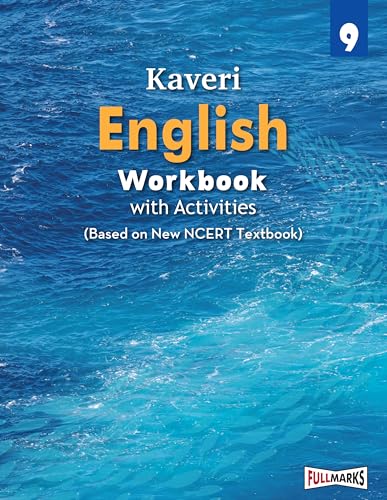
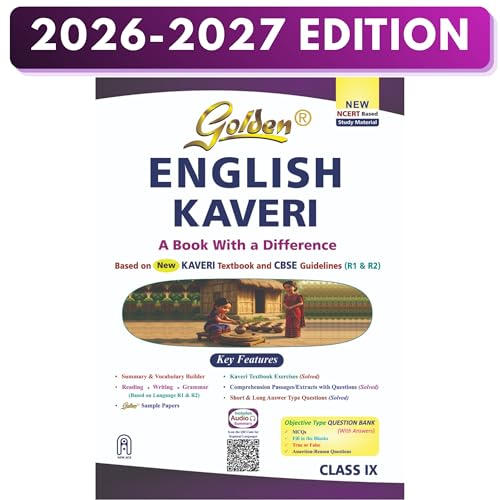
Best Books for CBSE Class 9 English 2026-27
Frequently Asked Questions
How are the 80 theory marks distributed?
Section A: Reading Skills – 20 marks
Section B: Writing Skills and Grammar – 30 marks
Section C: Language through Literature – 30 marks
What writing tasks are included?
1. Notice / Informal Invitation 3 Marks (Up to 50 words)
2. Letter to Editor / Formal E-mail 5 Marks (120-150 words)
3. Factual Description / Magazine Article 5 Marks (120-150 words)
4. Descriptive / Narrative Essay 7 Marks (200-250 words)
Are all chapters from Kaveri book tested?
Yes, check the chapter list given above for specifics.
How much time should I spend daily on English?
Spend 1-1.5 hours—split evenly between reading, writing/grammar, and literature.
Is handwriting important in the exam?
Yes, neat handwriting boosts readability and can improve scores, especially in writing and long-answer sections.
Related posts:
 CBSE Class 9 Maths Syllabus 2026-27: Download PDF & Full Exam Pattern
 CBSE Class 9 Science Syllabus 2026-27: Download PDF & Full Exam Pattern
 CBSE Class 9 SST Syllabus 2026-27: Download PDF & Full Exam Pattern
 CBSE Class 9 Hindi Course A (R-1) Syllabus 2026-27: Download PDF & Full Exam Pattern
 CBSE Class 9 Hindi Course B (R-2) Syllabus 2026-27: Download PDF & Full Exam Pattern
 CBSE Class 9 Computer Applications Syllabus 2026-27: Download PDF & Full Exam Pattern
 Top 15 Major Changes in CBSE Class 9 Curriculum 2026-27
 CBSE 3 Language Formula Explained (R1, R2, R3) – New Rules 2026-27