
Are you looking for Class 9 English Kaveri Chapter 4 – I Cannot Remember My Mother Question Answers? You are in the right place! In this post, we have provided complete and easy-to-understand solutions to all the NCERT textbook exercises of Rabindranath Tagore's beautiful poem I Cannot Remember My Mother. The solutions cover all sections, including Reflect and Respond, Check Your Understanding, Critical Reflection, Vocabulary in Context, and other textbook activities. Each answer is written in simple language, keeping students' learning and exam preparation in mind. Rather than simply memorising answers, students can understand the central ideas, literary devices, imagery, symbolism and emotions expressed in the poem. These concept-based answers will also help you tackle similar and competency-based questions confidently in your examinations.
Table of Contents
Reflect and Respond
I. Work in pairs. Discuss the memories from your childhood that you remember . List them and share with your classmates and teacher.
Ans. Some of my fondest childhood memories are:
- Playing outdoor games like cricket and hide-and-seek with my friends.
- Listening to bedtime stories told by my grandparents.
- Spending holidays with my family.
- Enjoying my mother's lullabies before going to sleep.
- Celebrating festivals with my family and friends.
- Going to school and enjoying activities with my classmates.
These memories bring happiness and remind me of the love, care and affection I received during my childhood.
II. Discuss how children’s relationship with their mother can influence their emotions and memories.
Ans. A mother's love, care and support play an important role in shaping a child's emotions and memories. Happy moments spent with her, such as listening to lullabies and bedtime stories, create lasting memories. Her affection helps children develop love, trust, confidence and a sense of security. Even in her absence, familiar sounds, smells and sights can remind them of her.
III. Match the words given in Column 1 with their meanings in Column 2.
| Column 1 | Column 2 |
|---|---|
| 1. Hover | (i) Sing a tune with your lips closed |
| 2. Hum | (ii) A type of flower (coral jasmine) |
| 3. Cradle | (iii) Look steadily for a long time |
| 4. Shiuli | (iv) Rituals conducted in a temple |
| 5. Morning service | (v) linger or remain near a place |
| 6. Gaze | (vi) a small bed for a baby |
Ans.
- 1 – (v)
- 2 – (i)
- 3 – (vi)
- 4 – (ii)
- 5 – (iv)
- 6 – (iii)
Check Your Understanding
I. Fill in the blanks with appropriate words.
Stanza 1
1. The poet remembers his mother while he ____________.
Ans. The poet remembers his mother while he plays with his toys.
2. The poet remembers the ____________ but not the ____________.
Ans. The poet remembers the tune but not the mother.
Setting: Indoor.
Stanza 2
1. The poet remembers his mother in the ____________ season.
Ans. The poet remembers his mother in the early autumn season.
2. The poet remembers his mother by the smell of ____________.
Answer: The poet remembers his mother by the smell of shiuli flowers and the morning temple rituals.
Setting: Outdoor.
Stanza 3
1. The poet feels that his mother ____________ at him from the ____________.
Answer: The poet feels that his mother gazes at him from the sky.
Setting: Indoor (the poet is looking at the sky through his bedroom window).
II. The senses of olfactory (smell), auditory (hearing), and visual (sight), are three of the five basic senses in humans. Give examples of references to senses from the poem. Complete the table given below.
| Stanza | Lines from the Poem | Senses |
| 3. | ||
| 1. | ...the tune of some song that she used to hum while rocking my cradle | |
| 2. | olfactory |
Ans.
| Stanza | Lines from the Poem | Senses |
| 3. | "my eyes into the blue of the distant sky, I feel that the stillness of my mother's gaze on my face has spread all over the sky." | Visual (sight) |
| 1. | ...the tune of some song that she used to hum while rocking my cradle | Auditory (hearing) |
| 2. | "the smell of the shiuli flowers floats in the air" and "the scent of the morning service in the temple" | olfactory (smell) |
III. Read the poem silently once again and complete the following.
1. Two examples of alliteration from the poem are (i) __________ and (ii) ___________.
Ans. (i) "smell of the shiuli"
(ii) "scent of the morning service"
Explanation: Alliteration is the repetition of the same initial consonant sound in nearby words.
2. An example of onomatopoeia is ________________.
Ans. Hum.
Explanation: Onomatopoeia is a literary device in which a word imitates or suggests a sound. The word 'hum' suggests the soft sound of singing with closed lips.
3. The poem uses imagery extensively. Explain.
Ans. The poet uses imagery to appeal to three senses. The humming tune creates auditory imagery, the fragrance of shiuli flowers creates olfactory imagery, and the blue sky and mother's gaze create visual imagery. These descriptions help readers experience the poet's emotions and memories.
4. Although the poem does not have a rhyme scheme, it is enjoyable because ____________.
Ans. It is enjoyable because of its beautiful imagery, musical quality, emotional expression and repetition of the refrain.
5. What is the tone of the poet? Why do you say so?
Ans. The tone of the poet is nostalgic and emotional because he recalls his mother's love and affection through familiar sounds, smells and sights, even though he cannot clearly remember her.
6. What impact does the title of the poem have on the overall mood of the poem?
Ans. The title creates a feeling of sadness and longing. It highlights the poet's inability to remember his mother clearly, while the poem shows how her memories remain alive through familiar experiences.
7. The poet uses 'I cannot remember my mother' as a refrain because ____________.
Ans. The poet uses this line repeatedly to emphasise his inability to remember his mother clearly and to highlight how different sensory experiences bring back her memories.
8. The poet uses symbolism to indicate the memory of his mother's presence. Identify the symbols used in the poem.
Ans. The poet uses the following symbols:
- Humming tune: Symbolises his mother's loving voice and affection.
- Shiuli flowers and temple fragrance: Symbolise his mother's familiar presence and memories.
- Blue sky: Symbolises his mother's endless presence and love.
- Mother's gaze: Symbolises her care, affection and protection.
Critical Reflection
I. Read the extracts given below and answer the questions that follow.
1. I cannot remember my mother
only sometimes in the midst of my play
a tune seems to hover over my playthings,
(i) Complete the following sentence appropriately.
The poet is reminded of his mother during his ________________.
Ans. playtime.
(ii) What is the primary emotion conveyed by the line ‘a tune seems to hover over my playthings’?
- A. It enhances the joy of play.
- B. It disrupts the playtime atmosphere.
- C. It activates memories of the mother.
- D. It symbolises the carefree nature of childhood.
Ans. Option (C)
(iii) In the context of the poem, what role does the hovering tune play during the speaker's playtime?
Ans. The hovering tune acts as a reminder of the poet's mother. It brings back memories of her gentle voice and loving care, making him feel her presence even though he cannot clearly remember her.
(iv) State whether the following sentence is true or false.
The poet experiences the tune lingering over playthings only occasionally during playtime.
Ans. True. The poet uses the word 'sometimes', which indicates that he experiences this memory occasionally while playing.
(v) How could the poet feel his mother's presence, even though she isn't there?
Ans. The poet feels his mother's presence through the familiar tune that she used to hum while rocking his cradle. This sound brings back memories of her love and affection.
2. I feel that the stillness of
my mother’s gaze on my face
has spread all over the sky.
(i) What does the poet suggest about the stillness of his mother's gaze spreading over the sky?
A. The mother’s gaze is physically present in the sky.
B. The sky is a symbolic extension of the mother’s presence.
C. The sky mirrors the mother’s emotions.
D. The stillness is fleeting and unrelated to the mother.
Ans. Option (B)
(ii) What emotion does the poet associate with the ‘stillness’ of his mother’s gaze?
A. a sense of grief
B. a sense of anticipation
C. a sense of nostalgia
D. a sense of serenity
Ans. Option (D)
(iii) State whether the following sentence is true or false.
The poet suggests that the mother's gaze has a tangible and visual effect on the sky.
Ans. False. The mother's gaze does not physically change the sky. The poet uses a symbolic and imaginative expression to show that he feels his mother's loving presence everywhere.
(iv) What is the purpose of likening the mother's gaze to the sky?
Ans. The poet compares his mother's gaze to the vast sky to express her endless love, care and protection. It suggests that her presence surrounds him everywhere, just like the sky.
(v) Complete the sentence appropriately.
The tone of the poet in the given extract is _____________ because _____________.
Ans. The tone of the poet in the given extract is nostalgic and peaceful because the blue sky reminds him of his mother's gentle and loving gaze.
II. Answer the following questions.
1. What is the emotional impact of the refrain, ‘I cannot remember my mother’?
Ans. The refrain creates a feeling of sadness and longing. It highlights the poet's inability to remember his mother clearly, while emphasising how familiar sounds, smells and sights bring back her memories.
2. Interpret the connection between the poet’s mother and the following:
(i) shiuli flowers
(ii) humming tune
Ans. (i) Shiuli flowers The fragrance of shiuli flowers during early autumn mornings reminds the poet of his mother. Their sweet scent makes him feel her loving presence.
(ii) Humming tune The humming tune reminds the poet of the song his mother used to hum while rocking his cradle. It symbolises her love, care and affection.
3. What role does nature play in the poet’s description of the memory of his mother?
Ans. Nature acts as a medium through which the poet remembers his mother. The fragrance of shiuli flowers and the vast blue sky remind him of her presence. These natural elements symbolise her love and affection.
4. What can be inferred about the poet’s perception of the mother–child relationship?
Ans. The poet believes that the bond between a mother and her child is deep and everlasting. Even when a child cannot clearly remember the mother, her love and affection remain alive through familiar memories and experiences.
Vocabulary in Context
I. Work in pairs to classify the sensory words given in the box below. One example has been done for you.
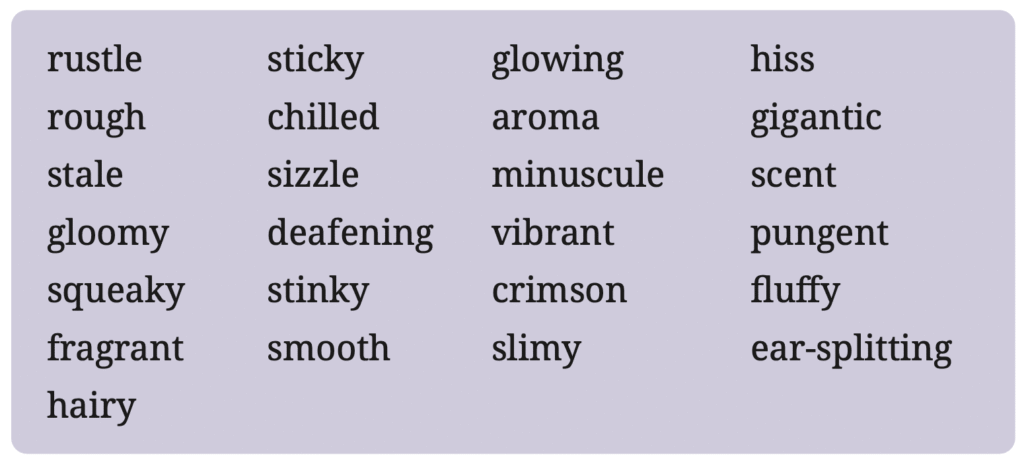
| Visual | Auditory | Olfactory | Tactile |
|---|---|---|---|
| Glowing | hiss | Aroma | Sticky |
Ans.
| Visual (Sight) | Auditory (Hearing) | Olfactory (Smell) | Tactile (Touch) |
|---|---|---|---|
| Glowing | Rustle | Aroma | Sticky |
| Gigantic | Hiss | Stale | Rough |
| Minuscule | Sizzle | Scent | Chilled |
| Gloomy | Deafening | Pungent | Fluffy |
| Vibrant | Squeaky | Stinky | Smooth |
| Crimson | Ear-splitting | Fragrant | Slimy |
| Hairy |
II. Fill in the blanks with sensory words in the box for the following passage written by Sarojini Naidu. There are two extra words.
| scarlet shrill sizzle perfumes flaming scents sweetness essence smooth |
Come and share my exquisite March morning with me: this sumptuous blaze of gold and sapphire sky; these 1. _____________ lilies that adorn the sunshine; the voluptuous 2. _____________ of neem and champak and serisha that beat upon the languid air with their implacable 3. _____________; the thousand little gold and blue and silver breasted birds bursting with the 4. _____________ ecstasy of life in nesting time. And, do you know that the scarlet lilies are woven petal by petal from my heart’s blood, these little quivering birds are my soul made incarnate music, these heavy 5. _____________ are my emotions dissolved into aerial 6. _____________, this 7. _____________ blue and gold sky is the ‘very me’…
Ans.
| Blank | Answer |
|---|---|
| 1 | Scarlet |
| 2 | Scents |
| 3 | Sweetness |
| 4 | Shrill |
| 5 | Perfumes |
| 6 | Essence |
| 7 | Flaming |
III. Write numbers against each picture with the phrases that describe them with their sensorial associations. One example has been done for you.
- beats of music echo in air
- melody of soothing scent, dancing in the air
- fragrant breeze of blooming buds
- gentle lullaby, a soft melody
- colourful sky, painting a lively sight
- attractive canvas painting the horizon

Ans.
| Picture | Correct number | Descriptive phrase |
|---|---|---|
| Flowers being collected | 3 | Fragrant breeze of blooming buds |
| Mother rocking a baby in a cradle | 4 | Gentle lullaby, a soft melody |
| Colourful kites in the sky | 5 | Colourful sky, painting a lively sight |
| Beautiful sunset and horizon | 6 | Attractive canvas painting the horizon |
| Tabla (already solved) | 1 | Beats of music echo in air |
| Burning incense sticks | 2 | Melody of soothing scent, dancing in the air |
Related Posts:
- I Cannot Remember My Mother Class 9 English Question Answers Kaveri Chapter 4
- Vitamin-M Question and Answers for Class 9 English (Kaveri Book)
- Canvas of Soil Class 9 English Questions and Answers (Kaveri)
- Winds of Change Class 9 Questions and Answers | Kaveri English Chapter 3
- Cell The Building Block of Life Class 9 Notes | CBSE Science Chapter 2
Related posts:
 How I Taught My Grandmother to Read Class 9 Questions and Answers | NCERT Kaveri
 Bharat Our Land Question Answers Class 9 English | NCERT Solutions (Kaveri Book)
 The Pot Maker Class 9 Questions and Answers | NCERT Kaveri English Chapter 2
 Gifts of Grace Honouring Our Vocations Class 9 Question Answers | Kaveri
 Winds of Change Class 9 Questions and Answers | Kaveri English Chapter 3
 Canvas of Soil Class 9 English Questions and Answers (Kaveri)
 Vitamin-M Question and Answers for Class 9 English (Kaveri Book)
 The Fundamental Unit of Life (Class 9) Important Questions