Key Takeaways
1. Low Input, High Output: You don't need 100% syllabus coverage. Mastering just 7-8 specific chapters can guarantee you 40+ Marks (10-12 Questions).
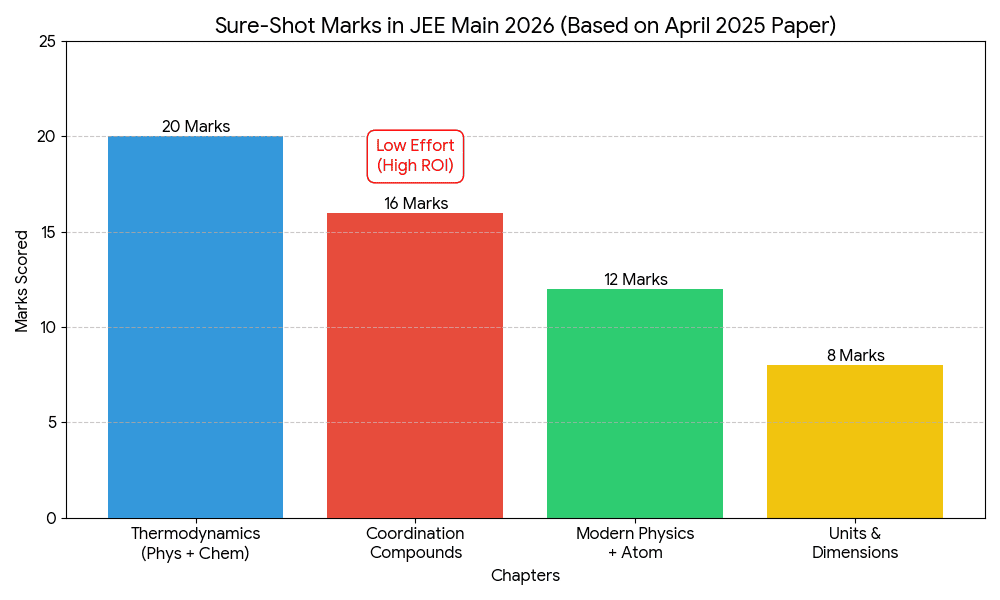
2. Proven by 2025 Data: Analysis of the April 3, 2025 (Shift 1) paper reveals that just 4 units (Thermodynamics, Coordination Compounds, Modern Physics, Units & Dimensions) accounted for 56 Marks.
3. The "Overlap Hack": Chapters like Structure of Atom and Thermodynamics appear in both Physics and Chemistry. Study them once to score in two sections.
4. Zero Calculus Needed: These "Sure-Shot" chapters are ideal for students weak in Math. They rely on basic algebra, logic, and standard formulas—no complex integration required.
5. NCERT is Enough: For chapters like Biomolecules and Coordination Compounds, questions are directly lifted from NCERT diagrams and text.
6. 7-Day Roadmap: Includes a step-by-step plan to master these topics and lock in your safety score within one week.
Are you feeling overwhelmed by the vast ocean of the JEE Main 2026 syllabus? You are not alone. Most students think they need to finish 100% of the syllabus to score well.
Here is the truth: You don’t.
What if I told you that you could secure 40+ Marks (10-12 questions) by mastering just 7-8 specific chapters? These are the "Gold Mine" chapters—topics that are short, easy to understand, and widely known for having a "Low Input, High Output" ratio.
In this guide, I will share the ultimate "Smart Strategy" list for Physics and Chemistry. I have backed this up with real proof from the JEE Main April 2025 paper, showing you exactly why these chapters are your ticket to a better rank.
The "Proof": Analysis of JEE Main April 2025 Paper
I analyzed the JEE Main April 3, 2025 (Shift 1) question paper to see if this strategy actually works. The results were shocking.
If you had studied just 4 Units (Thermodynamics, Coordination Compounds, Modern Physics, and Units & Dimensions), you would have secured 56 Marks in this single shift!
Here is the breakdown from the 2025 paper:
- Thermodynamics (Phys + Chem): 5 Questions (20 Marks).
- Coordination Compounds: 4 Questions (16 Marks).
- Units & Dimensions: 2 Questions (8 Marks).
- Modern Physics/Atom: 3 Questions (12 Marks).
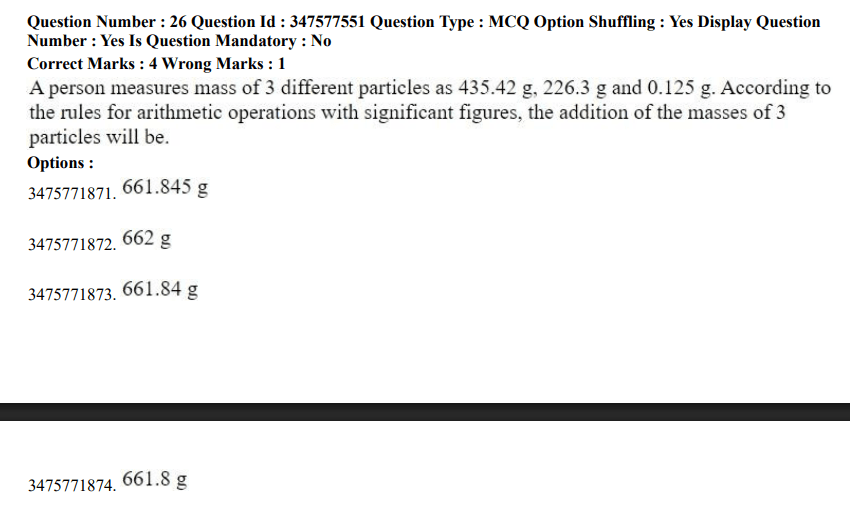
Real Example: Question 26 in the Physics section simply asked students to add three masses (435.42 g, 226.3 g, and 0.125 g) using significant figures. That is 4 marks for basic addition!
The Double-Benefit Chapters
Before you start random chapters, prioritize the "Double-Benefit" topics. These are chapters that appear in both Physics and Chemistry.
- Structure of Atom (Chem) & Modern Physics (Phys):
- The Hack: The concepts of Bohr’s Model, Transitions, and Photoelectric effect are identical.
- Proof: In the 2025 paper, Question 52 in Chemistry asked about Bohr's model postulates. If you had studied Modern Physics, you could have answered this Chemistry question easily.
- Thermodynamics:
- The Hack: The laws and processes (Isothermal, Adiabatic) are the same.
- Proof: The 2025 paper had questions on adiabatic compression in Physics (Q34) and Enthalpy changes in Chemistry (Q71).
Physics: The "Sure-Shot" List (Target: 20-24 Marks)
Physics is often feared, but these chapters are formula-based and require very little visualization.
| Chapter Name | Difficulty | Weightage | Why it's a "Sure Shot" |
| Units & Dimensions | ⭐ (Easiest) | 4-8 Marks | In 2025, Q27 was a simple "Match the Column" for dimensions. It takes 4 hours to master. |
| Semiconductors | ⭐⭐ (Easy) | 4 Marks | Focus on Logic Gates. Q45 in the 2025 paper was a standard Truth Table question. It's a guaranteed question. |
| Modern Physics | ⭐⭐ (Easy) | 8-12 Marks | Direct formula questions. Q43 asked for the color of light based on Work Function. |
| Current Electricity | ⭐⭐ (Medium) | 8 Marks | High weightage. Focus on Instruments (Meter Bridge/Potentiometer) and Shunt resistance (Q49). |
Must-Do Topics in Physics:
- Significant Figures & Error Analysis.
- Logic Gates (AND, OR, NAND, NOR).
- Bohr’s Model & Photoelectric Equation.
- Variation of 'g' (Gravitation).
Chemistry: The "High Scoring" List (Target: 20-24 Marks)
In JEE Main 2025, Chemistry was the scoring subject. Inorganic and Physical chemistry offered easy calculations.
| Chapter Name | Difficulty | Weightage | Why it's a "Sure Shot" |
| Coordination Compounds | ⭐⭐ (Easy) | 8-12 Marks | High ROI. Q63 asked to compare wavelengths absorbed by complexes. No complex math, just logic. |
| Biomolecules | ⭐ (Memo) | 4 Marks | Pure memorization. Q70 asked to identify the structure of L-Fructose. NCERT is enough. |
| Structure of Atom | ⭐ (Easy) | 4 Marks | Overlaps with Physics. Focus on Quantum Numbers and Electronic Config. |
| Solutions | ⭐⭐ (Medium) | 4-8 Marks | Formula-based (Colligative Properties). Q54 was a direct calculation on Boiling Point Elevation. |
Is it really safe to rely on just 7-8 chapters? What if NTA changes the pattern in 2026?
This is a valid fear, but here is the logic: These chapters are "Fundamental Units." NTA cannot set a paper without Thermodynamics, Atomic Structure, or Current Electricity because they form the basis of Engineering. Even in the toughest shifts of 2024 and 2025, the weightage of Modern Physics and Coordination Compounds remained consistent (10-15%). These are not "gambles"; they are "constants.
I am weak in Calculus and Math. Will I struggle with the Physics chapters mentioned here?
Not at all. That is exactly why these chapters were chosen!
Modern Physics requires simple multiplication/division (Formula based).
Logic Gates requires zero math (just binary logic 0/1).
Units & Dimensions is basic algebra. None of the chapters in this "Easy List" require Integration or complex Calculus. They are perfect for students who struggle with the mathematical side of Physics.
Do I need high-level books like H.C. Verma or J.D. Lee for these chapters?
NO. Do not overcomplicate "Easy" chapters.
For Chemistry: NCERT is your Bible. In the April 2025 paper, the question on L-Fructose was a direct image from the NCERT textbook.
For Physics: Stick to your coaching modules or Eduniti revision videos + Previous Year Questions (PYQs). Solving the last 5 years of PYQs (2021-2025) is more valuable than reading a thick theory book for these topics.
Must-Do Topics in Chemistry:
- Coordination Compounds: Hybridization (VBT), Magnetic Moment (Q62), Isomerism.
- Chemical Bonding: MOT and Hybridization of molecules like SF6 (Q59).
- Biomolecules: Structures of Glucose/Fructose and Vitamins.
Will 40 Marks be enough to get into an NIT?
40 Marks is your Safety Net, not your final destination. Scoring 40 marks in Physics/Chem ensures you clear the cutoff easily. To get a top NIT, you need to build on top of this foundation. However, you cannot build a building without a foundation—secure these sure-shot marks first, then move to the harder topics like Rotational Motion or Electrochemistry.
How many days does it really take to master this list?
If you study 6-7 hours a day:
Physics (4 Chapters): 3 Days max.
Chemistry (4 Chapters): 3-4 Days. In just one week, you can realistically move your score from a "danger zone" to a "confident zone."
Your 7-Day Action Plan
Don't just read this list—act on it. Here is how to secure these 40 marks in the next week:
- Days 1-2: Complete Units & Dimensions and Structure of Atom. (4 + 4 Marks)
- Days 3-4: Master Modern Physics and Biomolecules. (8 + 4 Marks)
- Days 5-6: Focus entirely on Coordination Compounds. (8-12 Marks)
- Day 7: Revise formulas and solve 2024-2025 PYQs.
Pro Tip: For these specific chapters, strictly stick to the NCERT textbooks. As seen in the 2025 paper, questions like "L-Fructose Structure" are lifted directly from NCERT diagrams.
Conclusion
JEE Main is not just about how much you know; it's about how smart your strategy is. By targeting these specific chapters, you ensure a safety net of 40-50 marks irrespective of how tough the rest of the paper is.
Start today with Logic Gates or Coordination Compounds, and lock in your first 8 marks!
Related posts:
 JEE Main 2026: Why It’s Conducted Twice & Which Session You Should Choose
 Is It Possible to Crack JEE Main Without Coaching in 2026?
 JEE Main 2026 Notification Out – Download PDF, Registration Dates, Eligibility & Exam Schedule
 The JEE Main 2026 Exam Pattern Might Surprise You — Here’s Why
 JEE Main 2026 Countdown: What You Should Do 100 Days Before the Exam
 JEE Main 2026 Chapterwise Weightage: High-Scoring Topics You Can’t Miss!
 JEE Main PYQs (2020–2025): Download Chapter-wise & Year-wise PDF
 JEE Main 2026 Application Form Rejected? Here’s What NTA’s Bulletin Really Says About Corrections